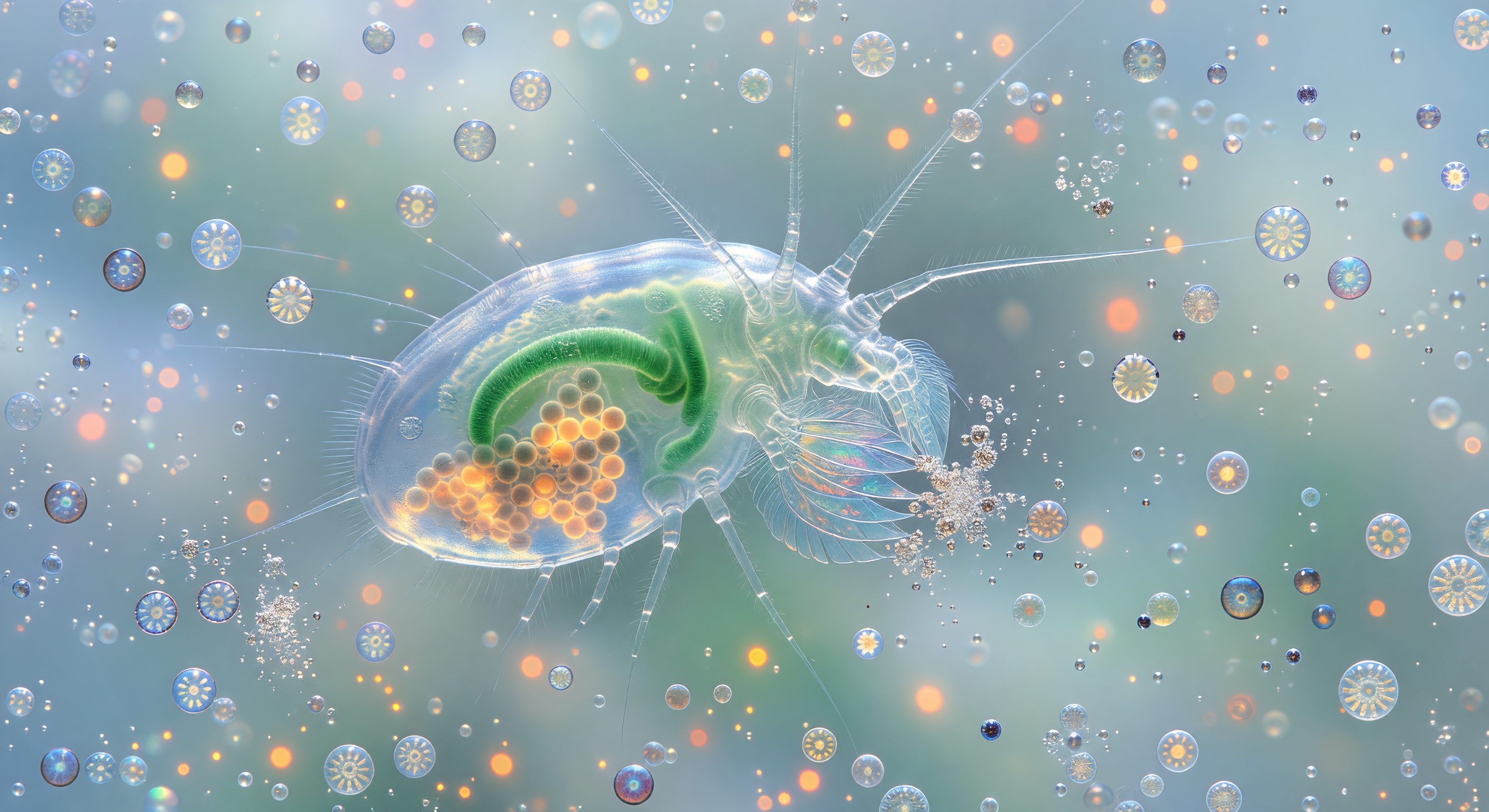
You hover two millimeters from a creature the size of a rice grain that is nonetheless an architectural presence, its chitinous carapace so transparent that jade-green gut contents and dense amber egg clusters burn through three layers of cuticle like lantern glass held to sunlight, every internal organ backlit by the diffuse blue-green luminance filtering down from the ocean surface above. The animal is a *Calanus* copepod, one of the ocean's dominant grazers, and its feathery maxillipeds — appendages arrayed like overlapping fans of blown glass, each seta hair-thin and refractive — tremble at the edge of vision as they intercept individual *Emiliania huxleyi* cells drifting inward along an invisible feeding vortex, the current legible only in the slow orbital rotation of whole coccospheres as they spiral toward the mouth, their interlocked calcite wheel-plates flashing from silver to pale gold depending on the angle of encounter. Where the maxilliped tips make contact, coccoliths detonate into white glitter bursts — each crushed two-to-four-micron calcite disc tumbling and strobing before the current sweeps it aside, releasing dissolved organic carbon that the surrounding bloom water will redistribute through chemical gradients no eye can follow. The water itself is not empty but a luminous turquoise suspension, tens of millions of detached coccoliths per milliliter scattering the available light into a soft glowing fog in every direction, so that distance collapses entirely — three body-lengths back the world dissolves into blue-white haze, intact coccospheres drifting through it like tiny armored planets trailing faint red autofluorescence from their chloroplasts, the whole living medium pressing inward from all sides as the copepod's feeding geometry organizes everything around it into vectors of approach, capture, and glittering calcite destruction.
Phytoplankton & coccolithophores