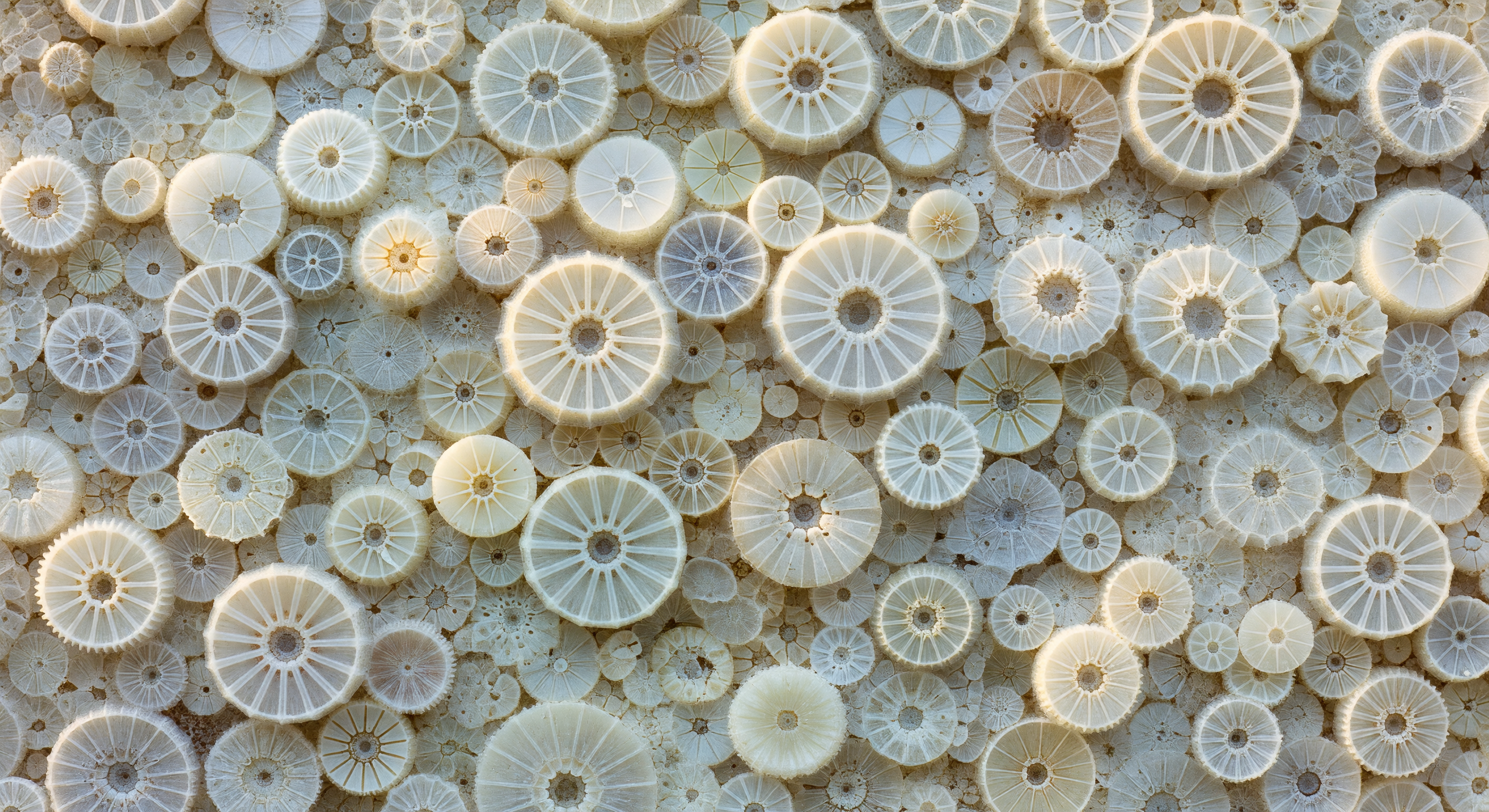
You are suspended within a compressed continent of the dead, surrounded in every direction by interlocking calcite wheels — the skeletal remains of coccolithophores that once photosynthesized in sunlit surface waters tens of millions of years above you in time. Each disc measures just a few microns across, yet its geometry is obsessively precise: radial crystal spokes fused into a raised rim, the trigonal calcite units still interlocked with structural integrity despite the crushing weight of millennia of overburden, their surfaces catching a raking amber sidelight that throws micro-shadows across every raised edge and transforms the dense matrix into a landscape of miniature craters and pale archways. This is coccolith ooze — the foundational material of chalk — where species of *Emiliania*, *Gephyrocapsa*, and *Calcidiscus* are identifiable by their spoke count and rim architecture alone, their biological identity reduced entirely to crystal symmetry. Looking along the laminar horizon, alternating bands of tightly-packed assemblages and clay-intruded glacial intervals curve across the field of view like compressed geological strata, each lamina only tens of microns thick yet representing centuries of slow carbonate rain from the photic zone above, the biological pump made lithological. There is no motion here, no chemical gradient, no Brownian jostling — only the afterlife of an ancient bloom, its geometry persisting long after every lipid, chloroplast, and membrane has dissolved into pore fluid, held in sharp relief by a sidelight that refuses to soften.
Phytoplankton & coccolithophores