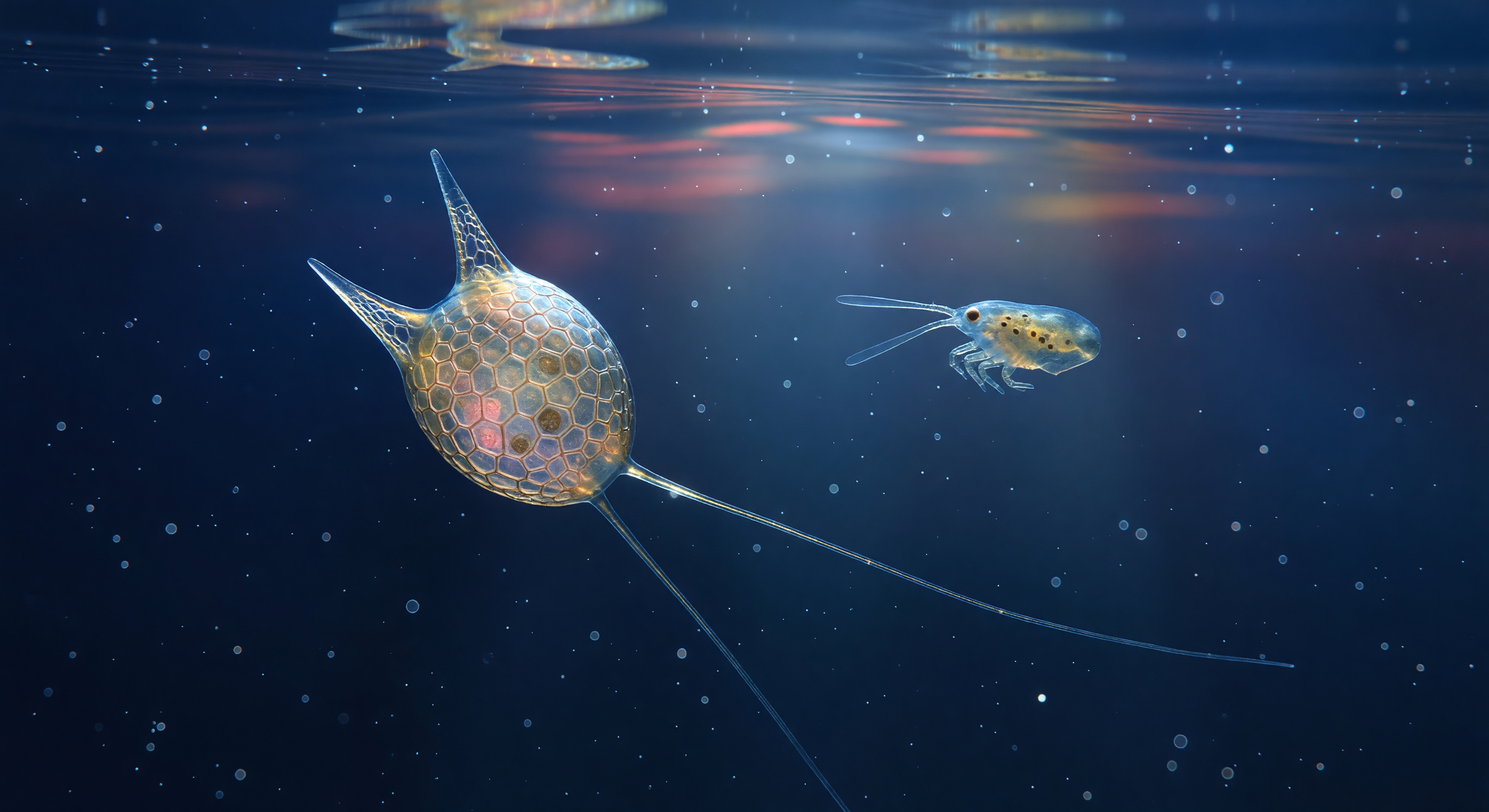
You are suspended in the uppermost millimeter of the open ocean in the last minutes before sunrise, floating beside a structure that dwarfs you the way a city bus dwarfs a pedestrian: a single *Ceratium tripos* dinoflagellate, its amber-gold body enclosed in tessellating amphiesma plates whose seams catch the first photons filtering down through the air-water interface above as hairlines of cold blue fire. The cell's three hollow horns — one apical, two antapical — are not solid spears but transparent calcite lances braced internally by trabecular lacework, thin enough that the deepening predawn light passes through them and illuminates the brownish-gold chloroplast clusters packed within the main cell body, strobing them rose and amber as micro-capillary ripples skate the surface and bend the incoming light into slow prismatic sweeps. At the equator of the cell, seated in the cingulum groove like a thread running through a carved canyon, the transverse flagellum beats in continuous helical strokes that blur into a silver shimmer — the primary engine of this organism's diel vertical migration, which carries it toward the surface each dawn to harvest photons before descending again at dusk, a daily commute of meters that, at this scale, feels like the movement of weather systems. Beyond the Ceratium, three to four centimeters away in real space but perceived here as the distance to a glass office tower, a copepod hangs motionless in the water column, its paired antennae spread like enormous translucent oars, its segmented legs individually larger than the entire dinoflagellate before you — a reminder that this luminous microscopic cathedral exists inside a food web whose predators are, by the logic of scale, geological in their mass.
Phytoplankton & coccolithophores