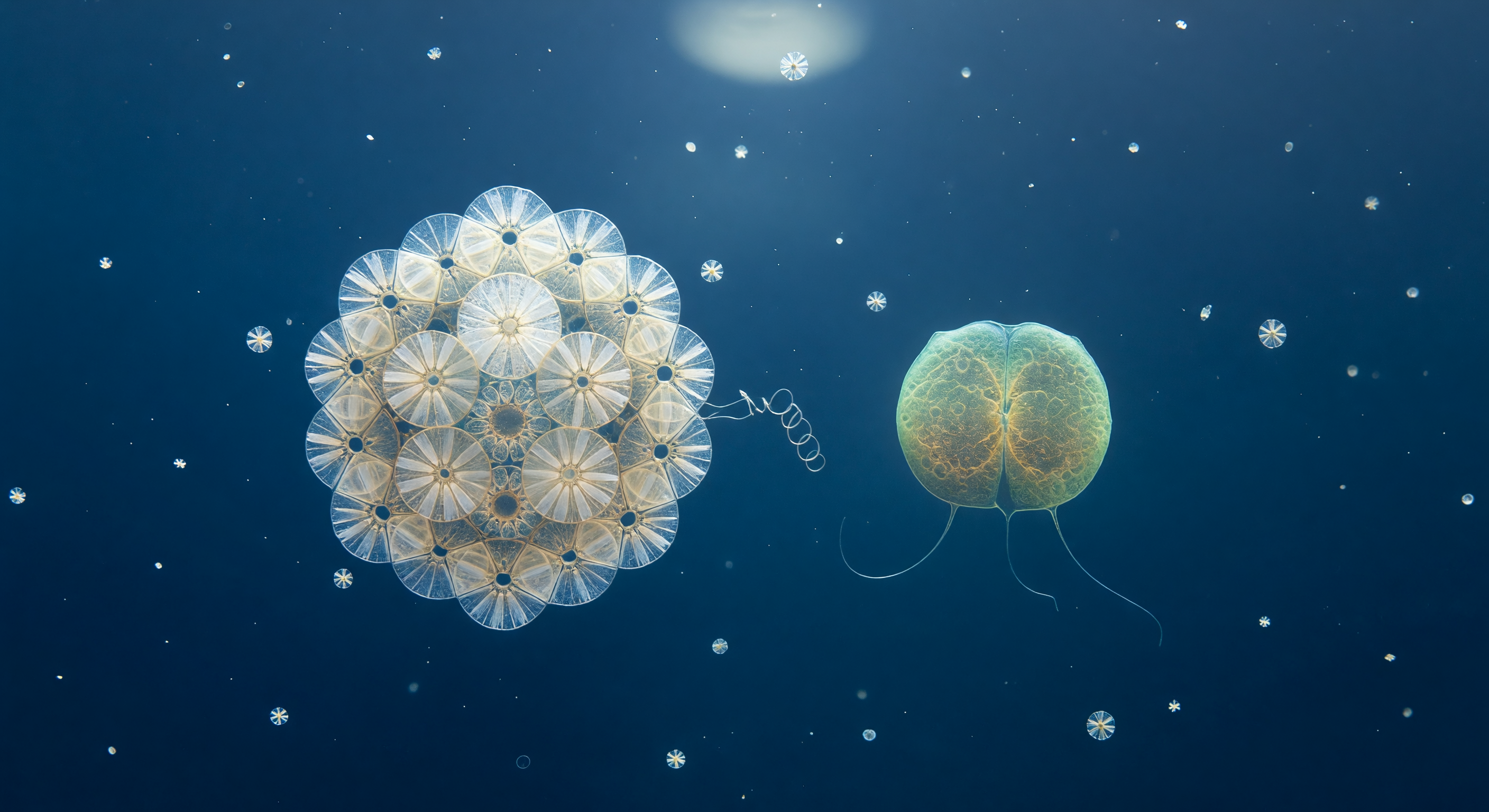
You are suspended in a column of deep oceanic blue where the sun exists only as a trembling silver smear above, its light stripped to cool blue-green wavelengths by fifty meters of water column, and every surface you see is lit not from any direction but from the water itself. To your left, the diploid C-phase cell fills your field of vision like a baroque chandelier carved from mineral precision: a coccosphere of overlapping cream-white calcite plates, each coccolith a wheel of interlocking crystal blades whose trigonal geometry throws back the ambient light as cold prismatic glints of white and pale gold, the entire armored surface so architecturally dense — radial spokes, interlocking shields, tiny central fenestrae — that the cell appears almost self-luminous against the surrounding ultramarine. To your right, separated by a gulf of open column that your Brownian drift makes feel vast, the haploid N-phase twin offers a startling contrast in every material register: entirely unarmored, its soft translucent membrane of greenish cream reveals the amber-jade warmth of chloroplasts beneath converting even this dim filtered light, and its two flagella — biological cables a fraction of a micron across — are frozen at maximum arc, each one a graceful sinusoid catching ambient glow like wet glass filaments, while the delicate haptonema coils between them in a loose spring, betrayed only by its faint refractive edge. These two cells represent the same species caught at opposite poles of its life cycle, the calcified diploid phase building the mineral armor that will eventually sink as geological sediment and the naked flagellated haploid phase trading structural protection for motility, both strategies written in the same deep water column where Brownian jostling and viscous drift govern all motion and detached free coccoliths drift at varying distances behind them, some close enough to resolve their full geometry, others reduced to white sparks of scattered light that give this infinite blue world its only sense of depth.
Other languages
- Français: Jumeaux C-Phase et N-Phase
- Español: Gemelas Fase C y Fase N
- Português: Gêmeas Fase C e Fase N
- Deutsch: C-Phase und N-Phase Zwillinge
- العربية: توأما الطور C والطور N
- हिन्दी: C-फेज़ और N-फेज़ जुड़वाँ
- 日本語: C相とN相の双子細胞
- 한국어: C상과 N상 쌍둥이
- Italiano: Gemelle Fase C e Fase N
- Nederlands: C-Fase en N-Fase Tweelingen