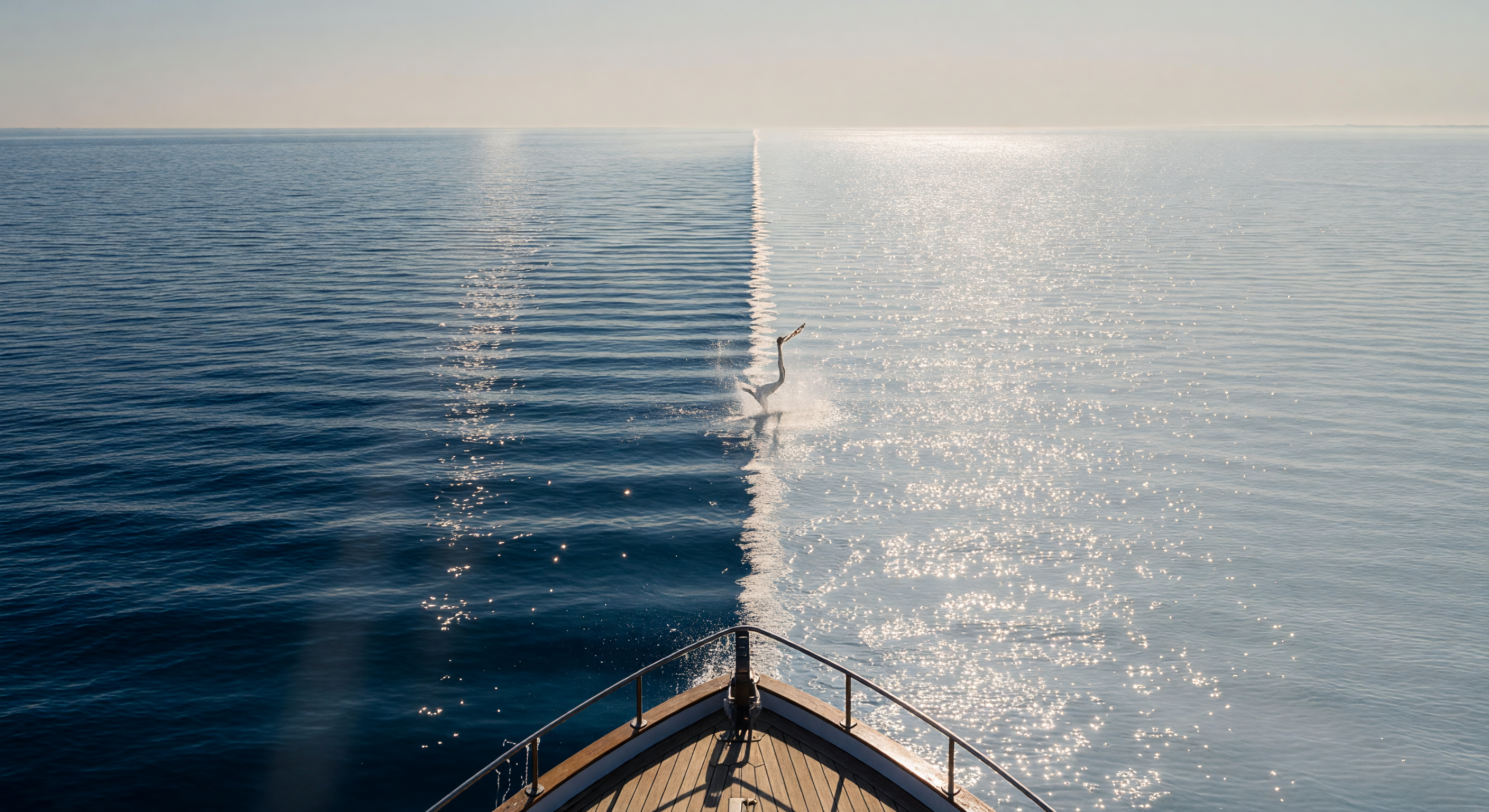
Standing at the bow rail, you look almost straight down at one of the sharpest natural boundaries visible anywhere on Earth's surface: to port, an abyss of indigo-cobalt water so transparent that afternoon light plunges meters into it and returns nothing but depth; to starboard, a body of water that reads as something between liquid and mineral — chalky, opaque, turquoise-white, emanating a diffuse pearl-bright luminescence that seems to originate from within the water column rather than from its surface. That glow comes from tens of billions of individual *Emiliania huxleyi* cells, each no larger than a human red blood cell, armored in interlocking calcite plates just two to four microns across that tumble freely and scatter incoming photons in every direction simultaneously, turning the upper water column into a living diffusion lens. The boundary between the two water masses — one ancient and empty of this white alchemy, one dense with microscopic geometric armor — is almost surgical, perhaps two meters wide, organized along its length by Langmuir circulation into parallel foam windrows that mark where the two regimes shear against each other in slow surface eddies; a gannet punches through exactly at that line and erupts a geyser of milk-white water that catches the low-angled sun before the surface closes and the bird vanishes into the bloom. The air carries the faint sulfurous sweetness of dimethylsulfide off-gassing from stressed cells, a scent that connects what the eye sees — a pastel planetary bruise stretching to the horizon — to chemistry happening inside organisms invisible to the naked eye and to the cloud-seeding, climate-altering consequences that follow from their collective death.
Other languages
- Français: Vue du Bord de Floraison
- Español: Vista de la Frontera Florida
- Português: Vista da Borda do Bloom
- Deutsch: Blütengrenze vom Deck
- العربية: منظر حدود الازدهار
- हिन्दी: पुष्पन सीमा डेक दृश्य
- 日本語: ブルーム境界甲板の眺め
- 한국어: 블룸 경계 갑판 전망
- Italiano: Vista dal Ponte del Bloom
- Nederlands: Bloei Grens Dek Uitzicht