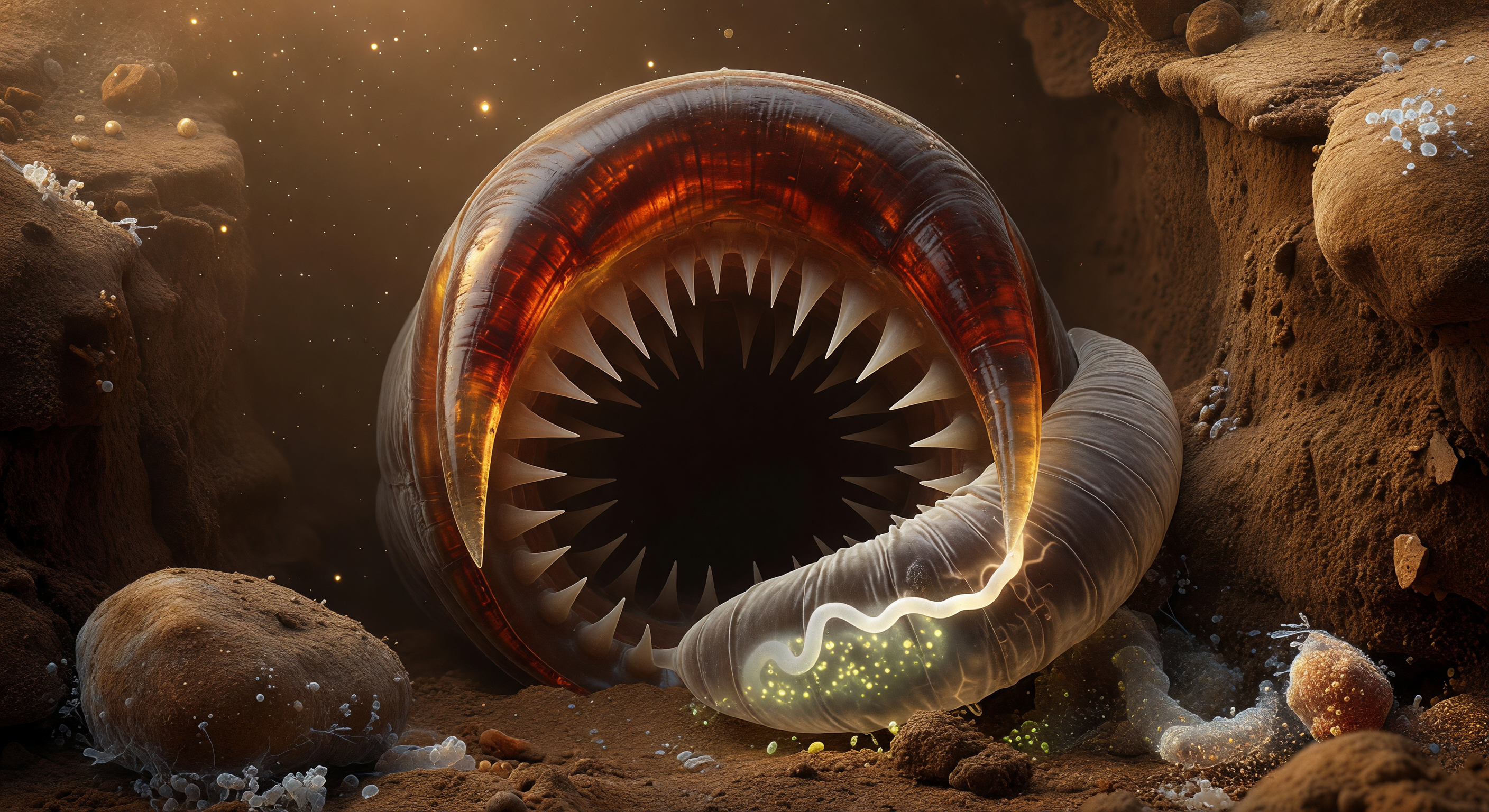
You stand at the mouth of what reads, at this scale, as a vast cathedral hewn from living amber — the buccal cavity of a *Mononchus* predatory nematode, perhaps 1.5 mm in total body length, whose gaping oral aperture at close range dwarfs your entire field of vision. The dominant structure is the dorsal tooth: a single massive arch of sclerotized cuticle, biochemically hardened into a stiff, dark reddish-brown material analogous to arthropod chitin in its mechanical role, its translucent surface refracting diffuse soil-light into caramel and burnt-ochre gradients along its razor-curved edge, while radially arranged denticles line the chamber walls in ivory-pale concentric rings, each one tapered to a piercing point, receding into the pulsing triradiate lumen of the pharynx beyond. Within this annihilating space, a smaller bacterivore nematode is already failing — its normally pressurized hydrostatic cuticle, which relies on internal pseudocoelomic fluid pressure for structural integrity, is visibly wrinkling and folding under the predator's suction force, diagonal compression creases propagating backward along its body as its hydraulic skeleton collapses, its transparent cuticle still revealing the pharynx, looping gonad strand, and gut granules glowing with a faint golden autofluorescence from within. The surrounding soil matrix — ochre-brown compressed mineral grains coated in opalescent bacterial biofilm — frames the scene like rough cliff-faces, light arriving not from any coherent source but as a warm diffuse fog, multiply scattered through a world where surface tension and viscosity govern all motion, and where this act of predation, lasting only seconds in human time, unfolds as a geological catastrophe at the scale of its participants.
Other languages
- Français: Abîsse Buccal Prédateur
- Español: Abismo Bucal Depredador
- Português: Abismo Bucal Predatório
- Deutsch: Räuberischer Mundraum Abgrund
- العربية: هاوية الفم المفترس
- हिन्दी: शिकारी मुख गुहा रसातल
- 日本語: 捕食性線虫の口腔深淵
- 한국어: 포식성 구강 심연
- Italiano: Abisso Buccale Predatorio
- Nederlands: Roofdier Mondholte Afgrond