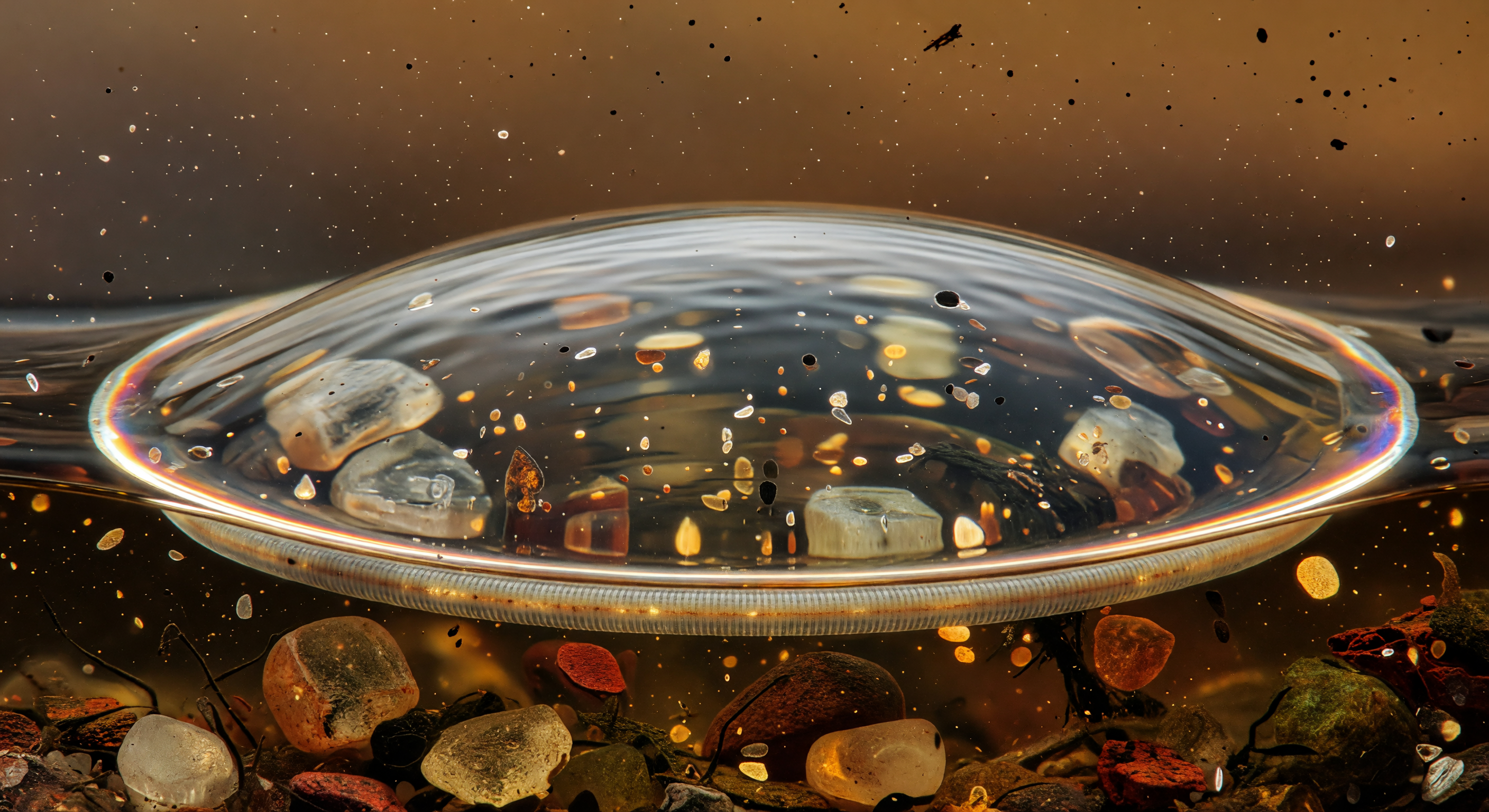
You hover suspended inside a lens of amber-tinted water no wider than a human hair, looking up through a curved meniscus dome that bows overhead like the inner surface of a soap bubble caught between two mineral boulders — a capillary bridge held in tension by the very physics of water molecules pulling against air. The meniscus acts as a convex fisheye mirror of extraordinary precision, its geometry drawn tight by surface tension, and in its curved silvered surface the entire surrounding soil landscape is radially compressed into a single shimmering panorama: frosted quartz faces, rust-stained feldspar, dark clots of decomposing organic matter, and pale corridors of gel-thick interstitial fluid, all folded together and trembling with every Brownian vibration transmitted through the medium. The water itself is not transparent but a deep luminous amber — humic acids leached from decomposing leaf litter staining the fluid warm as old tea held to light — and within it submicron platelets of kaolinite and illite drift in slow erratic arcs, each one flickering silver then rust-gold as it tumbles and scatters the multiply-diffused light arriving from all directions at once through overlying grain layers. At the edge of frame, the nematode's own cuticle intrudes as a pale corrugated wall of circumferential annuli — ridges spaced micrometers apart catching amber glints while their grooves drop into cooler shadow — and where it contacts the meniscus, the three-phase boundary where water, air, and biological surface converge burns as a continuous iridescent rim of concentrated refraction, white-gold at its crest fading to copper and rose, a luminous seam marking one of the most consequential interfaces in soil ecology: the place where life meets physics at its most unforgiving and intimate.
Other languages
- Français: Monde capillaire du ménisque
- Español: Mundo capilar del menisco
- Português: Mundo capilar do menisco
- Deutsch: Meniskus Spiegel Kapillarwelt
- العربية: عالم الشعيرات المنعكس
- हिन्दी: मेनिस्कस दर्पण केशिका जगत
- 日本語: メニスカス鏡の毛細管世界
- 한국어: 메니스커스 거울 모세관 세계
- Italiano: Mondo capillare dello specchio menisco
- Nederlands: Meniscus Spiegel Capillaire Wereld