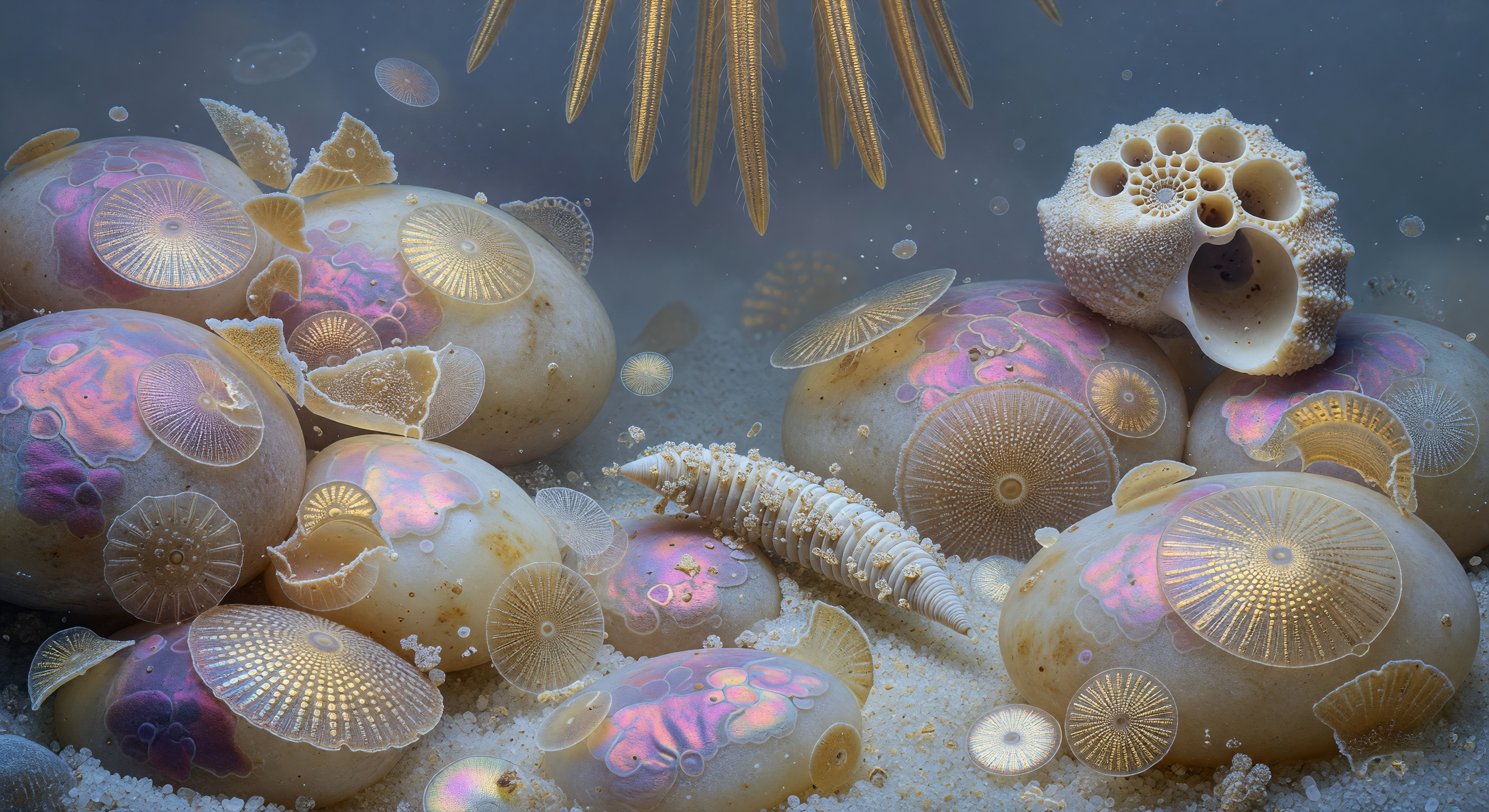
You drift through a dim, salt-laden corridor between immense pale boulders of silica — sand grains worn smooth by oceanic tumbling, their curved flanks glowing faintly with a sulfur-bacteria biofilm that shifts between magenta and deep violet as you pass, structural iridescence rippling across grain surfaces like slow chromatic breath. Wedged into every crevice between the grains, biogenic silica diatom frustules stand as elaborate glass architecture — honeycomb discs of *Coscinodiscus* wide as plazas, broken naviculoid fragments jutting like collapsed arches — their ornate surfaces bending the sourceless blue light into soft aureoles of amber and pale gold. Through this mineral city, a marine nematode sinuates with slow muscular inevitability, its corrugated ivory body encrusted with adhered sediment particles and diatom fragments at every cuticular ring, pushing through the interstitial fluid at near-zero Reynolds number where viscosity rules and every sinuous wave of its body is a negotiation with physics rather than a conquest of it. To the right, a foraminifera shell looms in cream-white calcite like a gothic cathedral, its coiled chambers stacked into vaulted archways that recede into warm interior shadow, while from above, golden polychaete chaetae descend like structural columns from the darkness between grains — reminders that this sediment is not a quiet archive but a layered, teeming metropolis compressed into the first few centimeters beneath the seafloor.
Other languages
- Français: Cité Diatomées des Sédiments
- Español: Ciudad Diatomea Sedimento Marino
- Português: Cidade Diatomácea Sedimento Marinho
- Deutsch: Meeressediment Diatomeen Stadt
- العربية: مدينة الدياتوم البحرية
- हिन्दी: समुद्री अवसाद डायटम नगर
- 日本語: 海底堆積物珪藻都市
- 한국어: 해양 퇴적물 규조 도시
- Italiano: Città Diatomee Sedimento Marino
- Nederlands: Mariene Sediment Diatomee Stad