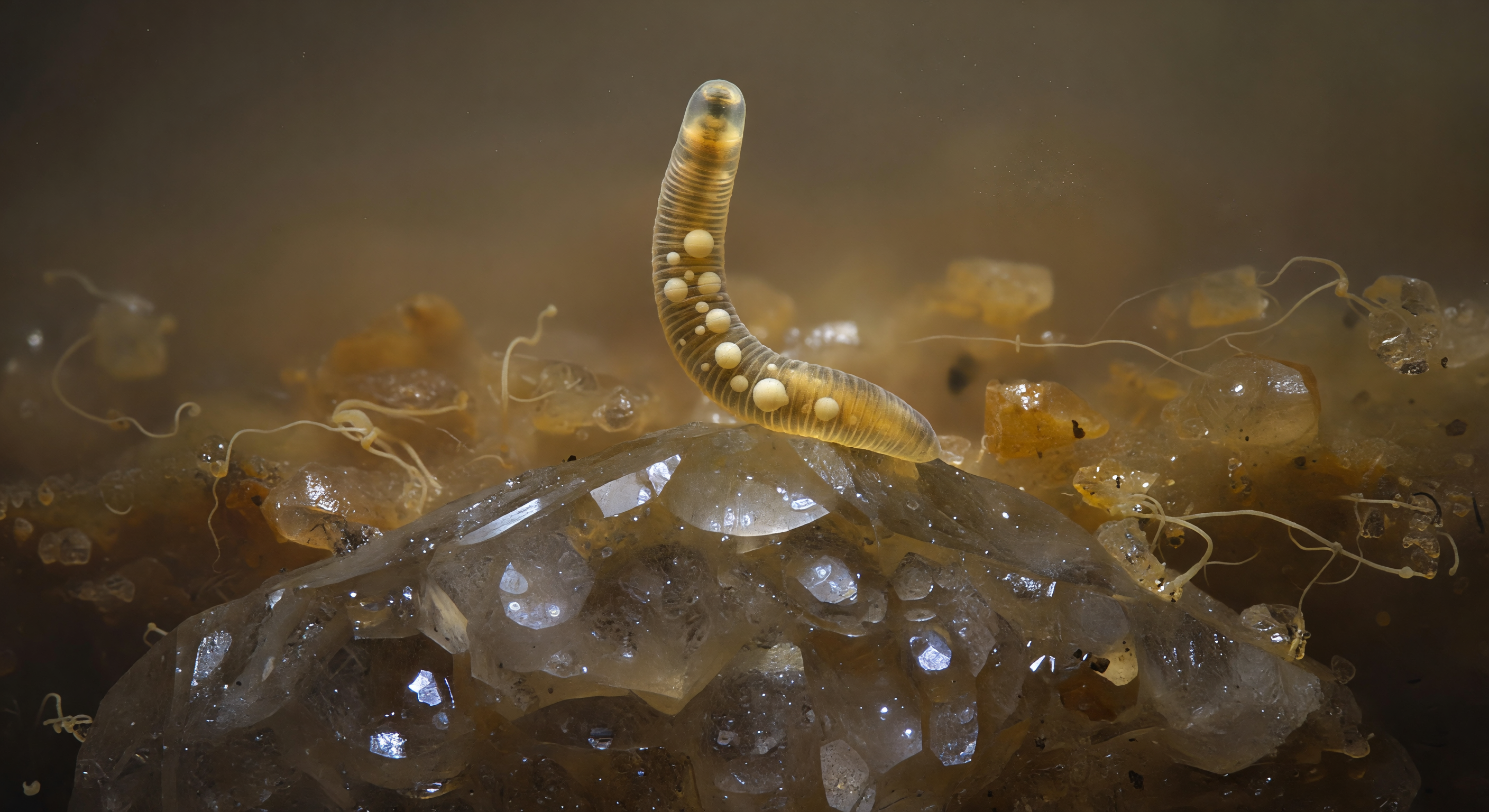
You are looking up from the fractured summit of a quartz grain the size of a small cliff, toward a dauer larva balanced on its tail tip like an amber minaret against a diffuse ochre glow — its sealed buccal plug the sole contact point between living tissue and ancient mineral, a posture called nictation that maximizes exposure for phoretic dispersal, the nematode broadcasting its presence to any passing arthropod large enough to carry it elsewhere. The quartz beneath fills the lower frame as a terrain of conchoidal fractures and glassy micro-plateaus, each facet deflecting multiply scattered light at a slightly different angle, the grain itself the product of millions of years of geological grinding now serving as a launching platform for an organism one millimeter tall. Through the dauer's thickened amber cuticle — its annular corrugations resolving as fine circumferential ridges under raking sidelight — large cream-white fat droplets cluster in the mid-body like pearls suspended in resin, reserves accumulated precisely because the buccal cavity is sealed and no feeding will occur until dispersal succeeds and favorable conditions trigger the dauer-exit signal. Below the grain, the world collapses into layered murk: broken soil aggregates, angular mineral shards, and looping pale fungal hyphae spanning between particle masses like frayed suspension cables in fog, the entire atmosphere thickened by bacterial exopolymers and dissolved organic matter suspended in interstitial moisture, a medium through which the nematode, were it moving, would sinuate at low Reynolds number with inertia entirely irrelevant — but here it simply stands, rigid and patient, waiting.
Other languages
- Français: Larve Dauer sur Grain de Sable
- Español: Larva Dauer en Equilibrio
- Português: Larva Dauer no Grão de Areia
- Deutsch: Dauer-Larve auf Sandkorn-Seil
- العربية: يرقة داور على حبة رمل
- हिन्दी: डॉयर लार्वा रेत-कण संतुलन
- 日本語: 砂粒の上のダウアー幼虫
- 한국어: 모래알 위의 다우어 유충
- Italiano: Larva Dauer sul Granello di Sabbia
- Nederlands: Dauer-larve op Zandkorrel-koord