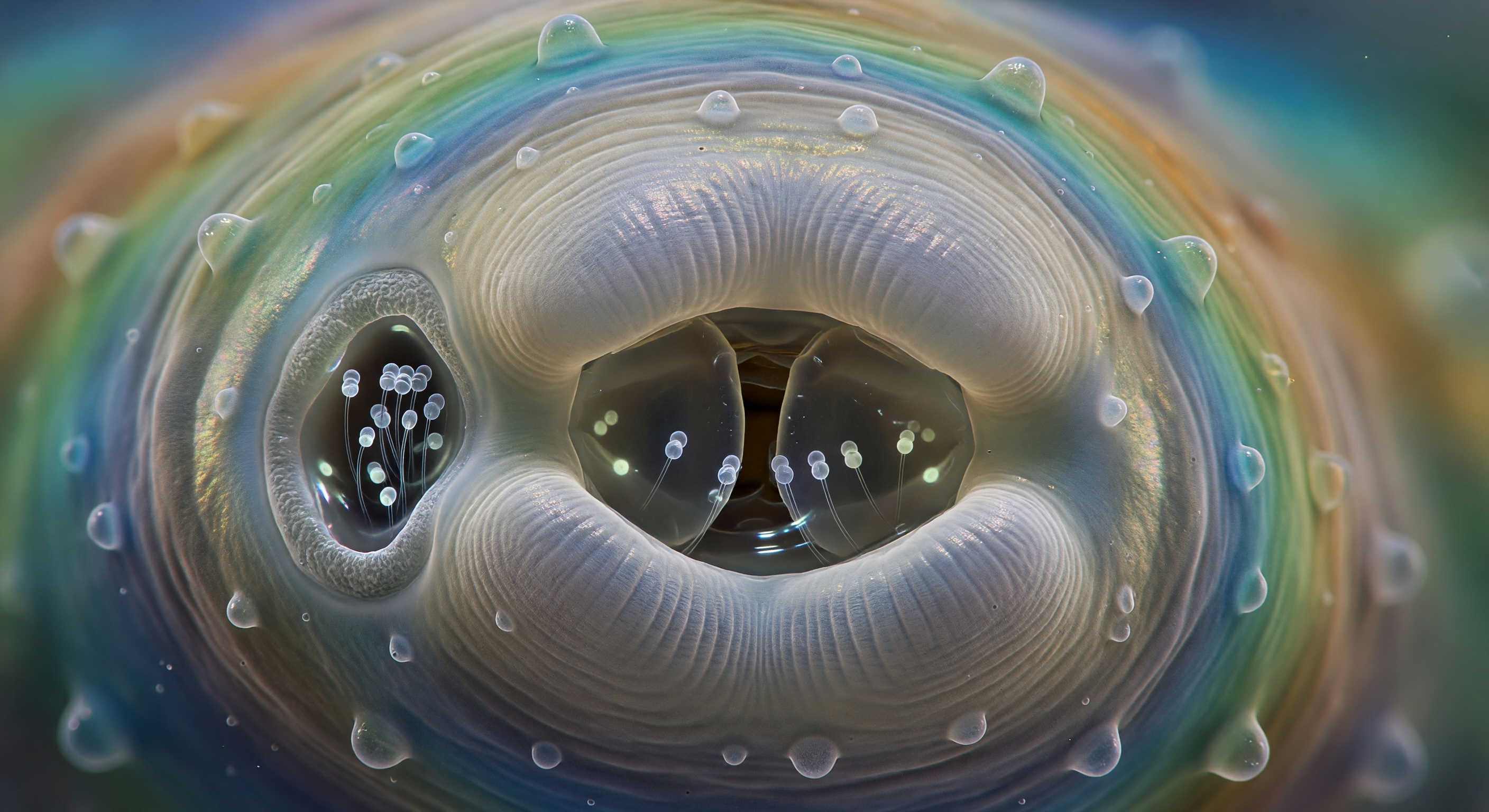
You hover centimeters from the anterior face of a nematode — a creature the size of a grain of sand — close enough that its three blunt, translucent lips fill your entire visual field like the mouth of a sea cave carved from iridescent alabaster, their corrugated annular ridges scattering light into pale gold and mother-of-pearl sheens across the pressurized cuticle. Dome-shaped papillae stud the lip margins like frozen water droplets, their mechanosensory endings implied by the taut stretch of cuticle over each convexity, while at the center a triradiate oral slit pulses rhythmically — the external face of a pharynx that grinds at roughly 250 strokes per minute, a muscular pump operating at a frequency closer to a heartbeat than a jaw. On the lateral flank, recessed into a shallow epidermal groove, the amphid pore opens as a crescent-shaped cleft barely a few microns wide, its glassy interior lined by sheath cells that cup a meniscus of secreted fluid like water held in polished obsidian, and within that channel twelve ciliated dendritic endings stand in a tight parallel fascicle, each filament tipped with elaborately folded receptor membranes that absorb accumulated fluorescent dye as a pale lime-white ghost-light — direct evidence of chemical signal being transduced into neural activity. The aqueous film coating the entire anterior surface is itself a map of the invisible: a saturated cyan pools near an attractant source just off-frame, bleeding slowly through teal and sage into warm amber-bronze at the periphery, a chromatic ombré of dissolved molecular gradients that, at this scale, is no longer metaphor but a physically navigable landscape of information the animal reads with its body.
Other languages
- Français: Antennes Chimiques Amphidiennes
- Español: Antenas Quimiorreceptoras Anfidiales
- Português: Antenas Gradiente Químico Anfídio
- Deutsch: Amphiden Chemische Gradient Antennen
- العربية: هوائيات التدرج الكيميائي الأمفيدي
- हिन्दी: एम्फिड रासायनिक प्रवणता एंटीना
- 日本語: 化学勾配感覚器官触角
- 한국어: 암피드 화학 기울기 촉수
- Italiano: Antenne Gradiente Chimico Anfidiale
- Nederlands: Amphid Chemische Gradiënt Antennes