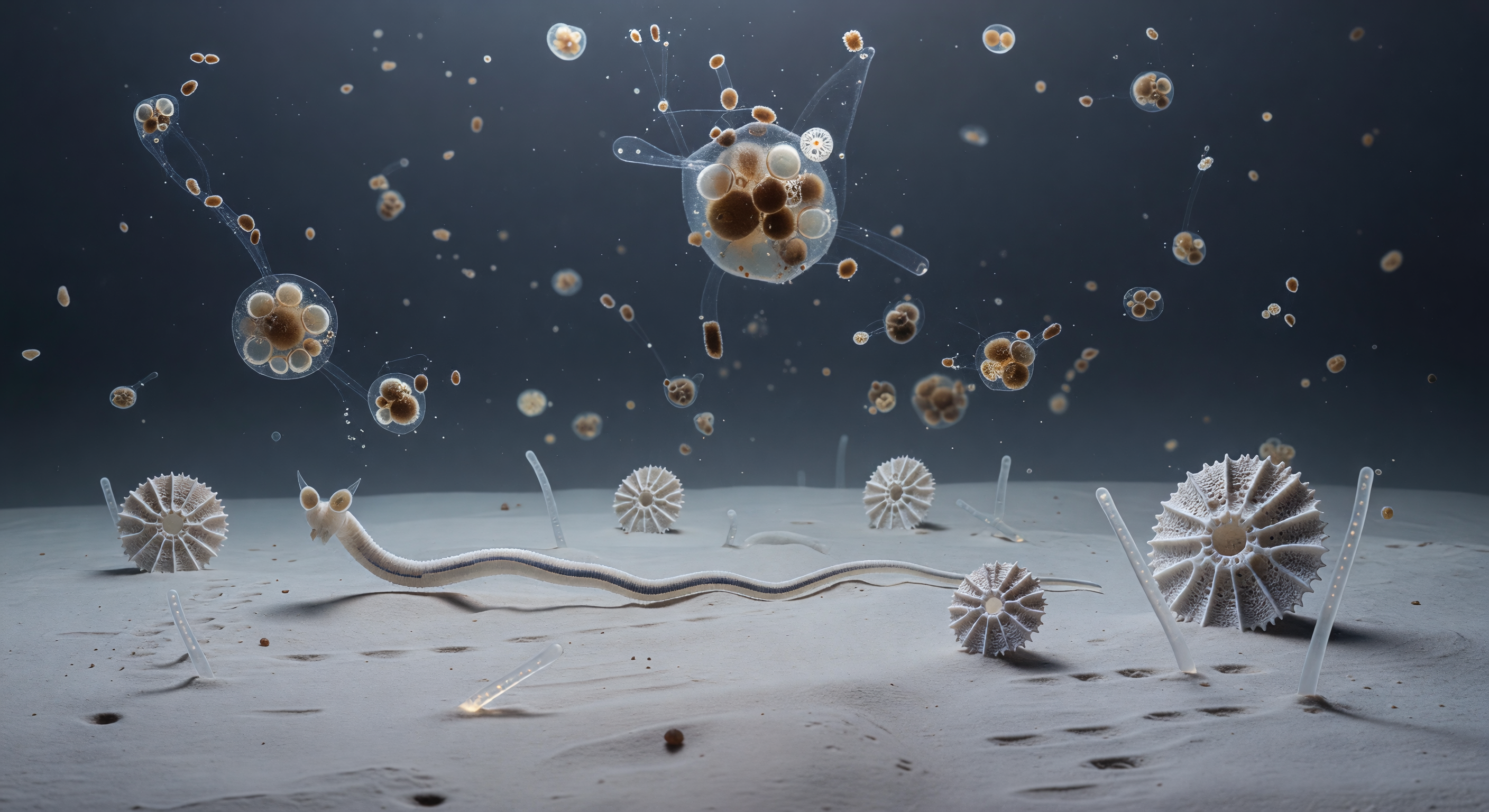
The seafloor here is not a floor in any ordinary sense — it is a nearly textureless plain of ultra-fine deep-sea clay, so cohesive and fine-grained that it behaves as a pseudoplastic surface at this scale, yielding almost imperceptibly under the slow pressure of an elongate body moving across it in long sinusoidal waves, each undulation completing so gradually that the motion registers more as geological deformation than animal locomotion. Foraminifera shells rise from the sediment like isolated cathedrals of calcite, their radial chambers and pore-studded walls the size of substantial architecture relative to the nematode body pressing through the near-bottom water alongside them, while silica sponge spicules lie scattered across the clay as enormous glassy beams, refracting the cold ambient blue into faint prismatic traces along their length. From far above, marine snow aggregates descend with the absolute patience of objects falling through a medium barely less dense than themselves — each one a loosely bound cluster of diatom frustules, compressed fecal material, mucus strands, and mineral dust, trailing transparent threads of mucopolysaccharide as they rotate in slow oscillation through the viscous bottom water, their dissolved organic compounds diffusing outward and downward into the sediment where chemosensory amphid organs, proportionally vast on the nematode's head, sample the gradient with the same unhurried precision that governs everything here. This is life at the tempo of the abyss: a world where two kilometers of ocean overhead compress into a soft brown blizzard of descending particles, where bacterial films coat every mineral surface as invisible cities, and where a nematode's 302 neurons are sufficient to navigate a cold desert of bone-pale clay and fallen silica towers in total, permanent, structural darkness.
Nematodes