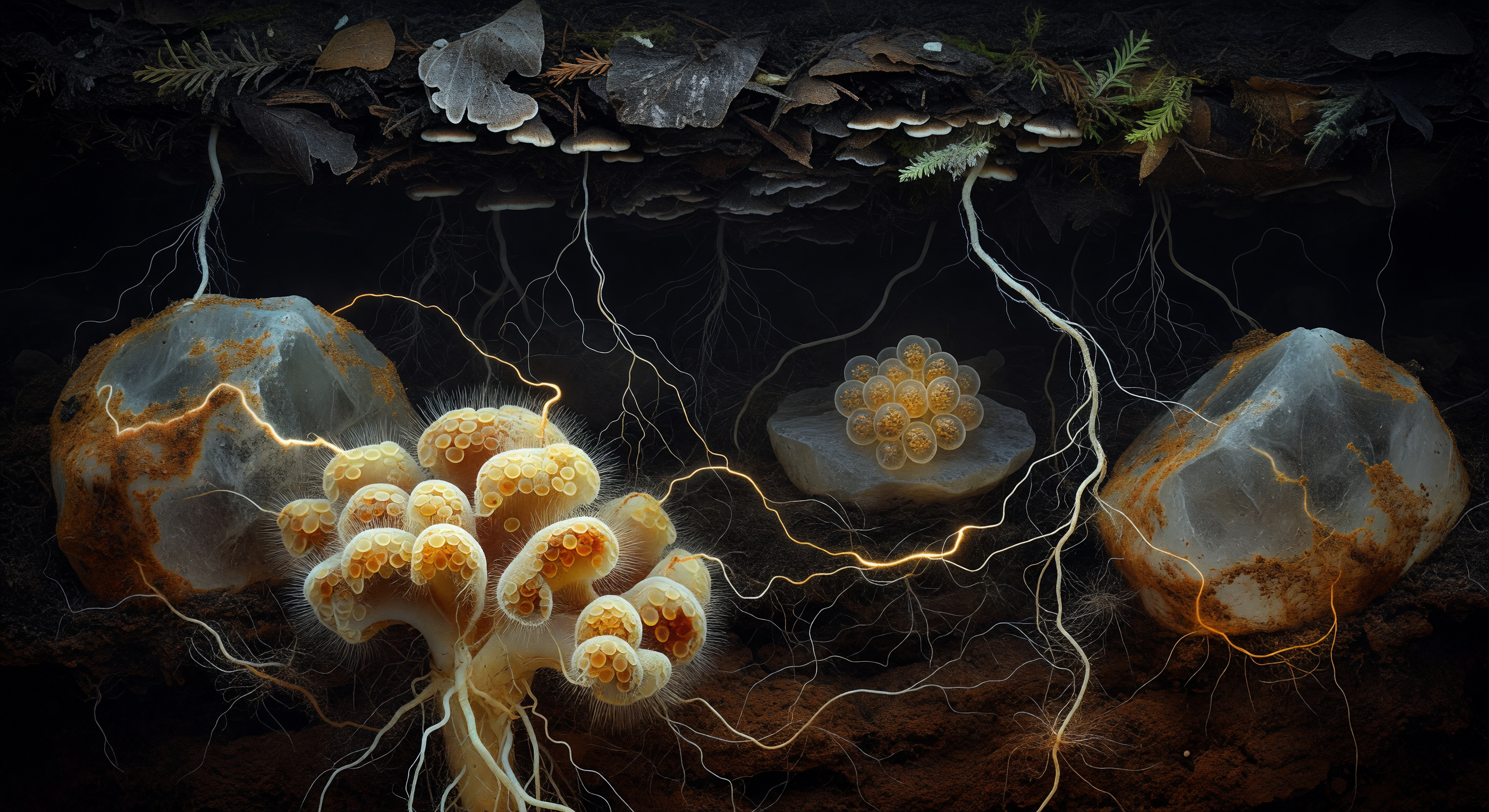
You are drifting through absolute darkness inside a pore channel no wider than a crack in old stone, suspended between quartz grains the scale of cathedral walls, their surfaces glazed in amber organic matter that seems to hold warmth rather than emit light. Directly ahead, an ectomycorrhizal root-tip cluster rises like a baroque reef structure: its mantle sheath layers cream, butter-yellow, and rust-ochre pseudoparenchyma around the root's pale cortex, outer hyphae radiating into the surrounding soil matrix like hair lifted in a slow current, the whole assembly functioning as a living interface where the tree surrenders photosynthate carbon and the fungus returns phosphorus and water scavenged from mineral surfaces no root hair could reach. Weaving outward from this cluster and threading across tens of centimetres of dark soil, the Common Mycorrhizal Network materializes as gossamer white hyphae — individually one to ten micrometres across — braiding near root surfaces then thinning to near-invisibility across bare feldspar faces, a recursive three-dimensional mesh that physically links trees of different species into a shared biochemical conversation. Mid-ground, an amber spore cluster rests against a flat mineral face, its stratified walls enclosing lipid globules that refract the scene's faint inferred luminosity into honeyed gold, each spore a dormant archive of fungal genetic potential awaiting the chemical signal of a nearby root. Above, fine roots descend from the near-black humus ceiling like silver and cream cables, some bare, others already cloaked in new mycorrhizal mantles, all of them dependent on this lightless web to survive.
Other languages
- Français: Panorama du Réseau Forestier Souterrain
- Español: Panorama de la Red Forestal Subterránea
- Português: Panorama da Rede Subterrânea Florestal
- Deutsch: Waldnetz Bodenpanorama
- العربية: بانوراما شبكة غابات التربة
- हिन्दी: वन मृदा नेटवर्क पैनोरामा
- 日本語: 森の土壌菌糸ネットワーク全景
- 한국어: 숲 토양 균사 네트워크 파노라마
- Italiano: Panorama della Rete Forestale Sotterranea
- Nederlands: Bosbodемnetwerk Panorama