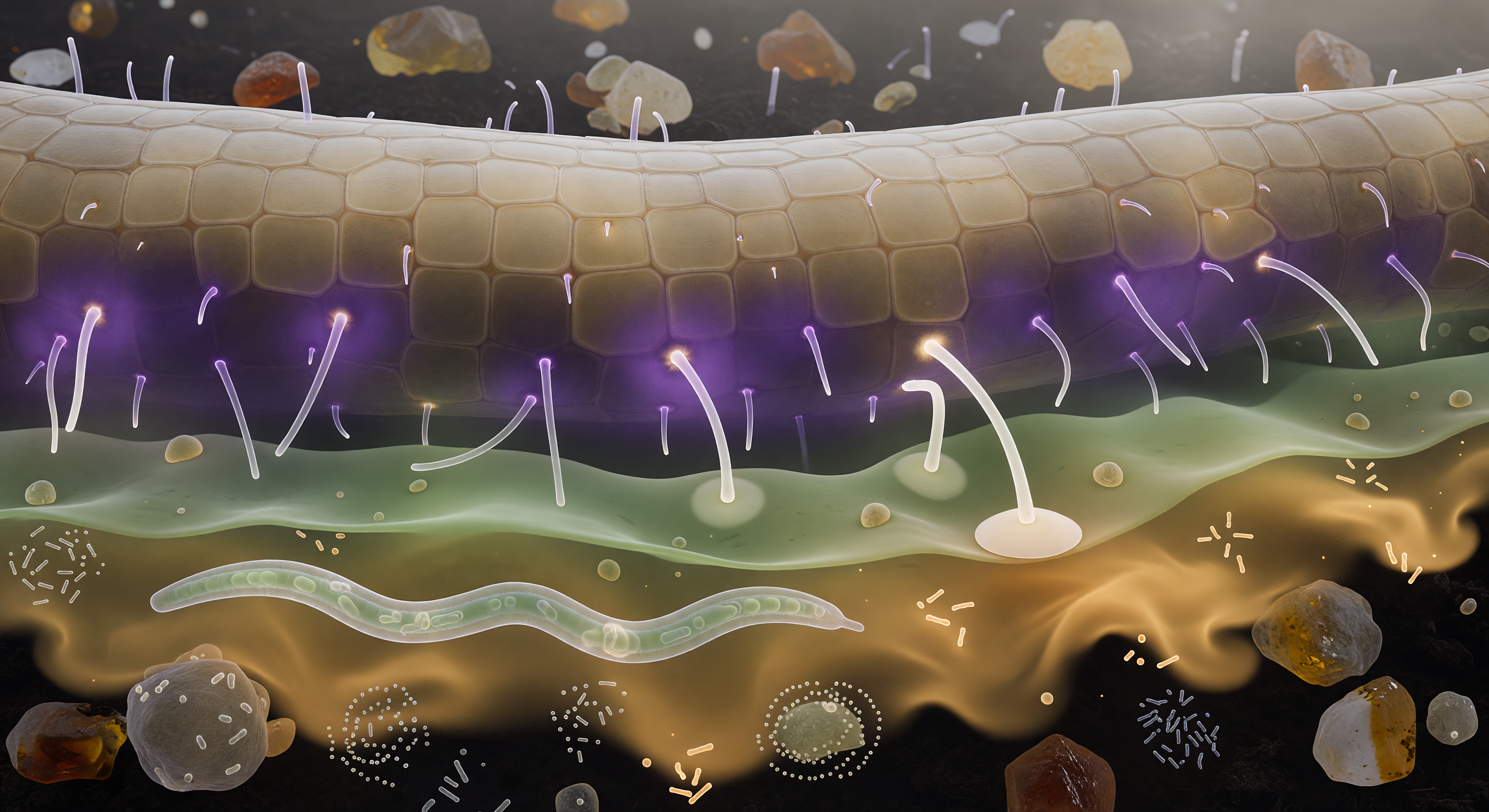
You are suspended just beyond arm's reach from a root wall that curves away like a pale sandstone escarpment, its epidermis a mosaic of subtly convex tan cells whose raised borders trace the geometry of ancient masonry, while glass-clear root hairs extend toward you as cold luminous filaments that refract the chemistry between you rather than any light source above. What you are seeing—the layered violet corona of strigolactones and flavonoids pressed against the epidermis, the cooler green-gray amino-acid haze diffusing outward through pore-water films, the slow amber-gold sugar plume dissolving in wisps toward the darkness behind you—is the rhizosphere's signaling landscape made visible, a chemical atmosphere that root and fungus have co-authored over 400 million years of coevolution to choreograph their encounter. Two hyphal tips bend measurably through the green layer, following the violet gradient as ships follow a coast, and one has already flattened its terminus into an appressorium disc flush against an epidermal tile, beginning the enzymatic negotiation that will, if the plant's immune system permits, thread the fungus into the cortex and establish a phosphate-for-carbon exchange worth more to both partners than anything visible at this moment. Below, a nematode crosses the amber fade in glassy sinusoidal progress while bacterial swarms pulse in loose spirals on aggregate faces around it, each rod or coccus barely a fifth the diameter of the hyphal walls overhead—a reminder that what looks like a bilateral drama between root and fungus is in fact an entire biome transacting simultaneously in the same few hundred micrometers of chemically saturated darkness.
Other languages
- Français: Aurore chimique de la rhizosphère
- Español: Aurora química de la rizosfera
- Português: Aurora química da rizosfera
- Deutsch: Rhizosphären-Chemische Gradientenaurora
- العربية: أورورا التدرج الكيميائي للجذور
- हिन्दी: प्रकंद रासायनिक प्रवणता ऑरोरा
- 日本語: 根圏化学勾配オーロラ
- 한국어: 근권 화학 기울기 오로라
- Italiano: Aurora chimica della rizosfera
- Nederlands: Rizosfeer chemische gradiënt aurora