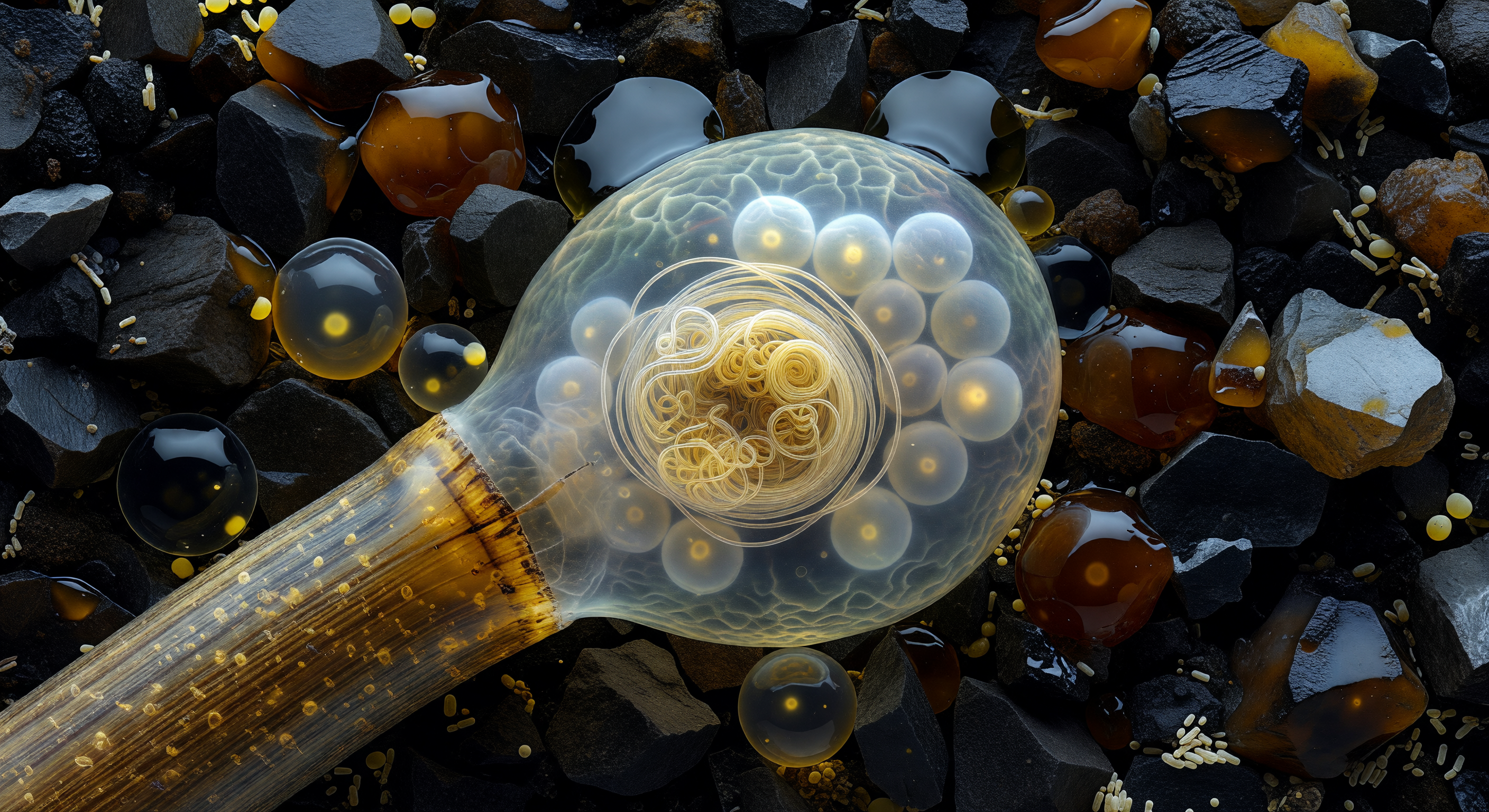
Suspended in the absolute dark of a soil pore beneath a temperate meadow, you face a single *Dactylorhiza* orchid seed that fills your field of view like a translucent airship moored against cliffs of black basalt and grey quartz — its seed coat a single iridescent membrane no thicker than a soap film, refracting the cold chemistry of pore water into ghostly silver and pale blue-green interference colors, enclosing a loose cluster of colorless embryo cells that glow with the dim warmth of paper lanterns, metabolically suspended at the very edge of possibility. From the lower left advances a Rhizoctonia hypha reading at this scale as a massive lacquered cylinder of chitin, warm ochre shading to umber at its septate nodes, its cytoplasm visibly streaming with organelles, and where it has breached the seed coat the membrane gathers into a tight puckered annulus around the entry point, sealed by the living tissue itself. Inside one embryo cell the peloton occupies the entire cellular interior — a wound-spring coil of hyphae dozens of loops deep, amber and pale ivory where the turns compress against each other, pressing the cell wall into a slight ellipse as it burns with the slow metabolic negotiation of two organisms deciding whether this contact is invasion or alliance. The adjacent embryo cells are already answering: fractionally enlarged, their membranes drawn taut, their interior luminosity shifting from cool silver-white toward a warmer cream-gold as the earliest molecular steps of differentiation begin — the fungus delivering fixed carbon and mineral phosphate in exchange for photosynthate the seedling cannot yet make, a mutualism so obligate for this orchid that without it the seed, containing no endosperm and almost no stored energy, would simply remain paused here in the dark until it died. Beyond the seed, mineral grains press in like brutalist architecture coated in caramel films of humic acid, pore water curving into perfect menisci under surface tension, and at the far edge of focus pale bacterial rods cling to quartz surfaces like barnacles on a sea cliff, impossibly small even here.
Other languages
- Français: Éveil Fongique de la Graine
- Español: Despertar Fúngico de Orquídea
- Português: Despertar Fúngico da Semente
- Deutsch: Pilzliches Erwachen des Samens
- العربية: صحوة فطرية لبذرة السحلبية
- हिन्दी: ऑर्किड बीज कवक जागरण
- 日本語: ラン種子の菌類覚醒
- 한국어: 난초 씨앗 균류 각성
- Italiano: Risveglio Fungino del Seme
- Nederlands: Orchidee Zaad Schimmel Ontwaking