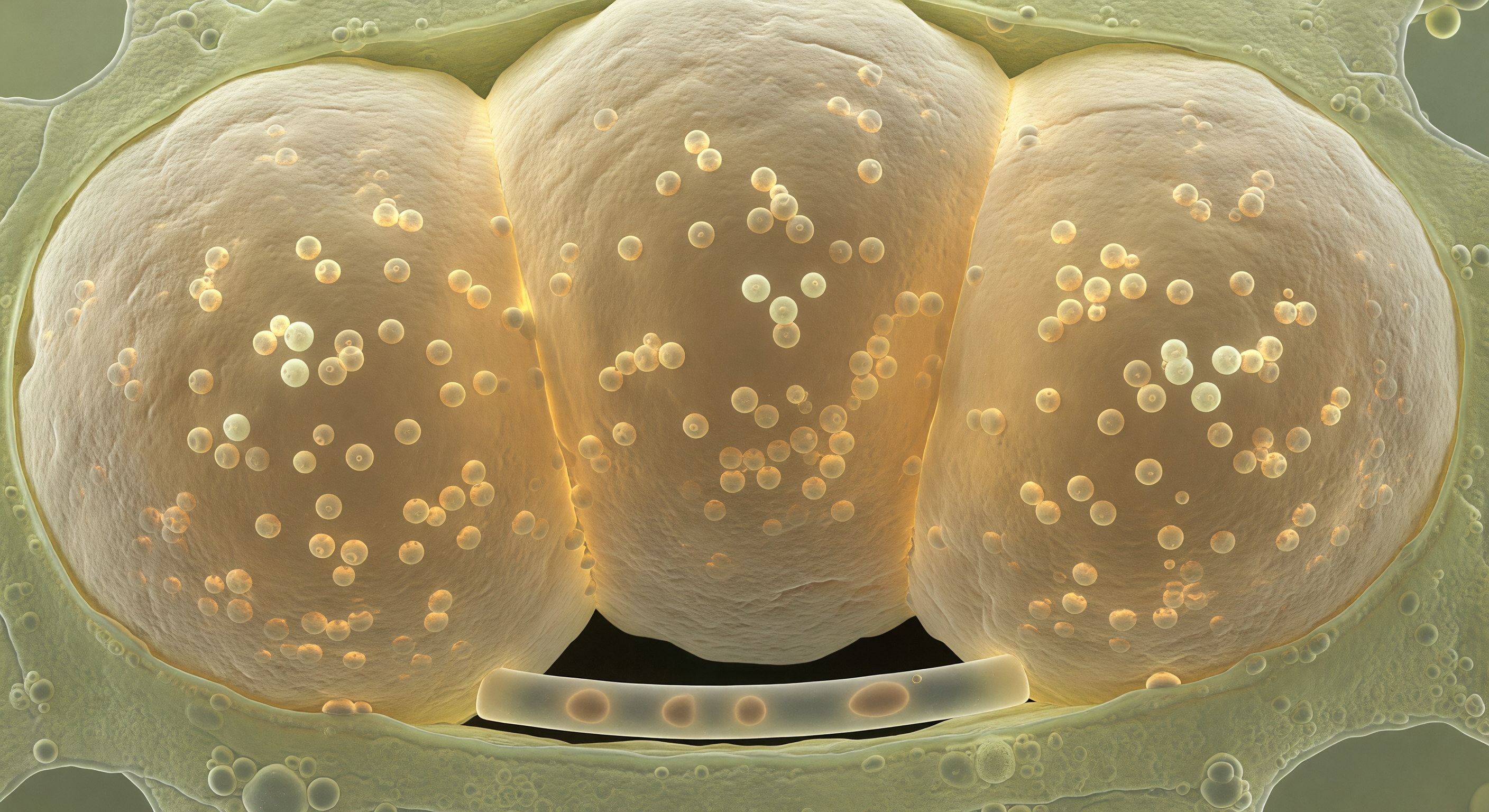
You are suspended inside a root cortical cell whose entire volume has been commandeered by three arbuscular mycorrhizal fungal vesicles, pressing against each other and the surrounding walls like amber hot-air balloons inflated well past capacity, their mutual contact zones flattened into broad planes of soft geometry wherever they collide. Each vesicle wall presents itself in layers — a rough, striated outer rind of chitin-glucan lamellae the texture of weathered ivory giving way inward to a glassy amber smoothness that seems to generate its own dim luminescence, as though the chemistry of lipid accumulation is itself warm enough to glow. Inside each amber mass, dozens of spherical lipid globules ranging from five to ten micrometers across hang in arrested suspension, refracting ambient light into pale-gold internal highlights: these are the fungus's primary carbon and energy reserves, triglyceride-rich droplets synthesized from sugars delivered by the host plant and destined for export outward along the extraradical mycelium to fuel soil exploration far beyond this root. The host cell has been reduced to a pressurized film of pale-green cytoplasm squeezed to the margins — ribosomes, organelles, and cellulose microfibrils still present but compressed under a load they were never designed to bear — while a single intraradical hypha no wider than five micrometers threads silently between two vesicles at the lower periphery, its colorless taut wall faintly glistening, the sole filament connecting this oil-packed interior vault to the invisible external network and everything it sustains.
Other languages
- Français: Cellule Réservoir de Vésicules
- Español: Célula Depósito de Vesículas
- Português: Célula Reservatório de Vesículas
- Deutsch: Lipidvesikel Speicherzelle
- العربية: خلية مستودع الحويصلات الدهنية
- हिन्दी: लिपिड वेसिकल भंडार कोशिका
- 日本語: 脂質小胞貯蔵細胞
- 한국어: 지질 소포 저장 세포
- Italiano: Cellula Riserva di Vescicole
- Nederlands: Lipide Blaasjes Reservoircel