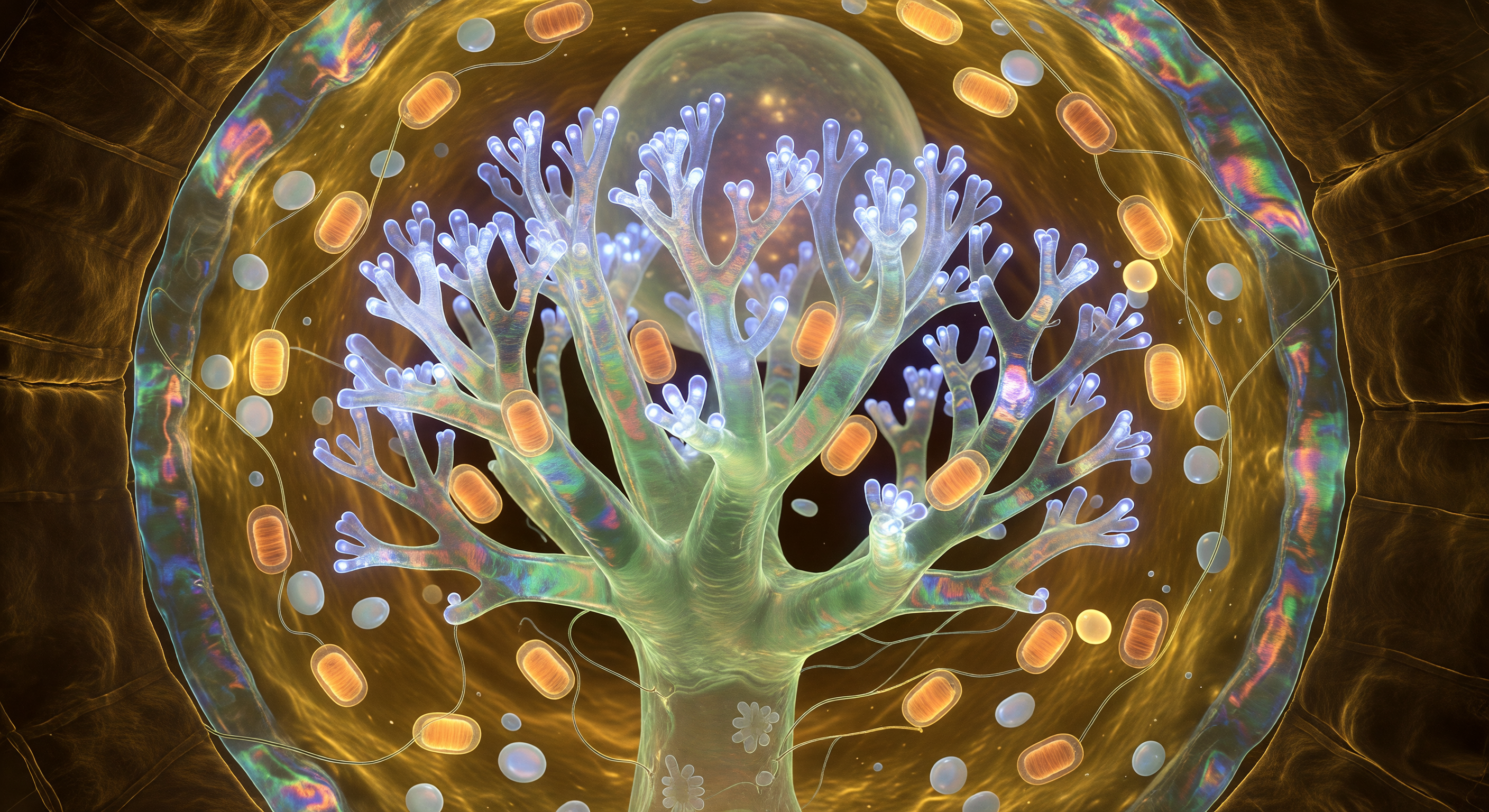
You float inside a living cell whose interior has become a cathedral of cold metabolic light, the arbuscule rising before you as an inverted coral forest of translucent jade-ivory, branching upward through recursive dichotomies until the terminal branchlets — each barely half a micron across — dissolve into a trembling haze of electric cobalt-white as phosphate transporter proteins cycle through their conformational states in massed, shoulder-to-shoulder unison across every square nanometer of the surrounding periarbuscular membrane. This double-membrane interface is the operational heart of the arbuscular mycorrhizal symbiosis: the fungal cell and the host root cortical cell never actually touch, remaining always separated by this taut amber-to-teal-iridescent film through which phosphate ions move outward into the plant and photosynthate flows inward to the fungus, an exchange so relentless that its energetic cost draws clusters of cigar-shaped mitochondria against every major branch like amber lanterns, their chemiosmotic respiration casting halos of warm orange-gold into the surrounding viscoelastic cytoplasm. Beyond the mitochondria, pearlescent amyloplasts drift through that golden cytoplasmic gel like opalescent river stones, refracting the bioluminescent blue into pale prismatic smears, while the cell wall curves at every horizon as a massive dark amber rampart — its crossed helical arrays of cellulose microfibrils catching the arbuscular glow at low angles and revealing a carved, vaulted topography. There is no external light source here; every photon you perceive is metabolic, emitted by the chemistry of an exchange that has been sustaining forests since before the first trees existed, and the entire glowing architecture around you — this single cell, this single arbuscule — is one node in a network that may span hectares of living soil above.
Mycorrhizae & soil networks