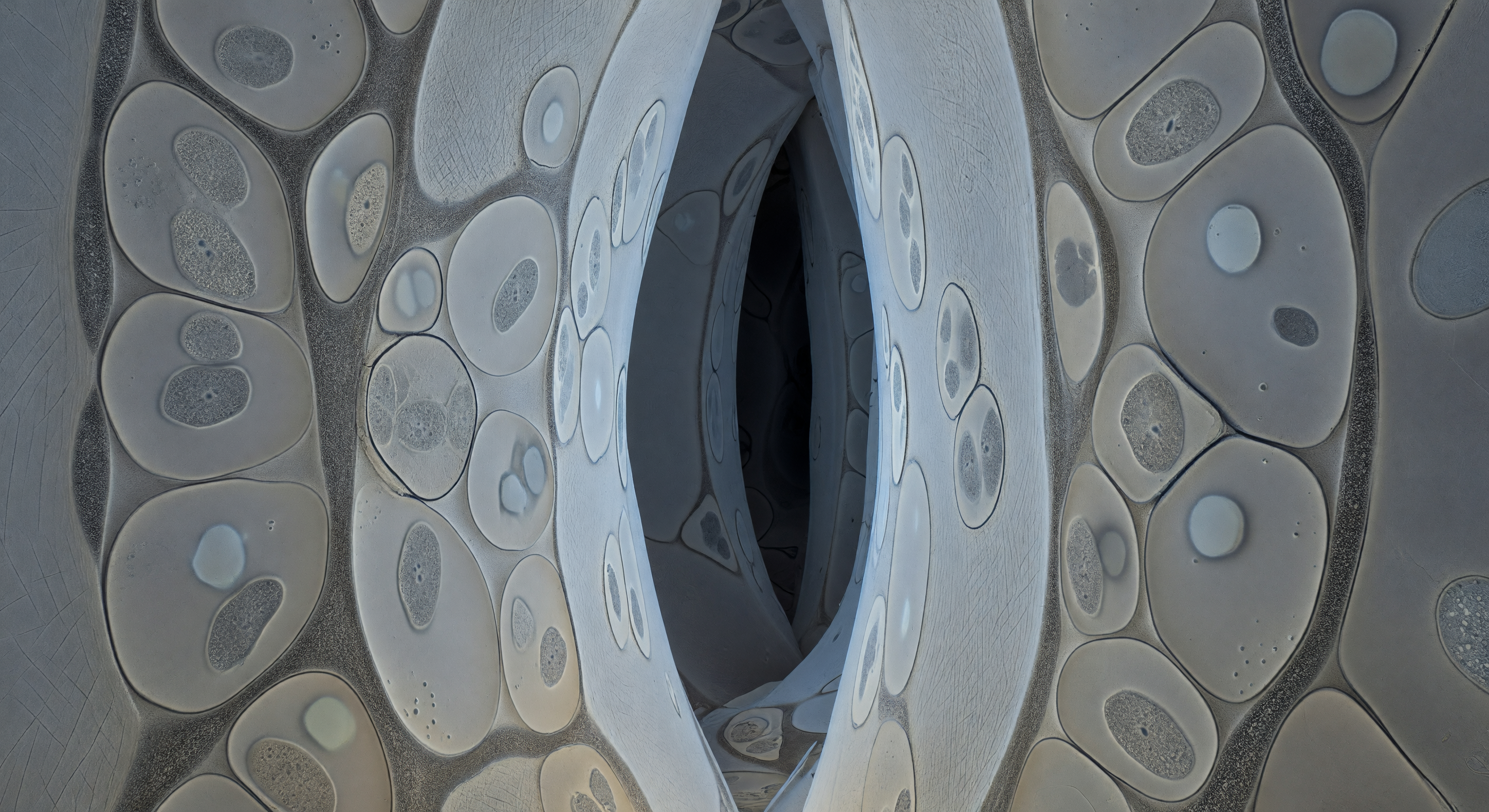
You are deep inside the root — not metaphorically but structurally, wedged into an intercellular corridor so compressed that the pale cream cellulose walls of adjacent epidermal cells press against you from every direction, their microfibril bundles running in crossed diagonals like the grain of ancient paper, cold and faintly translucent where metabolic chemistry leaks through the membranes behind them. The corridor is packed with fungal hyphae flattened into lens-shaped profiles by the same cellular pressure that shaped this passage, each one bounded by a razor-crisp graphite plasma membrane holding its curvature with palpable tension, enclosing dove-grey cytoplasm scattered with ovoid mitochondria and small lucent vacuoles that read as soft optical absences rather than resolved structures. Between every fungal wall and every root cell wall runs the interfacial matrix — a continuous 15–25 nm granular strip of slightly warmer mid-grey, heterogeneous in density, a glycoprotein meshwork secreted simultaneously from both sides, and it is here, in this near-invisible threshold, that phosphate ions leave fungal cytoplasm and photosynthetic sugars arrive from the plant, the entire metabolic contract of ectomycorrhizal symbiosis conducted across a boundary thinner than a ribosome is wide. Deeper corridors recede into flat planes of dark slate, losing fibrillar detail, the labyrinth extending beyond perception in every direction through lightless soil, navigated entirely by chemical gradient and membrane tension, without a photon to spare.
Other languages
- Français: Corridors Intercellulaires du Réseau Hartig
- Español: Corredores Intercelulares de la Red Hartig
- Português: Corredores Intercelulares da Rede Hartig
- Deutsch: Hartig-Netz Interzelluläre Gänge
- العربية: ممرات شبكة هارتيغ بين الخلايا
- हिन्दी: हार्टिग नेट अंतरकोशिकीय गलियारे
- 日本語: ハルティグネット細胞間回廊
- 한국어: 하르티그 네트 세포간 통로
- Italiano: Corridoi Intercellulari della Rete Hartig
- Nederlands: Hartig Net Intercellulaire Gangen