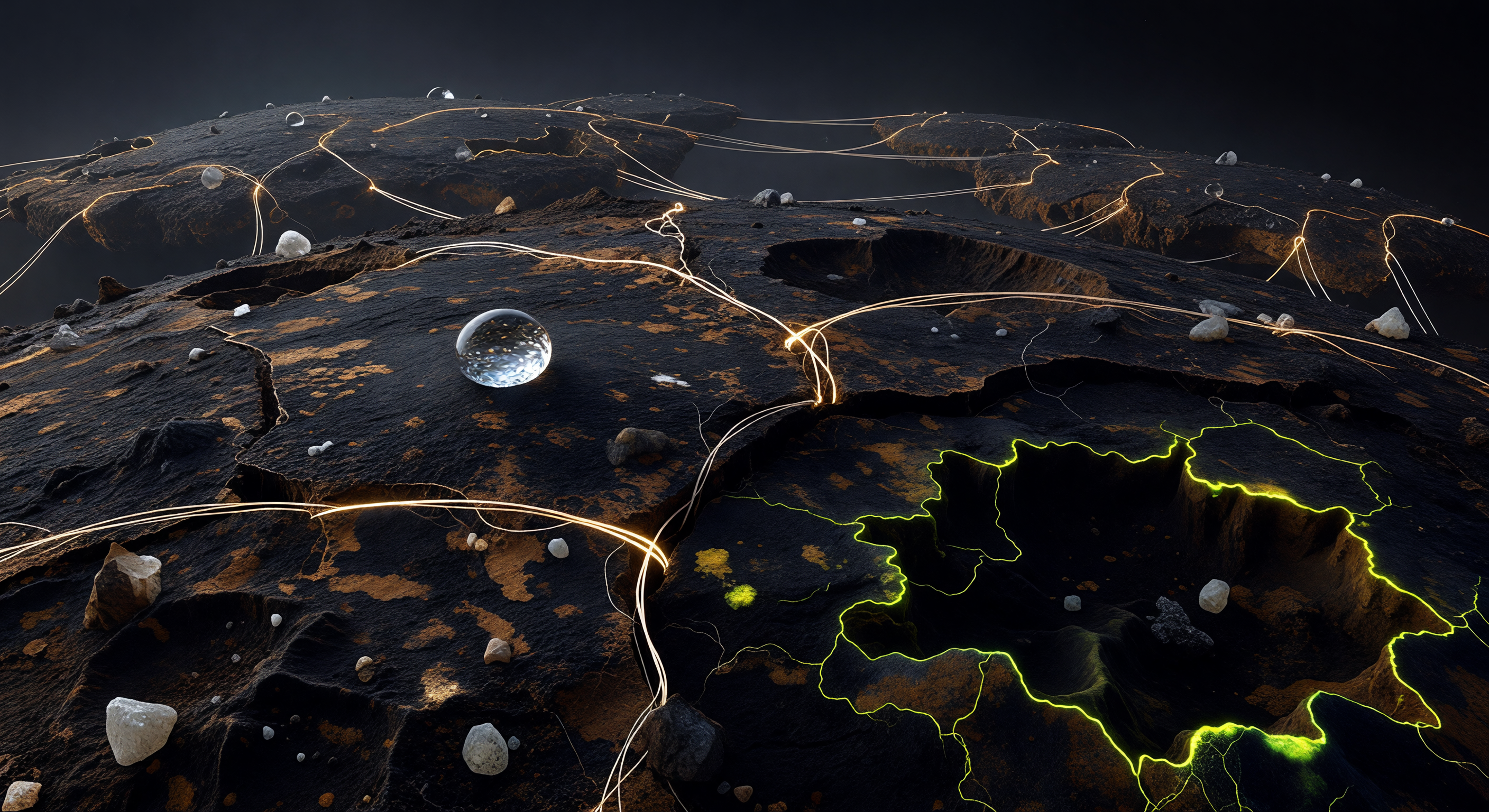
Filling the frame like the face of a dark volcanic moon, a single soil macroaggregate of compressed humus, fungal melanin, and silicate minerals forms a world entire unto itself—its espresso-black surface mottled with ochre and grey, the crystalline faces of quartz and feldspar grains catching raking amber light like pale boulders half-submerged in a dark sea. Across every exposed face, a thin lacquer of glomalin—a glycoprotein secreted by arbuscular mycorrhizal fungi and one of the largest repositories of stable carbon in terrestrial ecosystems—seals the aggregate in a hydrophobic amber-gold film, a single water droplet beading against it with a steep contact angle that speaks to the structural chemistry locked into this three-millimeter body. From stress fractures splitting the aggregate's equatorial belt, white hyphal threads emerge in loose parallel arcs, biological sutures that actively bind mineral and organic particles together through both physical enmeshment and the continued secretion of that same glomalin cement. In the ultraviolet inset, the ambient world drops to near-darkness and the glomalin coating erupts in brilliant yellow-green fluorescence, tracing the invisible architecture of carbon sequestration in incandescent relief—making visible a soil engineering project that arbuscular mycorrhizal fungi have been executing, largely unchanged, for four hundred million years.
Other languages
- Français: Agrégat de Sol Blindé par la Glomaline
- Español: Agregado de Suelo Blindado con Glomalina
- Português: Agregado de Solo Revestido de Glomalina
- Deutsch: Glomalin-gepanzertes Bodenaggregat
- العربية: تجمع التربة المدرع بالغلومالين
- हिन्दी: ग्लोमालिन-आवृत मृदा समुच्चय
- 日本語: グロマリン被覆の土壌団粒
- 한국어: 글로말린으로 감싼 토양 입단
- Italiano: Aggregato di Suolo Rivestito di Glomalina
- Nederlands: Glomaline-Gepantserd Bodemaggregaat