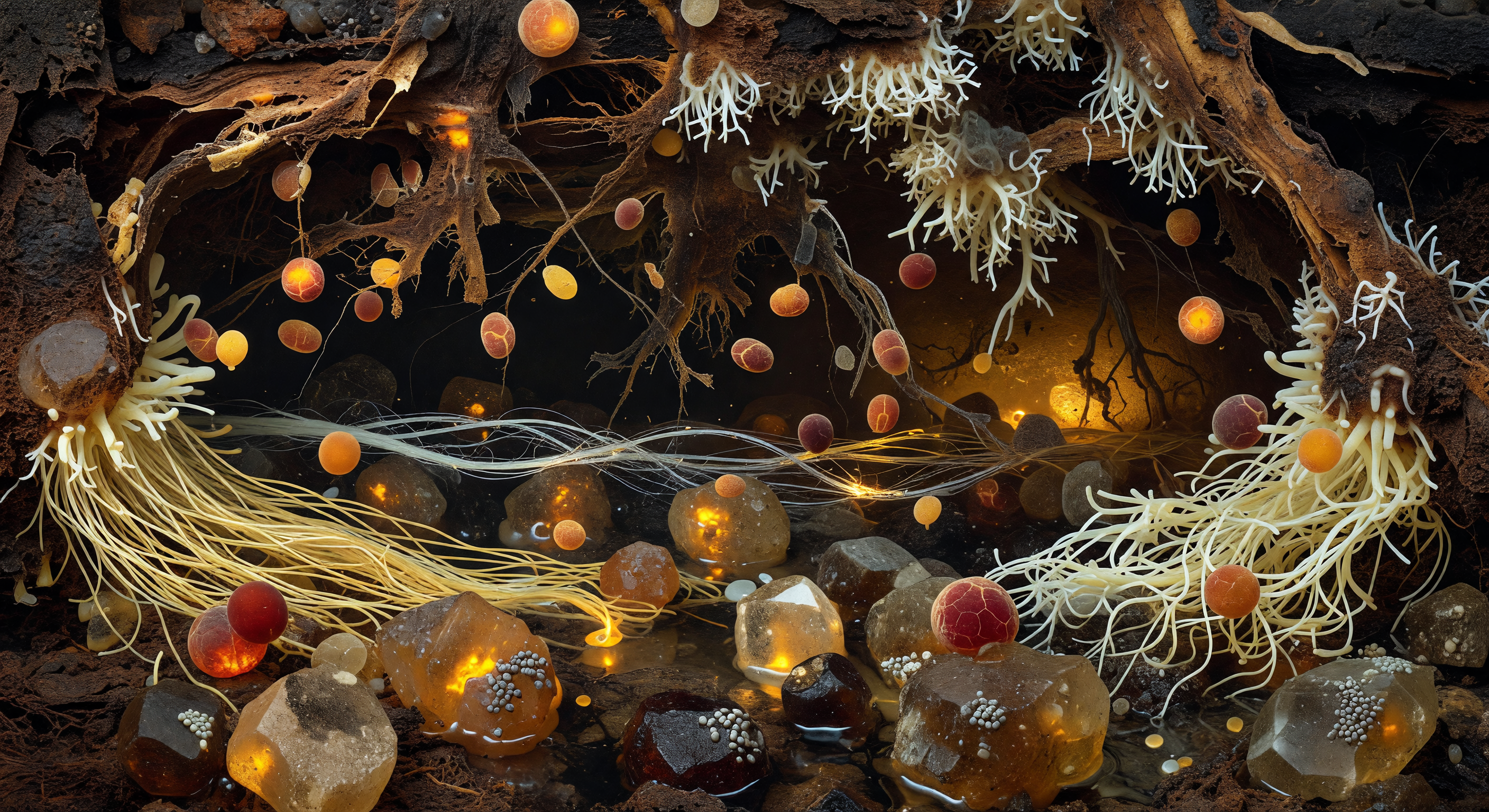
You are suspended inside a lightless soil pore just beneath a root system that died perhaps days ago, and what surrounds you is nothing less than the controlled disassembly of a biological empire. Overhead, the dead root cortex has collapsed into dark chocolate ribbons and spongy cellular wreckage, from whose fissures AMF spores tumble free in slow motion — spherical bodies the size of boulders and small houses at your scale, their thick walls glowing amber, wine-red, and ochre, some already cracking to leak pale lipid fluid into the surrounding water film, each spore a dormant archive of genetic and lipid capital now released into open competition. Every mineral surface around you — quartz towers rising like office buildings on all sides — is lacquered in glomalin, the glycoprotein secreted by arbuscular mycorrhizal fungi that stabilizes soil aggregates and sequesters carbon for decades, its amber resin film catching the faint bioluminescent chemistry of decomposition and diffusing it into the only light this world possesses. Across the mid-distance, remnant common mycorrhizal network threads still run silver-white toward living neighboring trees, their cytoplasm barely flowing as the dead tree's hydraulic pressure slowly equalizes — while against this elegance, saprotrophic hyphae twice their diameter colonize the cortex above with blunt, matte urgency, their chemistry optimized not for mutualism but for enzymatic demolition of lignin and cellulose. From opposite sides of the pore, two mycorrhizal fronts — one pale yellow, one cream-white — converge on this nutrient-rich catastrophe, their approaching filaments already contacting the outermost rolling spores, the entire scene a silent negotiation over the phosphorus, nitrogen, and carbon wealth of a giant's last bequest.
Other languages
- Français: Héritage Souterrain du Géant Mort
- Español: Legado Subterráneo del Gigante Muerto
- Português: Legado Subterrâneo do Gigante Morto
- Deutsch: Unterirdisches Erbe des Toten Riesen
- العربية: إرث العملاق الميت تحت الأرض
- हिन्दी: मृत दानव की भूमिगत विरासत
- 日本語: 死せる巨木の地下遺産
- 한국어: 죽은 거인의 지하 유산
- Italiano: Eredità Sotterranea del Gigante Morto
- Nederlands: Ondergrondse Erfenis van de Dode Reus