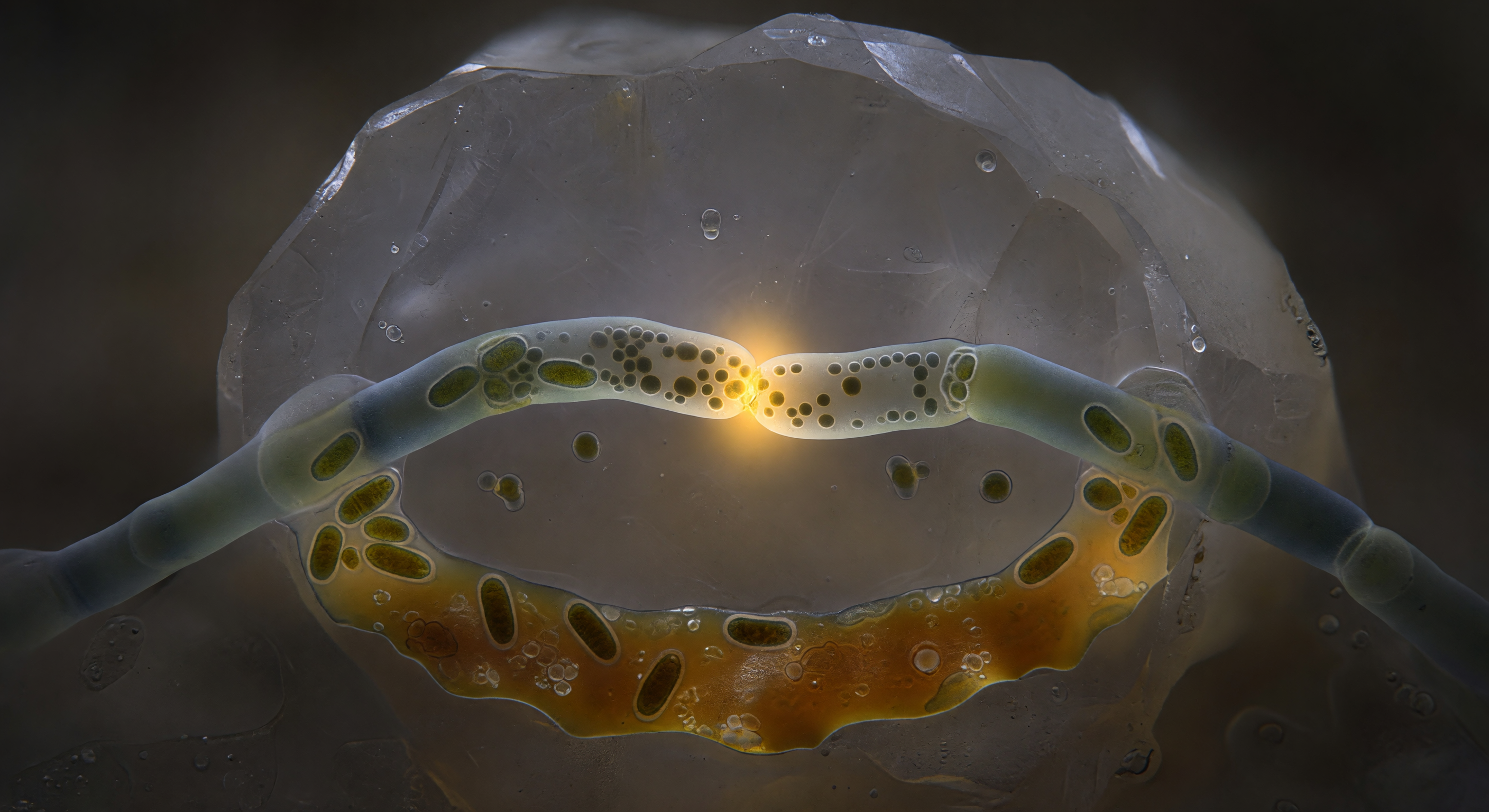
You are suspended in absolute darkness inside a soil pore no wider than a human hair's cross-section, pressed against the face of a feldspar grain that rises beside you like a glaciated cliff, its crystal planes emitting a cold diffuse gleam from within while a saturated film of soil water holds you in place. Before you, two arbuscular mycorrhizal fungal hyphae arc toward each other through this mineral-walled chamber, each tube five to six micrometres in diameter, their chitin-glucan walls the translucent blue-green of clouded sea glass — and at the single point where their walls have dissolved into one another, a fusion pore barely one and a half micrometres across blazes in concentrated amber-gold, the only warm light in this otherwise lightless world. This is hyphal anastomosis: the deliberate erasure of a boundary between two fungal individuals, a process that allows cytoplasm, organelles, nuclei, and signaling molecules to flow between formerly separate hyphal branches, enabling genetic exchange, resource redistribution, and network repair across the mycelium. Through the luminous throat of the pore, mitochondria cluster in dense amber-copper masses at the margin while lipid granules and cytoplasmic ground substance stream in a viscous rope from left to right, the metabolic traffic so intense it generates a visible thermal halo that scatters through the surrounding water film into the grey-brown obscurity of the soil pore — a pulse of biochemical energy intimate in scale yet foundational to the carbon and phosphorus economies of entire forest ecosystems.
Other languages
- Français: Gros Plan Fusion Anastomose
- Español: Primer Plano Fusión Anastomosis
- Português: Close Ponto Fusão Anastomose
- Deutsch: Anastomose Fusionspunkt Nahaufnahme
- العربية: تقارب نقطة اندماج الهيفات
- हिन्दी: हाइफल संलयन बिंदु क्लोज़-अप
- 日本語: 菌糸融合点のクローズアップ
- 한국어: 균사 융합 지점 근접 촬영
- Italiano: Primo Piano Fusione Anastomosi
- Nederlands: Anastomose Fusiepunt Close-Up