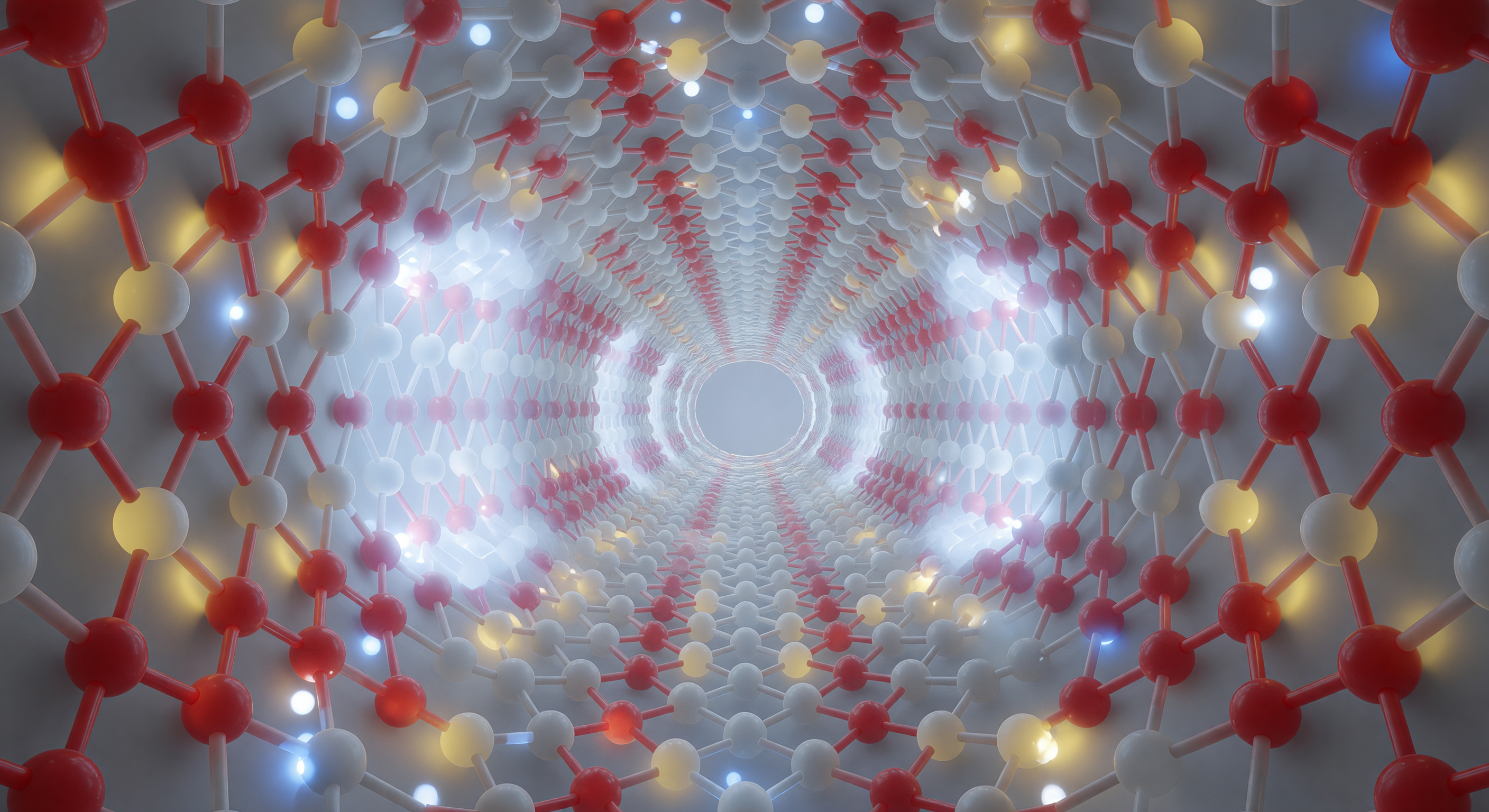
You are floating inside a crystalline labyrinth so narrow that the tunnel walls press in from every side at the distance of a single molecular diameter, the entire corridor — an ellipse barely 5.3 by 5.6 ångströms across — built from corner-sharing silicon-oxygen tetrahedra whose pale grey silicon nodes and vivid red oxygen bridges repeat with the unrelenting precision of a mineral crystal grown atom by atom over geological time. Ahead, successive ten-membered-ring portals recede in perfect perspective like the nave of a cathedral whose arches are made of covalent bonds rather than stone, and at a crossroads thirty ångströms forward, a second sinusoidal channel arrives at ninety degrees, creating a molecular junction where diffusing guests must squeeze through a bottleneck barely wider than a water molecule; scattered across these walls, intensely bright Brønsted acid sites mark the aluminum-substituted nodes where a single hydroxyl proton — a welding-arc pinpoint of reactivity — waits to protonate any hydrocarbon that approaches. ZSM-5 zeolite is a microporous aluminosilicate whose precisely engineered channel topology makes it one of the most commercially important catalysts on Earth, used industrially to crack petroleum and produce gasoline, its pore geometry exerting shape-selective control over which molecules can enter, react, and exit — a molecular sieve whose discrimination operates at the ångström level. Golden, space-filling hydrocarbon molecules pack the channel at near van der Waals contact with the oxygen-lined walls, their amber volumes conforming to the sinusoidal corrugation with an almost mechanical fit, held in place not by chemical bonds but by the cumulative whisper of London dispersion forces summed across an entire crystalline surface.
Other languages
- Français: Jonction des tunnels zéolite ZSM-5
- Español: Cruce de túneles zeolita ZSM-5
- Português: Junção de túneis zeólita ZSM-5
- Deutsch: Zeolith ZSM-5 Porentunnel-Kreuzung
- العربية: تقاطع أنفاق مسام زيوليت ZSM-5
- हिन्दी: जिओलाइट ZSM-5 सुरंग जंक्शन
- 日本語: ゼオライトZSM-5細孔トンネル交差点
- 한국어: 제올라이트 ZSM-5 기공 터널 교차로
- Italiano: Incrocio tunnel pori zeolite ZSM-5
- Nederlands: Zeoliet ZSM-5 poortunnel kruispunt