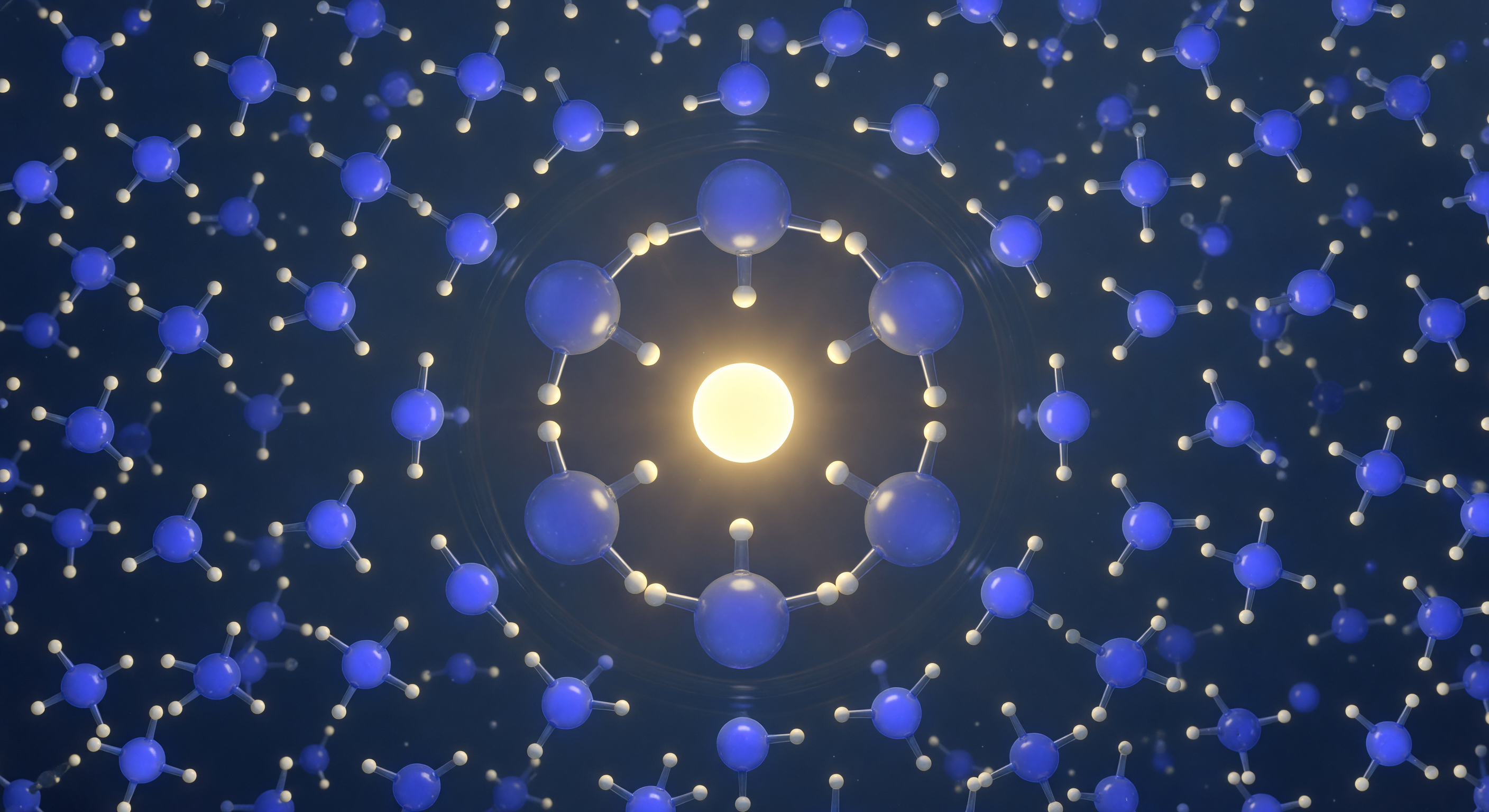
You are hovering at a distance smaller than a single nanometer from a sodium cation, close enough that the ion's electrostatic field is the dominant force shaping everything around you — no gravity, no wind, only the relentless pressure of concentrated positive charge radiating outward and bending the surrounding water into rigid, symmetrical submission. Six water molecules lock into an octahedral cage precisely 2.36 ångströms from the ion's nucleus, their electronegative oxygen faces wrenched inward by the Na⁺ field, their dipoles so strongly aligned that the hydrogen-bond order here is measurably higher than in bulk water — a genuine phase-like transition imposed by a single charged particle. Beyond this inner sanctum, a softer second shell of twelve to eighteen water molecules partially yields to the same ordering influence at roughly 4.5 ångströms, their alignment already fraying at the edges where thermal energy — on the order of kT, some 25 meV at room temperature — begins to compete with electrostatic coherence. Past 7 ångströms, the bulk hydrogen-bond network resumes its chaotic, picosecond-timescale restructuring, each molecule breaking and reforming bonds with its neighbors in a dense, restless churn that carries no memory of the ion's authority — a reminder that at this scale, order is always local, always borrowed, and always temporary.
Other languages
- Français: Puits de Solvatation du Sodium
- Español: Pozo Gravitacional del Ión Sodio
- Português: Poço de Solvatação do Íon Sódio
- Deutsch: Natriumion Solvatationshülle Gravitationsfeld
- العربية: بئر جاذبية غلاف أيون الصوديوم
- हिन्दी: सोडियम आयन विलायकीकरण कोश
- 日本語: ナトリウムイオン溶媒和殻の引力井戸
- 한국어: 나트륨 이온 용매화 껍질 중력장
- Italiano: Pozzo Gravitazionale dello Ione Sodio
- Nederlands: Natriumion Solvatatieschil Zwaartekrachtput