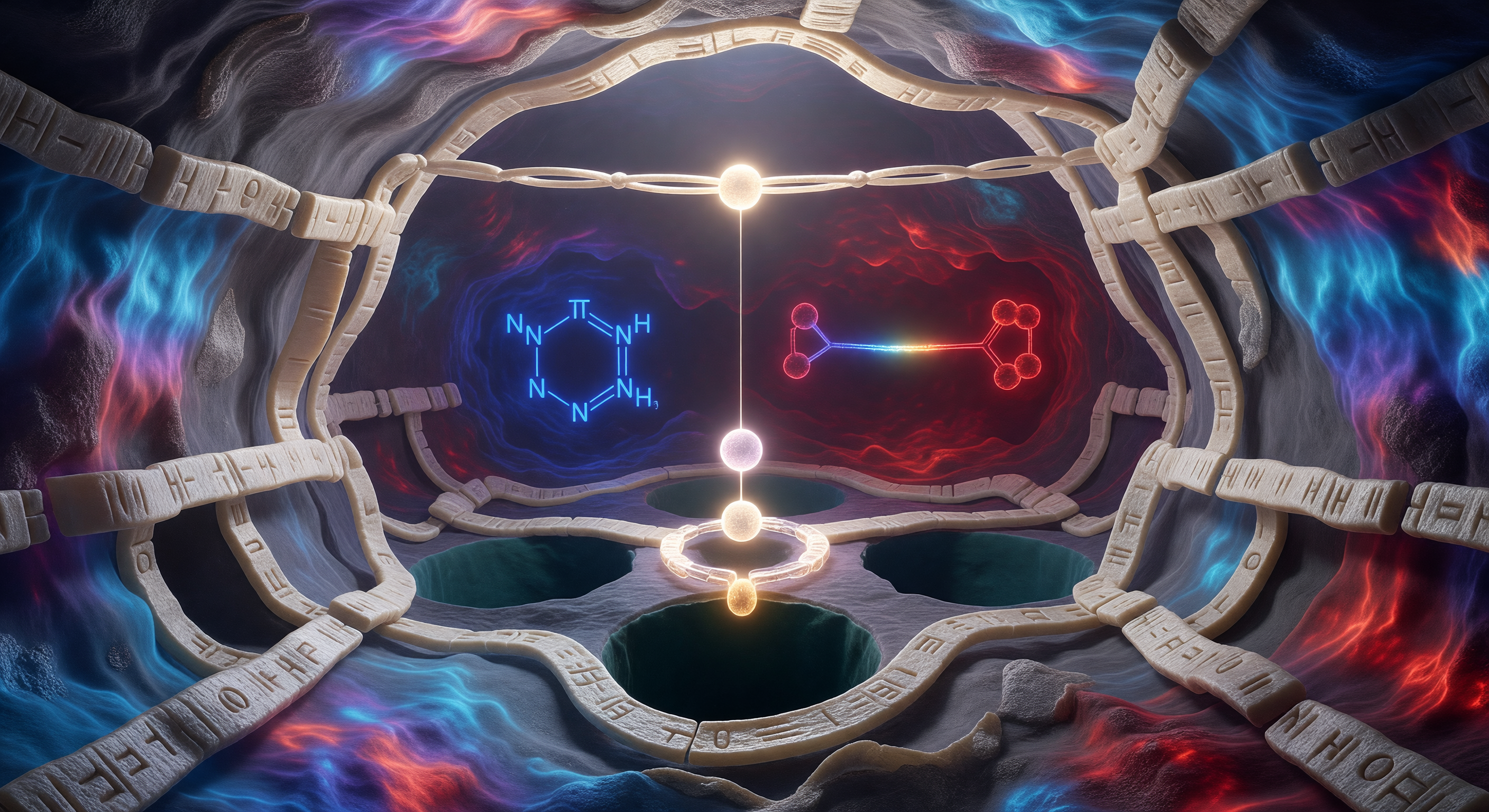
You are standing inside a catalytic pocket so small that the entire chamber spans barely fifteen ångströms from wall to wall, yet the architecture here has been refined by four hundred million years of evolutionary pressure into one of biochemistry's most precise reaction environments. The walls — pale ivory ribbons of beta-sheet and alpha-helix, their surfaces granular with the van der Waals radii of individual residues — glow in a continuous thermal electrostatic map: cool cerulean at the entrance bleeding through violet into deep scarlet at the rear, where the aspartate of the catalytic triad anchors its twin oxygens in burgundy charge against the back wall, stabilizing the entire network through electrostatic communication rather than covalent contact. Midway through the cavern, a histidine imidazole ring floats in electric cobalt blue, its π-electron cloud humming between two tautomeric states as a proton shuttle; directly below the substrate's scissile bond — which arches overhead like a luminous bridge, its carbonyl carbon suspended at approximately three ångströms of charged tension above the active-site floor — the hydroxyl oxygen of Serine 195 blazes white-gold, its lone pairs poised to launch a nucleophilic attack that will break the peptide bond in microseconds. Everything here vibrates: bond lengths oscillate on femtosecond timescales, side chains tremble through nanosecond fluctuations, and the ghost of recently expelled solvent water charges the pocket with an electric expectancy that is less metaphor than measurable electrostatic fact.
Other languages
- Français: Grotte du Site Actif Protéase
- Español: Cueva del Sitio Activo Proteasa
- Português: Caverna do Sítio Ativo Protease
- Deutsch: Höhle des Protease Aktivzentrums
- العربية: كهف الموقع الفعال للبروتياز
- हिन्दी: सेरीन प्रोटीज सक्रिय स्थल गुफा
- 日本語: セリンプロテアーゼ活性部位の洞窟
- 한국어: 세린 프로테아제 활성 부위 동굴
- Italiano: Grotta del Sito Attivo Proteasi
- Nederlands: Holte van het Actieve Protease Site