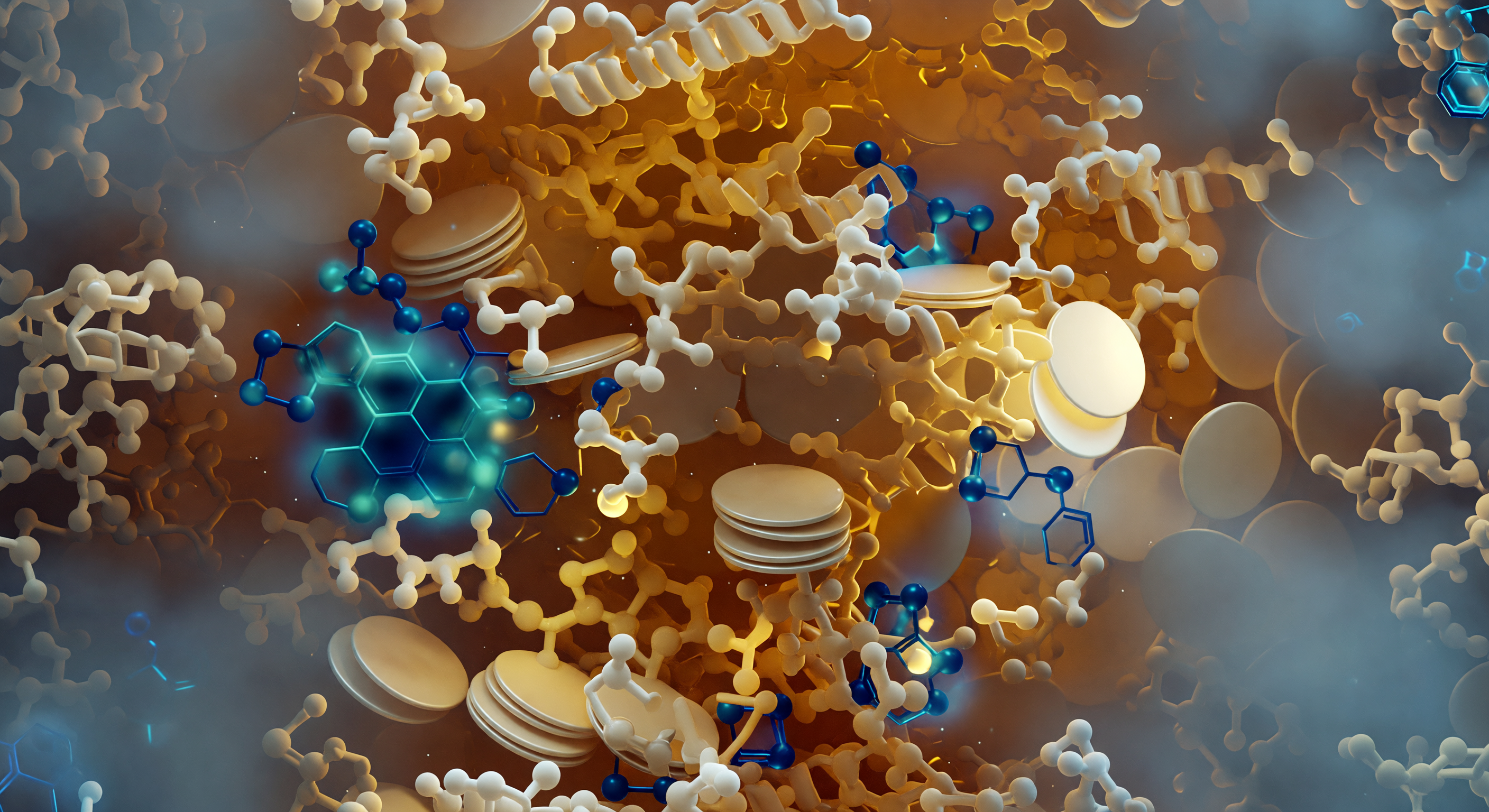
You are pressed into the amber heart of a folded protein, surrounded on every side by hydrocarbon chains and aromatic rings packed so tightly — at a density rivaling that of cut gemstone — that the nearest molecular surface is never more than a few ångströms away. Leucine and isoleucine branches interlock in warm ivory and beige, their methyl groups touching in soft van der Waals contacts at 3.5–4.0 Å, while phenylalanine rings slot between them like pale gold discs held in offset parallel planes by delocalized π-electron interactions. To one side, the bicyclic indole ring of a tryptophan residue radiates a deep teal-blue luminescence — its conjugated π system absorbing and re-emitting with a cooler hue that halos the surrounding amber chains in cold cerulean — and a buried methionine sulfur catches the ambient glow and returns it as a sharp metallic gleam. Far at the edge of perception, perhaps fifteen to twenty ångströms distant, the tight packing loosens almost imperceptibly and a diffuse cool blue-grey haze bleeds inward: the hydrophilic protein surface, where polar side chains surrender to the hydrogen-bonded disorder of bulk water, sealing this amber core from the aqueous world as completely as an insect sealed inside fossil resin.
Other languages
- Français: Cœur Hydrophobe Ambré Protéique
- Español: Interior Ámbar del Núcleo Hidrofóbico
- Português: Interior Âmbar do Núcleo Hidrofóbico
- Deutsch: Bernsteinfarbener Hydrophober Proteinkern
- العربية: قلب البروتين الكاره للماء العنبري
- हिन्दी: प्रोटीन हाइड्रोफोबिक कोर एम्बर आंतरिक
- 日本語: タンパク質疎水性コアの琥珀内部
- 한국어: 단백질 소수성 코어 호박빛 내부
- Italiano: Nucleo Idrofobico Proteico Ambrato
- Nederlands: Amberkleurig Hydrofobe Proteïnekern