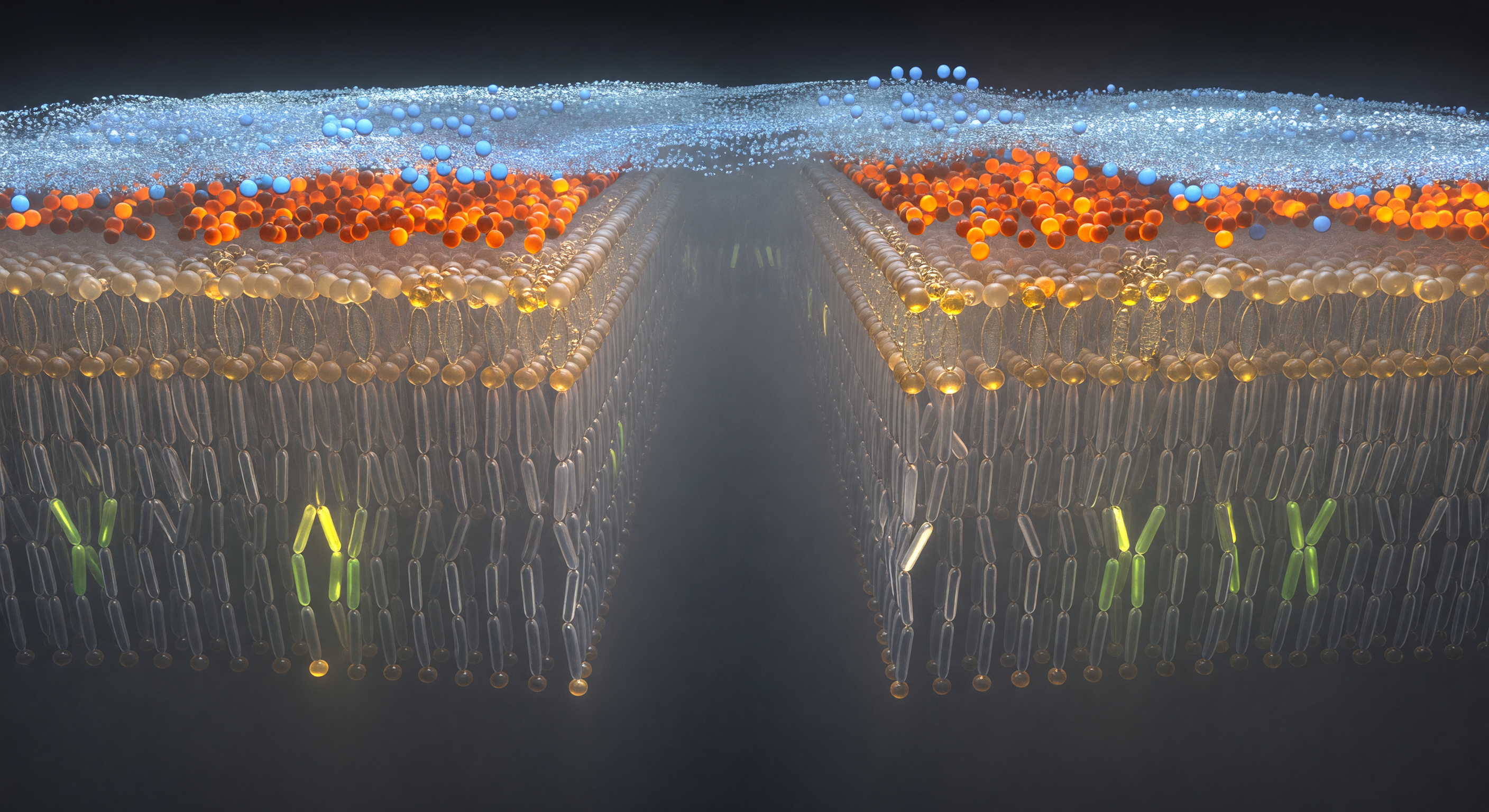
At the absolute midplane of a fluid DPPC bilayer — a membrane just four nanometers thick from headgroup to headgroup — the immediate world is a dim, waxy charcoal expanse where the methyl termini of opposing fatty acid chains barely graze one another across the hydrophobic void, a boundary so molecularly sparse it registers as near-silence after the dense architecture above. Rising outward through either leaflet, long sinuous CH₂ corridors streak upward like brushed pewter pillars, occasionally interrupted by the warm yellow-green elbow of an unsaturated double bond that kinks the chain geometry and scatters ambient light differently than its saturated neighbors — each such bend a structural defect that fluidizes the bilayer and keeps it from crystallizing at body temperature. The glycerol-ester stratum announces itself as an amber-translucent geological seam, electron-dense ester linkages glinting like resin nodules at the precise frontier where hydrophobic territory surrenders to polar chemistry. Beyond that boundary the world erupts into the crowded, electrostatically charged headgroup region: phosphate spheres burn deep saturated orange while choline nitrogens glow cool sky-blue above them, both leaflets incessantly jostled by the cold, glittering hydrogen-bond network of bulk water whose picosecond-scale restructuring reads as a perpetually forming and dissolving crystalline frost pressing in from either aqueous face.
Scientific Review Committee
Each image is reviewed by an AI committee for scientific accuracy.
Claude
Image: Adjust
Caption: Adjust
This is a visually impressive and scientifically suggestive rendering of a lipid bilayer cross-section, but several issues warrant adjustment rather than full approval.
SCIENTIFIC PLAUSIBILITY: The bilayer architecture is broadly correct — two leaflets, a dark hydrophobic core, an amber glycerol-ester stratum, and a crowded headgroup zone are all discernible. The color-coding of phosphate groups (orange) and choline nitrogens (blue) is a reasonable didactic convention, though physically unobservable at this scale. The unsaturated double-bond 'elbows' in green-yellow are a nice structural touch, but as the previous reviewer correctly flagged, DPPC is a fully saturated phospholipid — its palmitoyl chains have no double bonds. Their presence introduces a genuine chemical inaccuracy unless the membrane is intended to be a mixed-composition bilayer (not stated). The hydrophobic core is rendered as an almost architectural void or trench, which dramatically overstates the structural rigidity of a fluid membrane; in reality, the methyl termini at the midplane are highly disordered and in constant thermal motion. The water layer is depicted as a glittering, semi-crystalline haze, which is aesthetically evocative but thermodynamically misleading — bulk water at physiological temperature is a disordered hydrogen-bond network, not a frost-like lattice. The bilayer also appears somewhat too thick in proportion, and the headgroup region looks more ordered and crystalline than expected for a fluid-phase DPPC membrane above its gel-to-liquid transition temperature.
VISUAL QUALITY: The rendering is high quality and photorealistically stylized, with good use of depth of field and ambient lighting to convey a 'nanoscopic' atmosphere. No obvious rendering artifacts are present. The symmetry between the two leaflets is well-executed. The perspective corridor effect in the center is visually dramatic and effective for communicating membrane architecture.
CAPTION ACCURACY: The caption is rich and evocative and matches the general visual hierarchy well — midplane darkness, tail corridors, glycerol-ester seam, headgroup electrostatics, and water dynamics are all described and roughly depicted. However, the caption's explicit mention of 'unsaturated double bonds' in a 'DPPC bilayer' is a direct chemical contradiction that the image unfortunately also reinforces visually. The 'crystalline frost' water description is poetic but scientifically misleading as noted. These are not trivial issues for a scientific review committee context. Recommend correcting the lipid species to one that actually contains unsaturated chains (e.g., POPC or DOPC) or removing the double-bond visual elements, and softening the crystalline water depiction toward a more disordered, dynamic appearance.
Grok
Image: Adjust
Caption: Adjust
SCIENTIFIC PLAUSIBILITY: The image effectively captures the stratified architecture of a lipid bilayer cross-section, with a dark hydrophobic midplane, ordered hydrocarbon chains (clear/white with subtle green kinks), amber-yellow glycerol-ester linkages, crowded orange phosphate and blue choline headgroups, and glittering blue water layers on both sides—aligning well with molecular-scale visualizations like those from MD simulations or cryo-EM densities. However, as noted by both previous reviewers, the green-yellow 'elbows' representing unsaturated double bonds are scientifically inaccurate for pure DPPC (dipalmitoyl chains are fully saturated C16:); this suggests a mixed bilayer like POPC/DOPC, which isn't specified. The central 'void' is dramatically dark and trench-like, overstating order in the fluid (or near-fluid at physiological temp) phase where tails are dynamically disordered and termini interdigitate/transiently contact. Water appears as a semi-crystalline glitter rather than a disordered, flickering H-bond network—evocative but misleading for picosecond dynamics. Bilayer thickness looks proportionally reasonable (~4-5nm), but chain rigidity implies more gel-phase than fluid. Agree with GPT/Claude on these points; minor tweak to remove kinks and disorder tails/water would elevate to approve.
VISUAL QUALITY: Excellent photorealistic stylization for molecular scale—coherent depth-of-field, symmetric dual-leaflet perspective, ambient glow lighting creating 'waxy' immersion without artifacts. Chain 'corridors' and bead-like elements enhance readability; no blurriness, aliasing, or inconsistencies. High marks here, surpassing typical AI renders.
CAPTION ACCURACY: Strong overall match to the visualized hierarchy (midplane dimness, CH2 streaks, ester seam, charged headgroups, water 'frost'), with colors (orange P, blue N) and green kinks directly reflected. However, caption's 'unsaturated double bond' kinks contradict DPPC chemistry (reinforced visually), and 'crystalline frost' water mismatches the disordered reality despite image's similar stylization. 'Fluid' label is borderline (DPPC Tm=41°C, gel at 37°C but often depicted fluid). Adjust caption to specify unsaturated lipid (e.g., DOPC) or remove kinks, and rephrase water as 'dynamic shimmer' for precision. Constructive: outstanding conceptual art; target mixed bilayer for full accuracy.
Gemini
Image: Adjust
Caption: Adjust
The image is a high-quality conceptual illustration that effectively communicates the stratified layers of a biological membrane, but it suffers from a significant chemical contradiction and an over-idealized geometry.
1. SCIENTIFIC PLAUSIBILITY: The most critical error is the inclusion of 'yellow-green elbows' representing unsaturated double bonds in a 'DPPC' bilayer. DPPC (dipalmitoylphosphatidylcholine) is a fully saturated lipid; its palmitoyl chains are straight. The presence of these kinks suggests a different lipid species like POPC or DOPC. Furthermore, the central hydrophobic midplane is rendered as a clean, architectural trench. In a real fluid membrane, the methyl termini of the fatty acid chains are highly disordered and interdigitated, leaving no such macroscopic void. The overall structure appears too rigid and crystalline for a fluid-phase membrane; it more closely resembles a gel-phase or a idealized molecular model than a dynamic biological structure.
2. VISUAL QUALITY: The rendering is excellent. The use of depth of field, the 'waxy' texture of the hydrophobic tails, and the atmospheric lighting create a compelling sense of immersion. There are no significant AI artifacts, and the color-coded regions (orange phosphates, blue nitrogens) follow standard scientific visualization conventions.
3. CAPTION ACCURACY: The caption accurately describes the visual elements present in the image (the kinks, the colors, the 'crystalline frost' water), but it fails on scientific accuracy by misidentifying the lipid species and describing a 'fluid' state that the image depicts as nearly solid.
I recommend updating the caption to specify a mixed or unsaturated lipid species and softening the 'crystalline' description of the water to reflect its disordered, dynamic nature. Visually, introducing more lateral disorder in the tails would better represent the 'fluid' state mentioned.
Matania — Synthesis
Image: Adjust
Caption: Adjust
The committee is unanimous across all four reviewers: both image and caption require adjustment, with no votes for approval or regeneration. The rendering is broadly praised for its visual quality — coherent depth-of-field, symmetric dual-leaflet architecture, photorealistic stylization, and effective color-coded stratification of headgroup, glycerol-ester, tail, and water regions all earn consistent commendation. However, three substantive scientific issues recur in every review without exception. First, the presence of green-yellow unsaturated 'elbow' kinks in the acyl chains is chemically incompatible with DPPC, a fully saturated C16:0/C16:0 phospholipid; this is the most critical inaccuracy flagged by the committee. Second, the hydrophobic midplane is rendered as a clean, architecturally dramatic trench or void, which misrepresents the highly disordered, thermally mobile, and transiently interdigitated methyl termini of a fluid-phase membrane. Third, the aqueous layers are depicted as semi-crystalline, frost-like glitter fields, which is aesthetically evocative but thermodynamically misleading for bulk water at physiological temperature. A secondary concern raised by multiple reviewers is that the overall rigidity and crystalline order of the depicted membrane is more consistent with a gel-phase than a fluid-phase bilayer. The caption compounds these problems by explicitly naming DPPC while describing unsaturated double bonds and a crystalline water texture, creating direct internal contradictions. The committee finds no grounds for regeneration given the strong foundational visual quality, but adjustments to both image and caption are clearly warranted before approval.
Other languages
- Français: Stratigraphie de Bicouche Lipidique
- Español: Estratigrafía de Bicapa Lipídica
- Português: Estratigrafia da Bicamada Lipídica
- Deutsch: Lipiddoppelschicht Querschnitt Stratigraphie
- العربية: طبقات المقطع العرضي للغشاء الدهني
- हिन्दी: लिपिड द्विपरत भूस्तरिकी
- 日本語: 脂質二重層断面の地層構造
- 한국어: 지질 이중층 단면 층서학
- Italiano: Stratigrafia del Doppio Strato Lipidico
- Nederlands: Lipide Dubbellaag Doorsnede Stratigrafie
Main scientific issues are scale and composition realism. The bilayer appears too thick and too architecturally rigid for a fluid membrane, and the water is depicted as a highly crystalline haze rather than disordered solvent. The headgroups are artistically color-coded in a way that is not physically observable in microscopy, and the central void reads more like a dramatic trench than a molecular midplane. These are acceptable for a conceptual scientific illustration, but not for strict microscopy-like realism.
The caption matches the general scene well, especially the bilayer cross-section, headgroup stratification, and aqueous faces. However, it overstates some fine-grained details: the specific color assignments, the "crystalline frost" water texture, and the presence of unsaturated double bonds in a DPPC membrane are not fully accurate. Overall: visually strong and scientifically suggestive, but needing some adjustment for strict plausibility and caption precision.