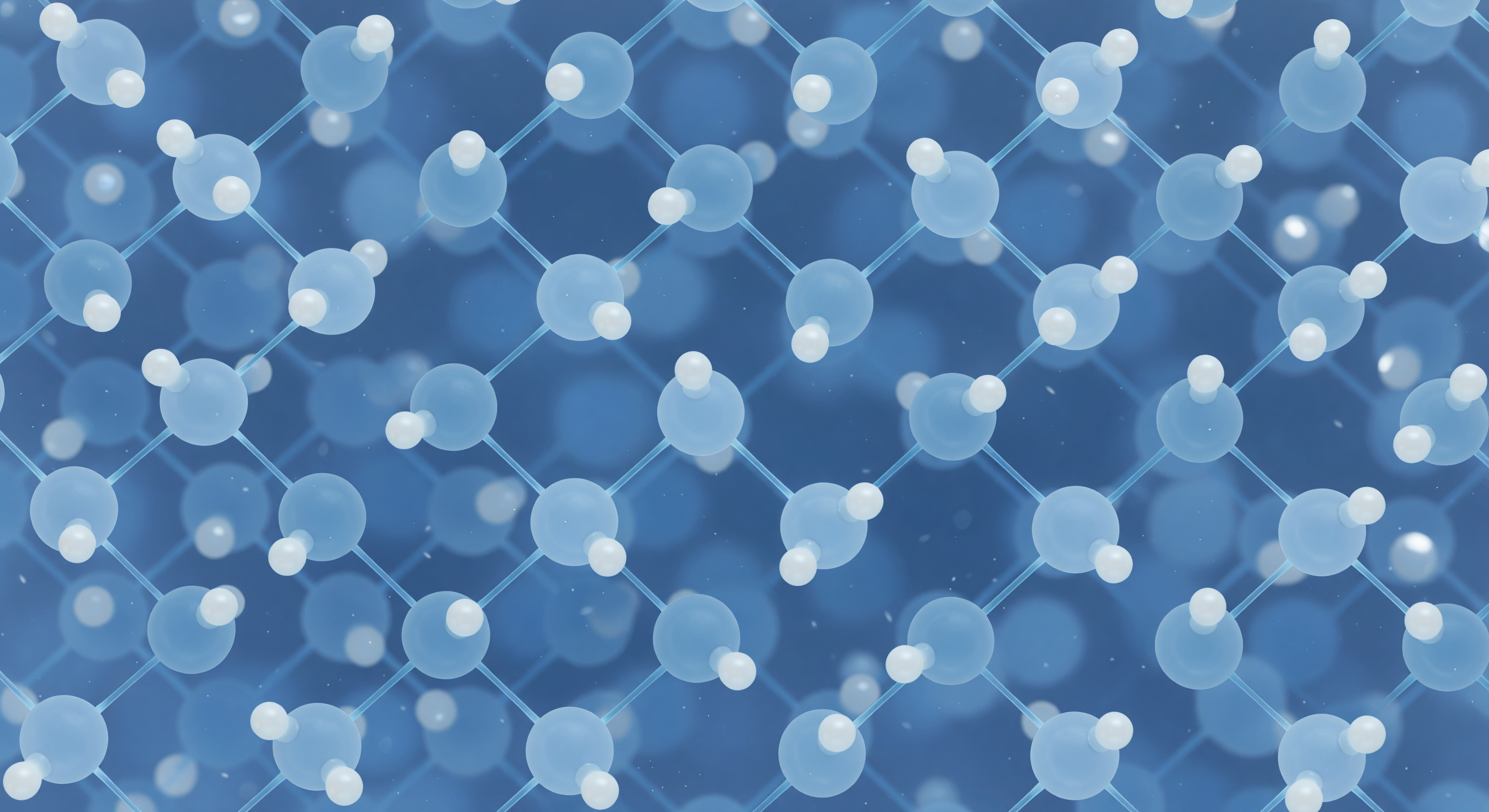
You are suspended inside liquid water — not observing it, but enclosed within it, surrounded in every direction by pale-blue translucent oxygen spheres pressing close at oxygen-to-oxygen spacings of just 2.75 Å, so near that the concept of empty space becomes meaningless. Each bent molecule carries two bright proton lobes angled at 104.5°, and between neighboring pairs, cyan hydrogen bonds — flickering threads of shared electron density — pulse and snap on picosecond timescales, too fast for any single event to register as discrete motion, perceived instead as a collective, living tremor running through the entire lattice. This is liquid water at 300 K: not the featureless solvent of intuition, but a dense, constantly rewiring hydrogen-bond network in which every molecule simultaneously donates and accepts bonds, achieving no fixed crystal order yet never collapsing into chaos. Beyond three or four molecular diameters, successive shells of molecules thicken into a deep cerulean haze, compressing the visual field into an intimate radius of resolution — only a handful of fully-formed neighbors visible before the world dissolves into indigo depth. The light has no source; it diffuses outward from the electron clouds of oxygen itself, scattering through overlapping shells until the entire environment glows cold and aqueous, simultaneously claustrophobically close and boundlessly infinite, the most abundant molecule on Earth revealed as a ceaselessly breathing, alien cosmos.
Other languages
- Français: Au Cœur du Réseau Aqueux
- Español: Dentro de la Red Acuosa
- Português: Interior da Rede Líquida
- Deutsch: Im Flüssigen Wassernetzwerk
- العربية: داخل شبكة الماء السائل
- हिन्दी: तरल जल नेटवर्क के भीतर
- 日本語: 液体水素結合網の内側
- 한국어: 액체 수소 결합망 내부
- Italiano: Dentro la Rete Acquosa
- Nederlands: In het Vloeibare Waternetwerk