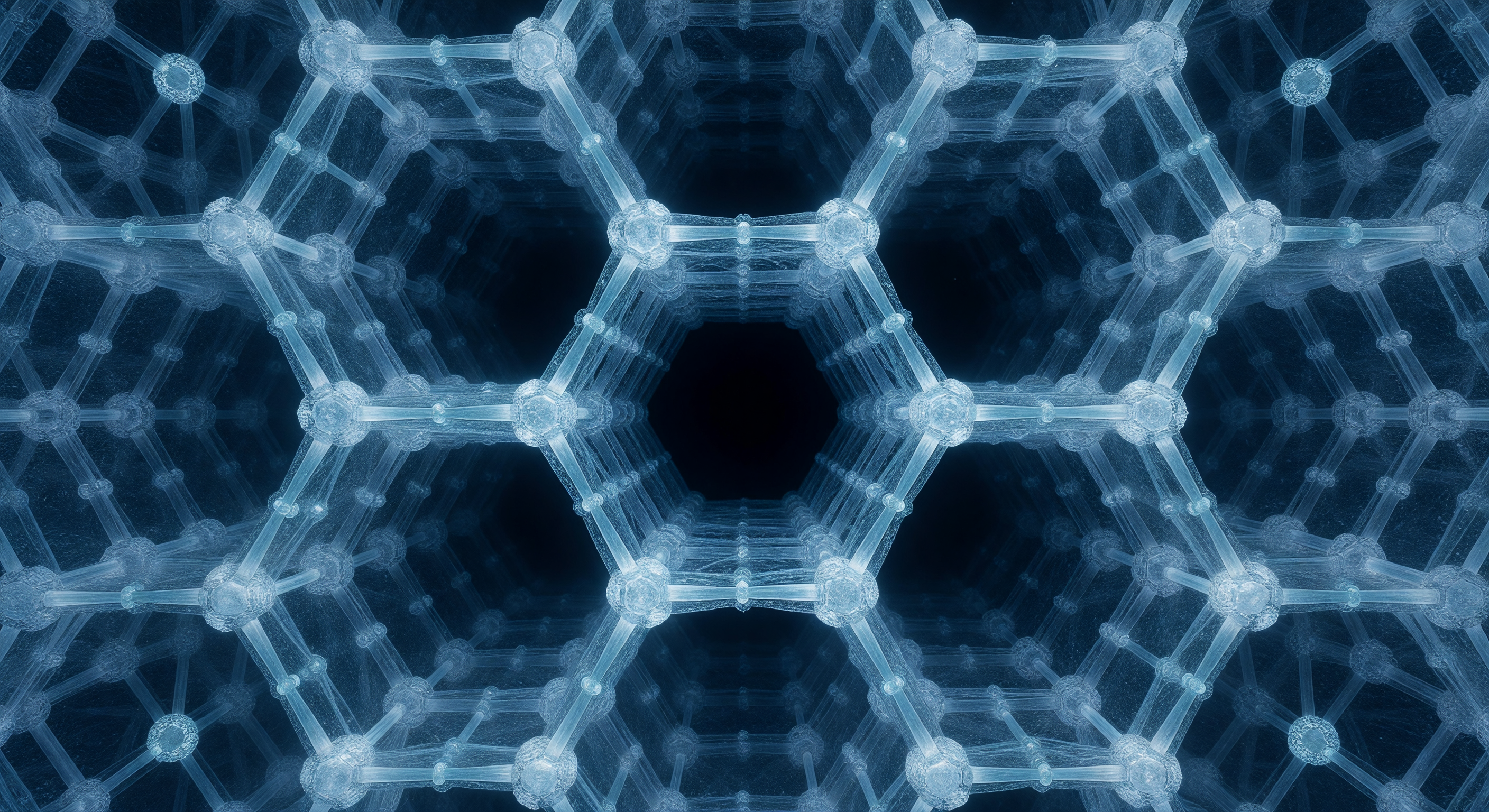
Looking straight down the crystallographic c-axis, the viewer is drawn into an infinite honeycomb cathedral of pale turquoise and deep blue-black, where each water molecule sits anchored at its lattice point like a frosted lantern, connected to four nearest neighbors by gently luminous hydrogen bonds spanning just 2.76 Å in perfect tetrahedral geometry. The commanding feature of this world is the series of hexagonal voids punched clean through the lattice at regular intervals — not empty in any casual sense, but structural absences born of tetrahedral bonding geometry that refuses to close-pack, and it is precisely these channels that give ice its anomalously low density compared to liquid water. At each bond, a subtle double shadow betrays proton disorder: the hydrogen is not fixed but statistically displaced toward one oxygen or the other, the probabilistic blur that Linus Pauling recognized in 1935 as an intrinsic residual entropy frozen into the crystal. The lattice-light seems to originate from within the structure itself — cold, sourceless, blueish-white at the nearest molecular nodes and deepening to saturated teal-indigo as crystallographic depth accumulates — while a faint softness at every molecular contour speaks to the thermal vibrations still alive at −10°C, causing the most distant visible layers to dissolve into a luminous, quietly trembling haze.
Other languages
- Français: Réseau Hexagonal de Glace Vu d'En Haut
- Español: Red Hexagonal de Hielo Desde Arriba
- Português: Rede Hexagonal de Gelo Vista de Cima
- Deutsch: Hexagonales Eisgitter Von Oben
- العربية: شبكة الجليد السداسية من الأعلى
- हिन्दी: षट्कोणीय बर्फ जाली ऊपर से
- 日本語: 六角形の氷格子を真上から
- 한국어: 위에서 본 육각 얼음 격자
- Italiano: Reticolo Esagonale di Ghiaccio Dall'Alto
- Nederlands: Hexagonaal IJsrooster Van Bovenaf