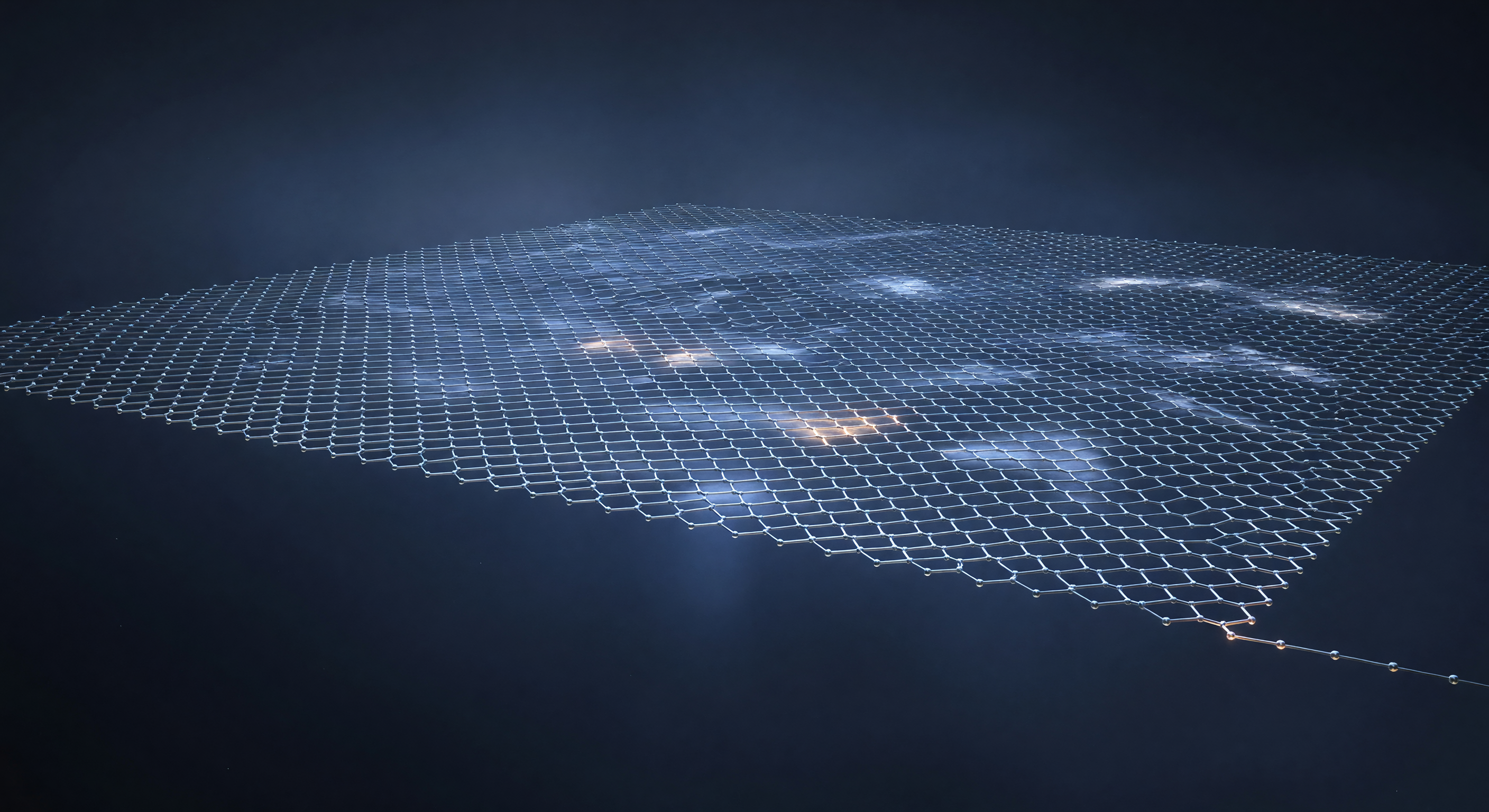
You stand at the absolute edge of a world one atom thick — the graphene sheet extending before you as a razor-dark discontinuity against vacuum, its boundary not quite a surface in any classical sense but a crystallized mathematical plane where carbon atoms line up like sentinels along a frontier that has no depth whatsoever, their dangling bonds glowing faintly amber where the hexagonal lattice terminates and electron clouds dissolve into emptiness. Wheeling upward to look down across the top-down expanse, the entire visible universe becomes a silver-blue hexagonal chainmail of sp²-hybridized carbon rings, each 1.42 Å carbon-carbon bond a node of elevated electron density within a continuous delocalized π-electron cloud that lends the whole infinite surface a cold metallic iridescence reminiscent of polished platinum — this is not a thin coating of metal but something stranger, a purely two-dimensional conductor where electrons flow through conjugated orbitals spread simultaneously above and below a plane of zero measurable thickness. Long-wavelength flexural phonons — quantized rippling vibrations with wavelengths stretching from tens to hundreds of nanometers — roll across the flatland in slow frozen swells, bowing the otherwise mathematically perfect lattice into gentle topographic undulations that distort the hexagonal symmetry at their crests like a geometric tide. Then, mid-distance, the perfection ruptures: a Stone-Wales defect, born from a single 90° bond rotation during formation, fuses one pentagon to one heptagon and traps localized electronic states that glow a distinct warm orange against the surrounding cold blue — a topological scar, an ember pressed into frost, radiating its energy signature outward through a dozen lattice rings before the crystalline order reasserts itself and the silver-blue chainmail resumes its silent, flawless extension toward every horizon.
Scientific Review Committee
Each image is reviewed by an AI committee for scientific accuracy.
GPT
Image: Adjust
Caption: Adjust
The image is broadly consistent with a stylized graphene sheet at molecular scale: the hexagonal carbon lattice is recognizable, the sheet is effectively one-atom thick, and the cool metallic blue tone fits a visualization of delocalized electronic density rather than literal color. The edge-on perspective is also appropriate for the title. However, there are some scientific and visual caveats. The lattice is rendered as a clean wireframe with prominent glowing nodes, which is more illustrative than physically realistic microscopy. The “dangling bonds” at the edge are hinted at with warm orange highlights, but the edge termination is not clearly chemically specific, and the single line of atoms extending off the lower right edge looks slightly ambiguous. The rippling topography is plausible in principle, though the amplitude and smoothness read more as artistic than atomistically exact. The caption matches the scene well overall, including the graphene sheet, edge, flexural ripples, and localized warm defect regions, but it overstates the visual evidence for a clearly identifiable Stone-Wales defect and localized electronic states, which are not unambiguously depicted. Overall: strong scientifically inspired visualization, but minor realism and annotation precision issues prevent full approval.
Claude
Image: Adjust
Caption: Adjust
I largely concur with the previous reviewer's assessment but want to add several specific observations. On scientific plausibility: the hexagonal sp²-hybridized lattice geometry is correctly rendered with the characteristic honeycomb topology, and the cool silver-blue metallic iridescence is a reasonable artistic proxy for the delocalized π-electron cloud. The long-wavelength flexural undulations visible mid-sheet are scientifically defensible — graphene is known to exhibit intrinsic thermal rippling with amplitudes on the order of 1 nm and wavelengths of tens of nanometers, and the gentle topographic swells here read as plausible phonon-scale deformations. The warm amber/orange nodes near the sheet interior are presumably the Stone-Wales defect signature, and the color contrast against the cold blue lattice is scientifically motivated — localized electronic states at topological defects do produce distinct density-of-states signatures. However, the defect region is insufficiently resolved to clearly distinguish the characteristic pentagon-heptagon pair that defines a Stone-Wales defect; it reads more generically as 'bright spots' than as a topologically specific structural feature. A scientifically rigorous depiction would show distorted ring geometry. On the edge termination: the lower-right dangling chain of nodes with warm coloring is evocative of edge states and dangling bonds, but the geometry looks like a simple linear chain rather than a properly terminated zigzag or armchair edge — graphene edges have crystallographically specific terminations with distinct electronic properties, and this distinction matters at this scale. The armchair vs. zigzag edge chirality is entirely absent. On visual quality: the rendering is polished and coherent as a stylized molecular visualization. The perspective projection is well-chosen, balancing the edge-on and top-down views described in the caption. Node spheres at atomic positions are slightly oversized relative to the bond lengths shown, which is a common illustrative compromise but reduces atomistic realism. The background vacuum treatment is clean and appropriate. The galaxy-like luminous clouds visible through the lattice are aesthetically compelling but have no physical basis at this scale and could confuse the viewer into thinking these represent something physically meaningful — they should be reconsidered. On caption accuracy: the description is richly detailed and mostly consistent with the image, but it overclaims on the Stone-Wales defect identification and the edge termination specificity. The caption's mention of 1.42 Å bond lengths is correct physics but unverifiable from the image alone. The 'zero measurable thickness' claim is philosophically accurate but the rendered nodes give the sheet an apparent thickness, creating a minor visual contradiction. Overall this is a high-quality scientifically inspired visualization requiring targeted adjustments to defect geometry, edge chirality, and removal of the unphysical background luminosity to reach approval standard.
Grok
Image: Adjust
Caption: Adjust
I agree with both previous reviewers' 'adjust' votes, as the image delivers a strong, coherent stylized visualization of graphene at the molecular scale but falls short of full scientific precision in key details. Scientific plausibility: The hexagonal honeycomb lattice correctly captures sp² carbon geometry with ~1.42 Å bonds implied by node spacing, and the silver-blue iridescence evokes the delocalized π-electron cloud effectively for a 2D conductor. Flexural phonons are well-represented by the gentle, wavelength-appropriate ripples (tens of nm scale visually), consistent with graphene's thermal undulations. Edge-on view emphasizes the 'one-atom-thick' flatland aptly, with vacuum discontinuity. However, the edge termination is problematic—a dangling linear chain of orange-glowing atoms in the lower right suggests unsaturated bonds but lacks crystallographic specificity (no clear zigzag or armchair reconstruction, which dictate edge states); real graphene edges saturate or reconstruct. The mid-sheet orange clusters plausibly represent localized states at defects, but they appear as generic bright nodes rather than a resolved Stone-Wales 5-7-7-5 topology with distorted rings—Claude's point on this is spot-on, as the structure isn't verifiable. No unphysical galaxy clouds are evident here, unlike Claude's note (perhaps image variant). Visual quality: Photorealism impossible at atomic scale, but stylization is polished and immersive—glowing wireframe nodes/bonds are standard for molecular viewers (e.g., like PyMOL), perspective blends edge-on/top-down seamlessly, ripples add dynamic topography without artifacts, dark vacuum BG enhances scale. Minor nit: atomic spheres slightly oversized vs. bonds, giving subtle apparent thickness contradicting 'zero thickness.' Caption accuracy: Excellent poetic match to visuals (edge sentinels, amber dangling bonds, blue chainmail, rippling tides, orange defect ember), but overclaims specificity—the Stone-Wales is not unambiguously 'one pentagon to one heptagon' (just glow), edge lacks 'dissolving electron clouds' detail, and phonon wavelengths/bond lengths unmeasurable from image. Constructive adjustments: Sharpen defect to explicit 5-7 ring pair with radial distortion; specify edge as zigzag (common, metallic states) with proper bond angles; reduce node size for flatter 2D illusion; caption could soften defect ID to 'defect-like glow suggestive of Stone-Wales.' Overall, evocative and educationally valuable—minor tweaks elevate to approve.
Gemini
Image: Adjust
Caption: Adjust
The visualization effectively captures the essence of a two-dimensional material, using a silver-blue palette that successfully evokes the delocalized π-electron system of graphene. The flexural phonons (ripples) are well-rendered and provide a necessary sense of physical scale and thermal dynamics. However, there are several points requiring adjustment for scientific accuracy. First, the 'Stone-Wales defect' described in the caption as a pentagon-heptagon pair is rendered only as a color change (orange glow) without any actual topological rearrangement of the hexagonal lattice; a true representation should show the bond rotation and resulting geometric distortion. Second, the 'edge' in the bottom right corner features a non-physical linear chain of atoms trailing off into space, which contradicts the crystalline rules of sp² carbon. Real graphene edges would terminate in specific armchair or zigzag configurations, often saturated by functional groups. Third, while the caption claims an 'edge-on' view, the perspective is actually a high-angle oblique view; a true edge-on perspective would emphasize the one-atom thickness as a singular line. Finally, the atomic spheres are slightly too large relative to the bonds, which gives the sheet an artificial 'thickness' that conflicts with the 'zero measurable thickness' mentioned in the text. Refining the defect geometry and cleaning up the edge termination would significantly improve the scientific value of the image.
Matania — Synthesis
Image: Adjust
Caption: Adjust
The committee reached unanimous consensus on adjust verdicts for both image and caption, with no dissenting votes across all four reviewers. The visualization is broadly praised as a polished, coherent, and educationally compelling stylized representation of graphene at molecular scale. The hexagonal sp²-hybridized honeycomb lattice geometry is correctly rendered, the silver-blue iridescence is a scientifically defensible proxy for the delocalized π-electron cloud, and the long-wavelength flexural ripples are well-motivated by graphene's known intrinsic thermal undulations. The edge-on oblique perspective is considered well-chosen. However, the committee identified four recurring and substantive scientific deficiencies that prevent approval. First, the Stone-Wales defect is rendered only as a warm amber glow without any topological rearrangement of the hexagonal lattice — no pentagon-heptagon pair geometry, no bond rotation, no ring distortion — reducing it to an ambiguous bright spot rather than a structurally specific feature. Second, the edge termination in the lower right presents a non-physical linear dangling chain of nodes rather than a crystallographically valid zigzag or armchair termination, erasing the scientifically meaningful chirality distinction that governs edge electronic states. Third, atomic node spheres are consistently judged oversized relative to bond lengths, imposing an apparent thickness that visually contradicts the zero-thickness claim central to the graphene concept. Fourth, the caption overclaims specificity on both the defect identification and edge termination, asserts bond lengths that are physically correct but unverifiable from the image, and uses language that implies structural precision the image does not deliver. One reviewer also flagged unphysical luminous background clouds as a potential source of viewer confusion, though this was not universally observed across all image variants reviewed. The caption's poetic register is appreciated but must be reconciled with its scientific claims.
Other languages
- Français: Graphène Plat Atomique Tranché
- Español: Grafeno Plano Atómico de Canto
- Português: Grafeno Plano Atômico de Perfil
- Deutsch: Graphen Atomares Flachland Kante
- العربية: غرافين مستوٍ ذري من الجانب
- हिन्दी: ग्राफीन परमाणु समतल किनारा
- 日本語: グラフェン原子平面エッジ視点
- 한국어: 그래핀 원자 평면 측면도
- Italiano: Grafene Piano Atomico di Taglio
- Nederlands: Grafeen Atomair Vlakland Zijkant