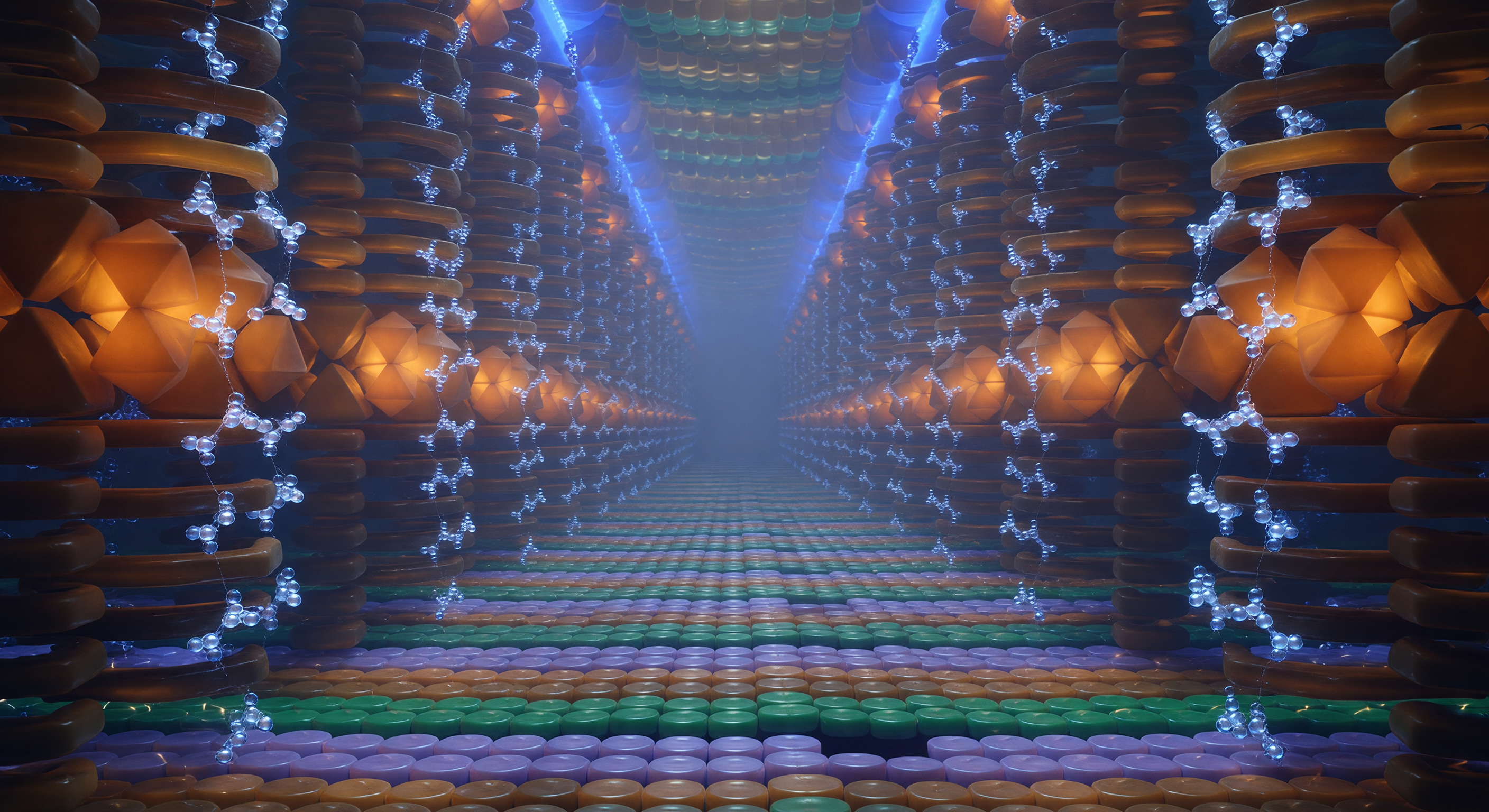
You stand at the bottom of a canyon that has no geological age — carved not by water or wind but by the precise logic of base-pairing and phosphodiester bonds, its walls built fresh at every cell division and read continuously by proteins that must find their footing on this same uneven terrain. The groove enclosing you is the major groove of B-form DNA: 22 ångströms wide and lined on both sides by the sugar-phosphate backbone, whose deoxyribose rings arch upward in bronze pentagonal frames while the phosphate groups project outward as rust-orange tetrahedra, each one slicked with an ordered shell of water molecules arranged in pearl-like hydrogen-bonded chains — the spine of hydration that stabilizes the helix and helps transcription factors recognize their binding sites without ever touching the bases directly. Beneath your feet, the groove floor is a mosaic of stacked base-pair discs — teal adenine against sienna thymine, forest-green guanine against lavender cytosine — separated by 3.4-ångström π-stacking gaps, those hairline shadows where aromatic electron clouds overlap just enough to contribute several kilocalories per mole of stabilizing energy to the entire double-helical architecture. The negatively charged phosphate backbone floods the atmosphere with a deep cobalt electrostatic field, a volumetric blue fog that grows denser toward the walls and draws counterions and water into the groove, making the medium around you not empty space but a dense, electrostatically sculpted aqueous environment where every surface trembles with thermal vibration at frequencies measured in femtoseconds — geometry that is real and precise but never, even for an instant, entirely still.
Other languages
- Français: Traversée du Grand Sillon ADN
- Español: Travesía del Gran Surco del ADN
- Português: Travessia do Sulco Principal do DNA
- Deutsch: Durchquerung der DNA-Hauptfurche
- العربية: عبور الأخدود الرئيسي للحمض النووي
- हिन्दी: डीएनए मेजर ग्रूव घाटी पार
- 日本語: DNA主溝峡谷の横断
- 한국어: DNA 주요 홈 협곡 횡단
- Italiano: Traversata nel Solco Maggiore del DNA
- Nederlands: Doorsteek door DNA-hoofdgroef