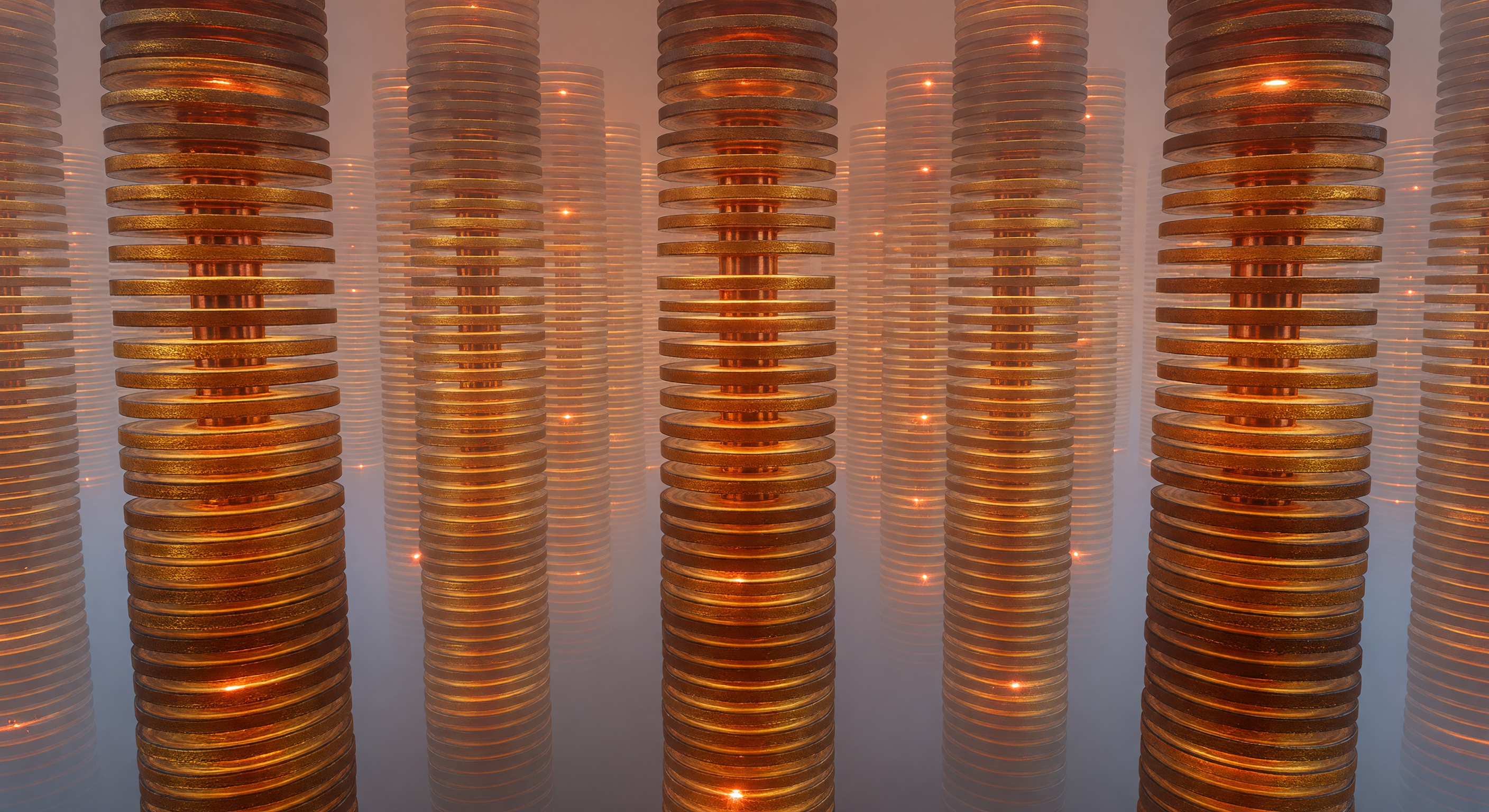
The viewer stands at the base of an infinite colonnade of coronene columns rising through an organic crystal, each aromatic disc roughly 9 ångströms across and separated from its neighbour by only 3.4 ångströms — the same interval that governs the interlayer spacing of graphite, a distance set by the equilibrium between π-electron repulsion and dispersive van der Waals attraction. Coronene is a polycyclic aromatic hydrocarbon of twelve fused benzene rings whose sp²-hybridized carbon framework forces every atom into a single plane, allowing the π-electron clouds above and below each disc to overlap with those of adjacent molecules in the stack, producing the shared luminous halos visible at every inter-disc gap — genuine electron density merging into a quasi-continuous conjugated pathway along which polarons, charge carriers dressed in local lattice distortion, hop between molecules in bursts that appear here as electric-orange flashes. The hexagonal crystal packing places each column within van der Waals contact of its neighbours, the inter-column space filled not with vacuum but with the diffuse, opalescent haze of weak dispersive interactions — forces negligible at human scales yet here the sole architecture holding an entire ordered solid together. Standing inside this structure is to inhabit a world where gravity has no jurisdiction, where thermal vibrations shake every disc by a fraction of a bond length sixty times per picosecond, and where the amber glow of delocalized aromatic electrons is not metaphor but a direct translation of quantum mechanical reality into light.
Other languages
- Français: Forêt de Colonnes π Coronène
- Español: Bosque de Columnas π Coroneno
- Português: Floresta de Colunas π Coroneno
- Deutsch: Coronene π-Stapel Säulenwald
- العربية: غابة أعمدة كورونين المتراصة
- हिन्दी: कोरोनीन π-स्तंभ वन
- 日本語: コロネンπスタック柱の森
- 한국어: 코로넨 π 적층 기둥 숲
- Italiano: Foresta di Colonne π Coronene
- Nederlands: Coroneen π-Stapel Kolomwoud