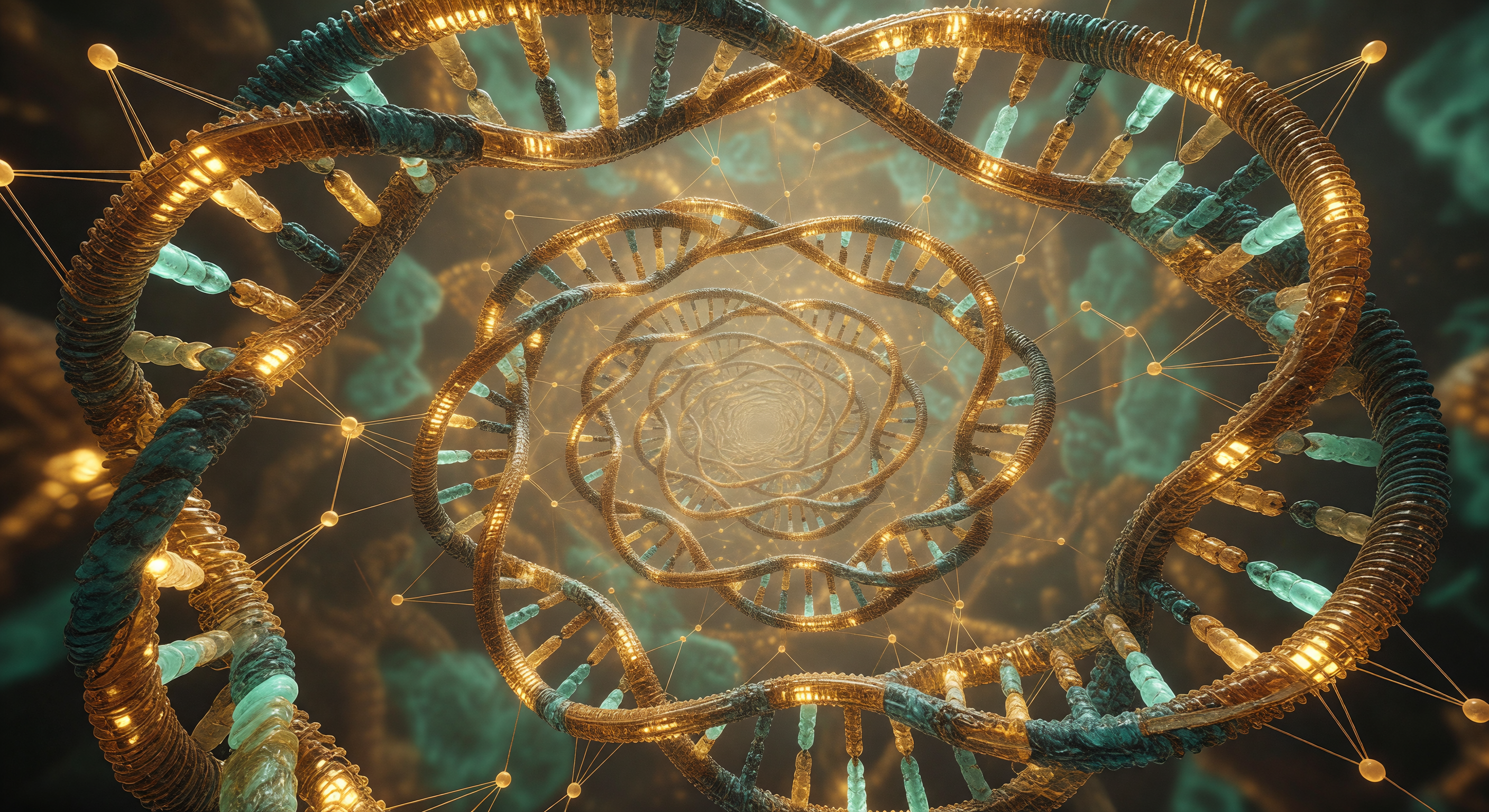
Looking directly down the axis of the collagen triple helix, the viewer is drawn into a spiraling corridor of three intertwined polypeptide chains — amber, teal, and jade — coiling away into a warm molecular haze with the hypnotic precision of a braided rope frozen at the boundary between chemistry and architecture. This is collagen in its fundamental form: three left-handed polyproline-II helices wound together into a right-handed supercoil, held in register by a network of interchain hydrogen bonds that shimmer between the strands like gold filaments under tension, supplemented by aquamarine hydroxyproline-water bridges that cool the palette and stitch additional order into the assembly. The extraordinarily tight central column — where glycine residues from all three chains converge with Cα–Cα spacings near 3.9 ångströms — is only possible because glycine carries no side chain, its single hydrogen atom the only geometry small enough to fit; any substitution would rupture the helix entirely. Projecting outward from each strand, the ribbed pyrrolidine rings of proline and hydroxyproline create a densely corrugated exterior surface whose repeating geometry reflects the precise 8.7 ångström helical pitch, reasserting a three-fold rotational symmetry every fraction of a nanometer down the receding tunnel. At this scale, thermal motion is not background noise but a physical presence — the soft focus deepening toward the far end of the helix is not optical aberration but the true consequence of femtosecond bond vibrations, the molecular architecture perpetually alive at the edge of its own stability.
Other languages
- Français: Corde Tressée Triple Hélice
- Español: Cuerda Trenzada Triple Hélice
- Português: Corda Trançada Tripla Hélice
- Deutsch: Geflochtenes Kollagen Dreifachhelix
- العربية: حبل ملتوي ثلاثي الحلزون
- हिन्दी: कोलेजन त्रिगुण हेलिक्स रस्सी
- 日本語: 三重らせんコラーゲン縄
- 한국어: 콜라겐 삼중 나선 밧줄
- Italiano: Corda Intrecciata Tripla Elica
- Nederlands: Gevlochten Collageen Drievoudige Helix