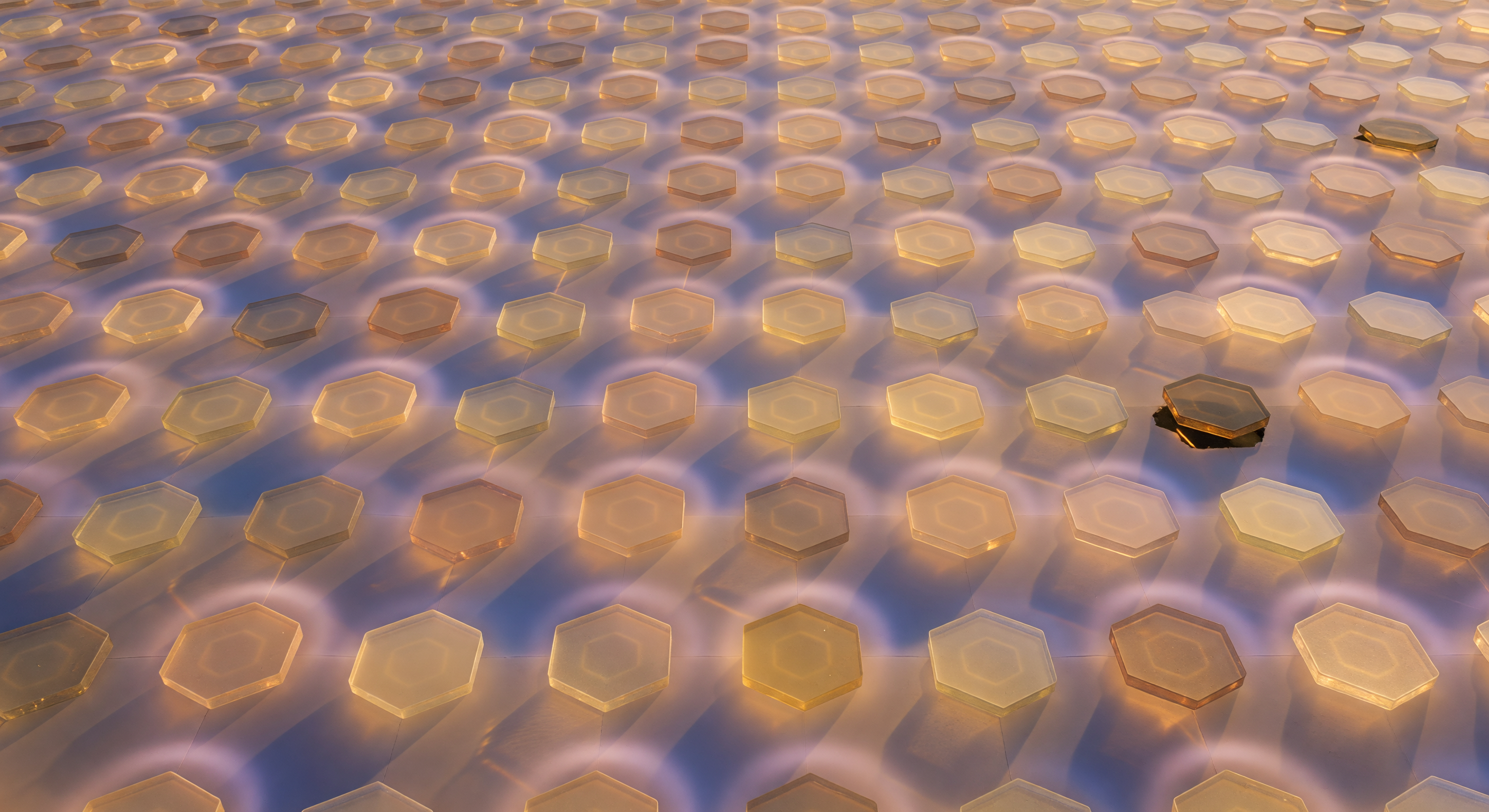
The world underfoot is an infinite plain of warm hexagonal discs, each one tilted at a sharp alternating angle to its neighbor in a herringbone weave that repeats with hypnotic exactness in every direction, like a vast tiled floor laid by some crystallographic intelligence working at a scale where cobblestones are made of electron density rather than stone. These are benzene molecules frozen into their monoclinic lattice at 175 K, each flat aromatic ring held in place not by covalent bonds to its neighbors but by the subtle geometry of edge-to-face CH–π interactions — one molecule's hydrogen edge leaning toward another's π face across a gap of roughly 3.5 ångströms, a distance so intimate that the ghostly violet-amber halos of delocalized π-electron cloud hovering above and below each molecular plane nearly overlap, pooling faintly at the closest approach like shared breath. The cold is not warmth but absolute stillness: bond vibrations reduced to their irreducible quantum minimum, every disc locked in crystallographic exactitude, the entire landscape held in a frozen cathedral geometry that recedes through softly glowing amber-indigo corridors toward a luminous infinity. Here and there a dark socket interrupts the perfection — a vacancy defect where a single molecule is absent, its neighbors leaning fractionally inward, their π halos fraying at the edges as though registering the disruption in the only language available to them: a slight asymmetry in the otherwise flawless periodic order.
Other languages
- Français: Plaine Cristalline en Chevrons
- Español: Llanura de Cristal en Espiga
- Português: Planície de Cristal Benzênico
- Deutsch: Benzolkristall Fischgrätebene
- العربية: سهل بلورات البنزين المتشابكة
- हिन्दी: बेंजीन क्रिस्टल हेरिंगबोन मैदान
- 日本語: ベンゼン結晶のヘリンボーン平原
- 한국어: 벤젠 결정 헤링본 평원
- Italiano: Pianura di Cristallo a Spina di Pesce
- Nederlands: Benzeen Kristal Visgraat Vlakte