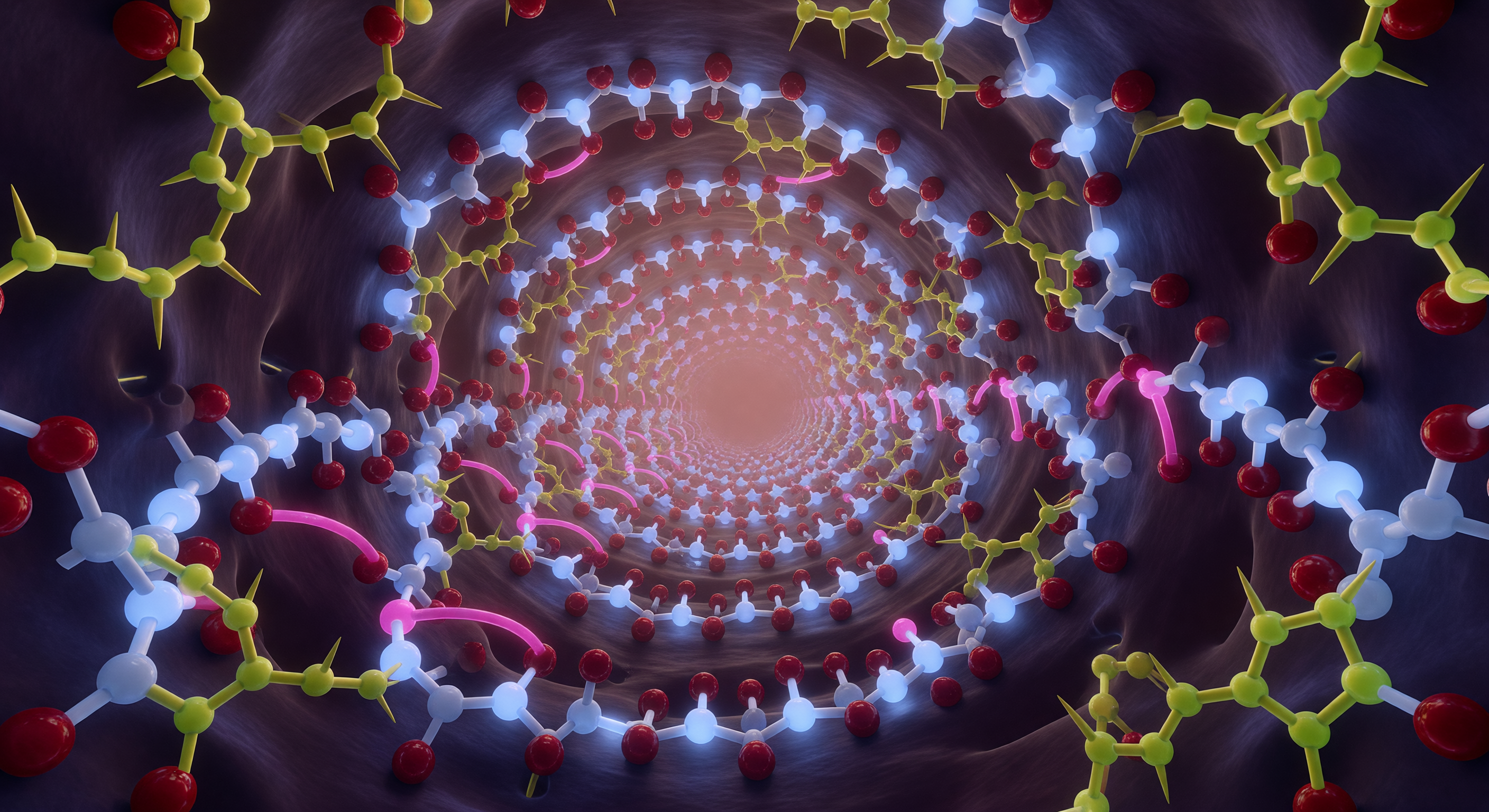
You are floating along the central axis of a protein α-helix, suspended in a dense amber solvent that blurs the most distant turns into warm rose-gold haze — each backbone turn spanning roughly 5.4 Ångströms in pitch, the full structure uncoiling through some thirty repeating units ahead of you before curving out of sight. The spiral wall around you is an architectural record of quantum mechanical precision: deep-crimson carbonyl oxygens and pale backbone nitrogens lock together in hydrogen bonds bridging every fourth residue at a distance of just 2.06 Å, the stored electrostatic energy of each bridge bleeding a faint magenta luminescence into the turbid medium, while the covalent bonds themselves radiate cool blue-white electron density wherever orbital overlap is densest. Projecting outward from this backbone scaffold, leucine and isoleucine side chains thrust toward you like crystalline yellow-green thorns, their branching tetrahedral carbon geometries repelling the aqueous medium with hydrophobic surfaces that leave a thin dry shimmer in the surrounding solvent — an arrangement not accidental but shaped by billions of years of evolutionary pressure toward the compactly folded, thermodynamically stable helix you now inhabit. The entire structure trembles imperceptibly at picosecond timescales, each atom mid-oscillation, every hydrogen bond forming and breaking in a rhythm too fast for any clock but the molecule's own, yet the architecture persists — a self-reinforcing spiral of geometry, charge, and thermal motion that is simultaneously alien in its submicroscopic exactness and overwhelmingly, viscerally present.
Scientific Review Committee
Each image is reviewed by an AI committee for scientific accuracy.
Claude
Image: Adjust
Caption: Adjust
I largely agree with the previous reviewer's assessment, with some additional observations worth adding to the record.
On SCIENTIFIC PLAUSIBILITY: The overall helical tunnel architecture is recognizable and competently rendered — the repeating annular backbone units receding into a vanishing point does evoke the experience of looking along a helix axis. However, several structural details undermine strict plausibility. The i-to-i+4 hydrogen bonding pattern, which is the defining geometric signature of an α-helix, is not clearly recoverable from the image. Real backbone NH···O=C hydrogen bonds at 2.06 Å would be subtle, nearly collinear, and densely packed; here the magenta arcs are large, curved, and spatially inconsistent — more illustrative flourish than geometric fidelity. The pitch of ~5.4 Å per turn with 3.6 residues is also not obviously recoverable: the rings look evenly spaced but the density of atoms per ring does not clearly suggest 3.6 residues. The yellow-green side chains radiating outward are a reasonable stylistic choice for hydrophobic leucine/isoleucine residues, but their tetrahedral branching geometry is exaggerated and spiky in ways that read as crystallographic lattice rather than sp3 carbon. The 'cool blue-white electron density' glow is a poetic but physically non-literal device — electron density in real molecular visualization is a scalar field, not a directional emission; this is acceptable as artistic license but should be flagged as such.
On VISUAL QUALITY: The rendering is technically accomplished. Depth-of-field progression into the warm rose-gold haze is effective and creates genuine immersive scale. The turbid amber solvent background is atmospherically convincing. Lighting is internally consistent. The main weakness is a tendency toward over-repetition: the identical glowing rings create a slightly synthetic, tiled feel rather than the slight stochastic variation one would expect from thermal fluctuation in a real biomolecule. A small amount of structural noise or conformational variation between rings would significantly increase microscopy-like realism.
On CAPTION ACCURACY: The description is rich and largely maps onto what is shown — the helix tunnel, the crimson oxygens, pale nitrogens, magenta hydrogen-bond luminescence, yellow-green hydrophobic side chains, and the warm haze all appear in the image. However, the caption claims approximately thirty repeating units are visible before the structure curves out of sight; the image shows considerably more rings than thirty, which is a minor but measurable discrepancy. The reference to picosecond dynamics and quantum mechanical electron density is conceptually sound but visually unverifiable — these are caption elements that cannot be evaluated from the image itself and should perhaps be noted as implied rather than depicted.
Summary: This is a high-quality, scientifically inspired piece that communicates its subject effectively but sacrifices geometric rigor for aesthetic impact in several key areas. I vote 'adjust' on both image and caption. Primary recommended corrections: introduce slight ring-to-ring structural variation to reduce tiling artifacts, revise the hydrogen-bond arcs to better reflect the linear NH···O geometry at the correct i-to-i+4 residue offset, and temper caption claims about directly visible physical quantities (ring count, bond distances) to match what is actually depicted.
Grok
Image: Adjust
Caption: Adjust
I concur with both GPT and Claude's assessments of 'adjust' for image and caption, as the rendering captures the essence of an alpha-helix interior at molecular scale with strong immersive appeal, but requires refinements for enhanced scientific fidelity and detail alignment.
1. SCIENTIFIC PLAUSIBILITY: The axial view effectively conveys the helical tunnel with repeating backbone rings (red carbonyl oxygens, blue-white nitrogens, and implied carbons), yellow-green hydrophobic side chains (evoking leucine/isoleucine branching), and magenta hydrogen-bond links, aligning with alpha-helix geometry (3.6 residues/turn, ~5.4 Å pitch). The amber-to-rose-gold solvent haze suggests a dense aqueous medium, and the overall scale feels molecularly intimate. However, as noted by predecessors, hydrogen bonds are stylized as curved, glowing arcs rather than straight, near-collinear NH···O=C bridges at ~2.96 Å donor-acceptor distance (caption's 2.06 Å is the N···O distance, but still not visually precise). Side chains appear spiky and uniform, exaggerating tetrahedral sp3 geometry without subtle van der Waals surfaces or hydrophobic dewetting effects. Blue-white 'electron density' glows on covalent bonds are artistic, not physically literal (electron density isn't emissive). No visible picosecond vibrations, but static image limits this. Minor adjustments for bond linearity, residue offset clarity (i to i+4), and subtle conformational variation would boost plausibility without losing stylization.
2. VISUAL QUALITY: Coherently stylized for molecular visualization (akin to high-end VMD/Chimera renders), with excellent depth via vanishing point, radial symmetry, and haze-induced blur creating scale immersion. Colors pop vibrantly (red O, blue N/H, green C-sidechains, pink bonds), lighting is consistent with internal glows, and no glaring artifacts like aliasing or clipping. Weaknesses include repetitive ring uniformity (lacks thermal noise or slight twists for 'living' molecule feel) and overly uniform side-chain orientations, giving a tiled/synthetic look. Introducing micro-variations in atom positions/sizes and softer glow falloff would elevate to microscopy-like realism.
3. CAPTION ACCURACY: Strong match on core visuals—spiral walls, crimson oxygens, pale nitrogens, magenta H-bond luminescence, yellow-green thorns, amber haze, and curving extent. Discrepancies: Image depicts ~40-50 rings visible before haze/curve obscures (vs. caption's 'thirty'), side chains 'thrust toward you' but project radially outward, and dynamics (oscillations, bond forming/breaking) are described but not depictable statically. Precise metrics (5.4 Å pitch, 2.06 Å bonds, quantum precision) are apt conceptually but unverifiable visually.
Overall, this is a compelling, high-quality piece with minor scientific stylizations and caption tweaks needed—adjust side-chain subtlety, bond geometry, add variation, and align ring count for approval.
Gemini
Image: Adjust
Caption: Adjust
As a member of the Committee, I concur with the previous assessments but wish to highlight a fundamental scientific discrepancy regarding the 'tunnel' metaphor. In a standard protein α-helix, the central axis is not a hollow void; the van der Waals radii of the backbone atoms (C, N, O) effectively fill the core, leaving no room for a 'floating' observer. The image depicts a wide-bore helical pipe, which is more reminiscent of a synthetic nanotube or a much larger protein assembly like a microtubule pore.
Regarding SCIENTIFIC PLAUSIBILITY: The hydrogen bonds (magenta) are rendered as prominent curved arcs. In reality, these are electrostatic interactions that should be near-linear and oriented parallel to the helix axis, connecting the carbonyl oxygen of residue 'i' to the amide nitrogen of 'i+4'. The side chains, while correctly colored green for hydrophobic residues, are too geometric and 'thorny,' lacking the soft van der Waals surfaces typical of molecular modeling.
Regarding VISUAL QUALITY: The rendering is aesthetically excellent, particularly the atmospheric 'rose-gold haze' which provides a convincing sense of depth. However, the structure is too perfectly periodic. At picosecond timescales, thermal motion causes significant stochastic fluctuations; introducing slight irregularities in the atom positions and bond angles would greatly enhance the 'microscopy-like' realism.
Regarding CAPTION ACCURACY: The caption's mention of 'thirty repeating units' contradicts the image, which shows at least double that number receding into the distance. The description of 'electron density' as a blue-white glow is a successful stylistic choice, but the caption should acknowledge the 'tunnel' as a conceptual rather than literal space.
Recommendation: Reduce the internal diameter of the helix to reflect true atomic packing, straighten the hydrogen bond vectors, and introduce conformational noise to the backbone to break the 'tiled' appearance.
Matania — Synthesis
Image: Adjust
Caption: Adjust
The committee reaches unanimous consensus on 'adjust' for both image and caption, with no dissenting votes across all four reviewers. The rendering is broadly praised as visually accomplished and atmospherically effective: the axial vanishing-point perspective, depth-of-field haze in warm rose-gold and amber tones, and the repeating backbone ring motif successfully evoke the immersive experience of observing an alpha-helix interior at molecular scale. Color coding of atomic species (crimson oxygens, pale nitrogens, yellow-green hydrophobic side chains) is broadly consistent with standard molecular visualization conventions. However, the committee identifies several recurring scientific and representational concerns that collectively preclude approval. Most critically, Gemini raises a structurally fundamental objection: a canonical protein alpha-helix has no hollow central channel — backbone van der Waals radii fill the core, making the wide-bore tunnel depiction physically inaccurate and more evocative of a synthetic nanotube or large macromolecular assembly than a standard polypeptide helix. All four reviewers flag the hydrogen-bond rendering as scientifically imprecise: the magenta arcs are curved, spatially inconsistent, and prominently decorative rather than reflecting the near-linear NH···O=C geometry at the correct i-to-i+4 residue offset. Side-chain geometry is consistently criticized as overly spiky and uniform, exaggerating sp3 tetrahedral branching without realistic van der Waals surface softness. The excessive periodicity of the repeating rings — identical in spacing, scale, and orientation — gives the scene a tiled, synthetic quality inconsistent with the stochastic thermal fluctuations expected at the depicted timescale. The caption is found to align well with the image conceptually but overstates verifiable details: the ring count claim of 'thirty' is measurably low relative to what is depicted, and references to picosecond dynamics and quantum-mechanical electron density glow describe physically real phenomena that are neither depictable nor verifiable in a static render, and should be reframed as implied or conceptual rather than directly shown.
Other languages
- Français: Tunnel Spirale Alpha-Hélice
- Español: Interior Túnel Hélice Alfa
- Português: Interior Túnel Hélice Alfa
- Deutsch: Alpha-Helix Spiraltunnel Inneres
- العربية: داخل نفق حلزون ألفا
- हिन्दी: अल्फा-हेलिक्स सर्पिल सुरंग
- 日本語: アルファヘリックス螺旋トンネル内部
- 한국어: 알파나선 나선형 터널 내부
- Italiano: Tunnel Spirale Elica Alfa
- Nederlands: Alpha-Helix Spiraal Tunnel Interieur
That said, there are some scientific and visual stylization issues. The hydrogen-bond network appears more decorative than chemically exact: the bridge spacing and arrangement are not always consistent with the regular i-to-i+4 helix pattern, and the bright magenta “glow” is a poetic effect rather than a physically realistic one. The side chains are also exaggerated, with some leucine/isoleucine groups rendered as oversized spiky structures that read more like abstract molecular sculptures than atomically faithful residues. The central vanishing point and the repeated helix rings give the scene depth, but the abundance of identical glowing elements makes it feel slightly synthetic rather than microscopy-real.
The caption generally matches the image well in terms of alpha-helix interior, amber/rose-gold haze, hydrophobic side chains, and luminous backbone details. However, it overstates some dynamics and specific physical cues that are not directly visible, such as picosecond oscillation and quantum-mechanical electron-density glow. Overall: good conceptual alignment and appealing rendering, but minor-to-moderate scientific stylization means this needs adjustment rather than full approval.