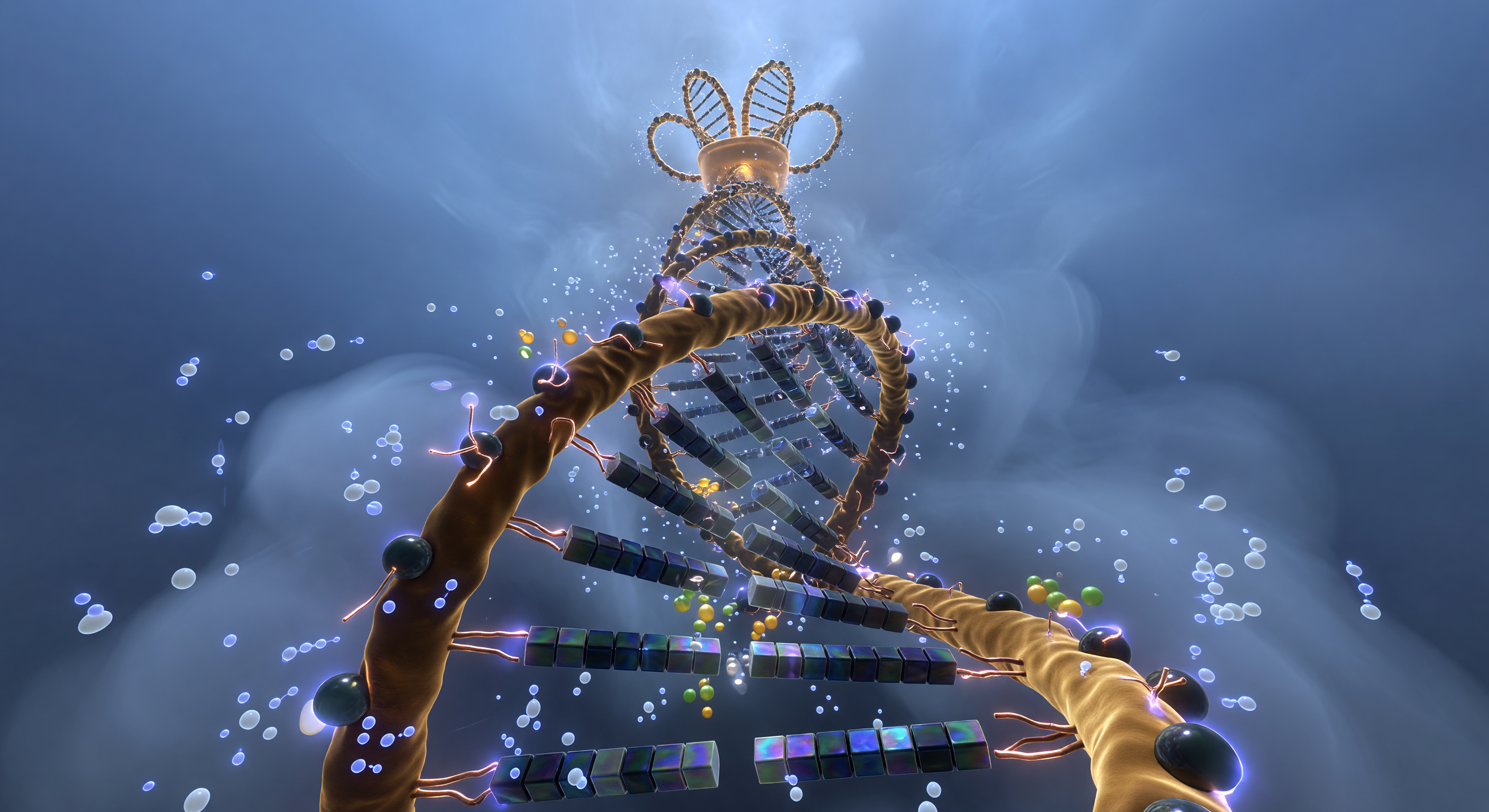
Looking up from below the stem base, you are confronted by a spiraling tower of interlocked amber and copper rings that fills the entire sky above — the A-form double helix of an RNA hairpin, its geometry noticeably more compact and inclined than DNA, its 2.3-nanometer width tapering as it climbs through layered aqueous haze toward the baroque flowering crown of the GNRA tetraloop far overhead. The ribose-phosphate backbone rises in two intertwined strands of burnished bronze-ochre, each ribose unit bristling with a small copper-bright 2'-hydroxyl antenna — those outward-pointing oxygen groups that chemically distinguish RNA from DNA, vibrating softly within their local energy wells and catching the ambient light with a warmer glow than the surrounding solvent. Crowding in from every direction, water molecules manifest as semi-translucent opalescent spheroids in perpetual agitated motion, their oxygen atoms flickering with cold blue sparks, while sodium ions streak past as hard silver-white points trailing brief hydration wakes and magnesium ions hover in warm gold-green clusters close to the phosphate groups, electrostatically tethered to the backbone's dense negative charge. The base pairs stacked within the minor groove above are dark iridescent sheets of guanine and cytosine whose pi-stacked aromatic electrons delocalize across neighboring rings in shimmering plum and teal, and the whole structure vibrates invisibly at femtosecond rhythms even as this instant holds it in monumental, luminous stillness.
Other languages
- Français: Tour Flottante d'ARN
- Español: Torre Flotante de ARN
- Português: Torre Flutuante de RNA
- Deutsch: Schwebender RNA-Haarnadel-Turm
- العربية: برج دبوس الشعر الطافي
- हिन्दी: आरएनए हेयरपिन तैरता मीनार
- 日本語: 浮かぶRNAヘアピン塔
- 한국어: 떠다니는 RNA 헤어핀 탑
- Italiano: Torre Flottante di RNA
- Nederlands: Zwevende RNA-Haarspeldtoren