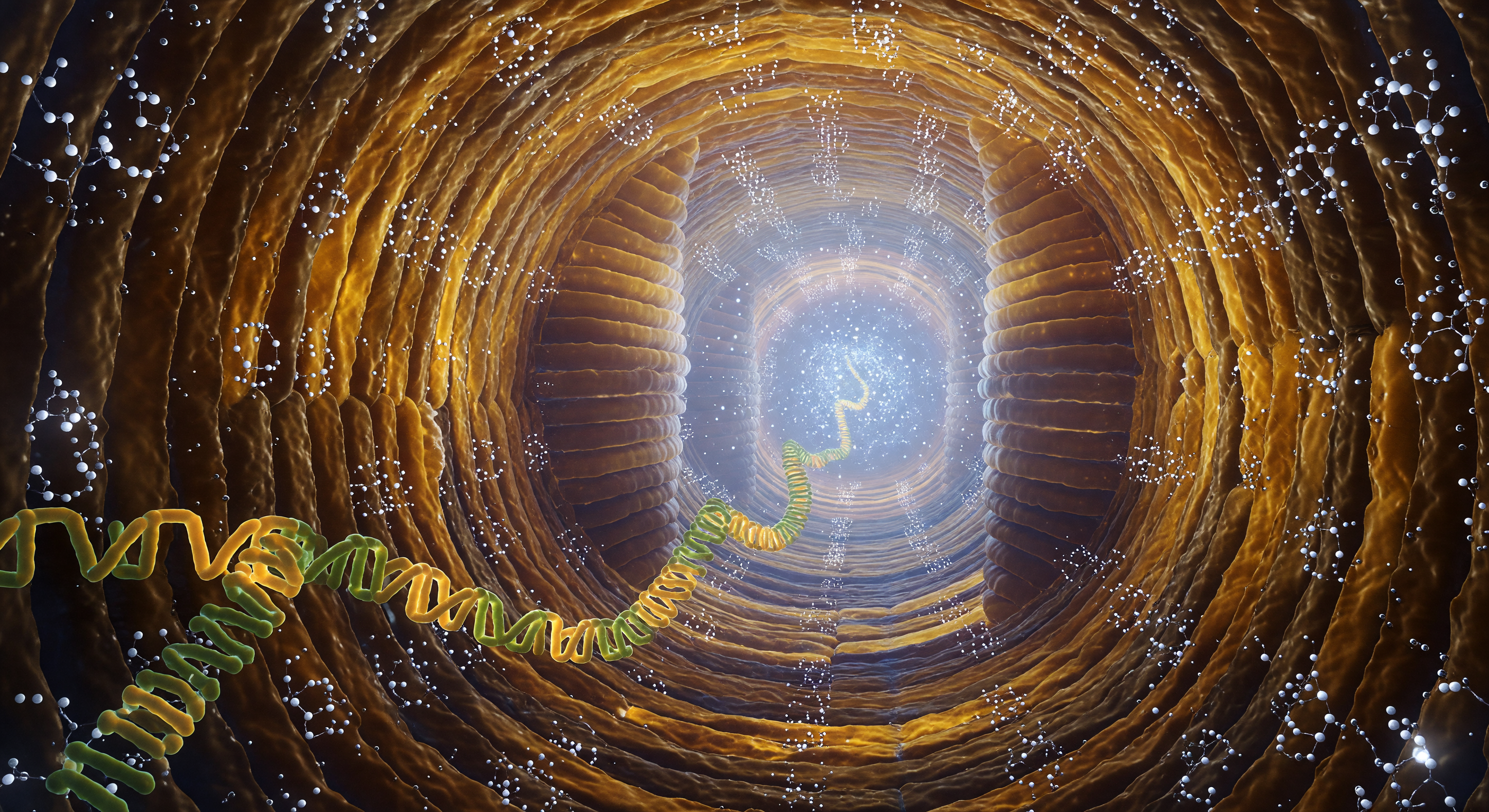
You are looking inward along the ribosomal peptide exit tunnel, a corridor roughly 100 ångströms long and barely 15 ångströms across at its narrowest constriction, its walls built from interlocking rRNA helices whose sugar-phosphate backbones curve and ridge like polished horn under the cold blue-white glow bleeding in from the peptidyl transferase center ten nanometers ahead. Every surface here is probabilistic rather than hard — the boundary between rRNA wall and the dense fog of thermally agitated water molecules is a negotiated gradient of electron density, and magnesium and potassium counterions sit in the major-groove indentations like bright silver-white specular points, each one haloed by a shell of rigidly oriented water dipoles that extends its electrostatic influence another ångström or two into the solvent. Threading toward you from that catalytic hearth is the nascent polypeptide itself, its backbone alternating lime-green and warm amber along each peptide bond, its hydrophobic side chains making fleeting van der Waals contact with the ridged nucleotide platforms lining the tunnel walls before thermal motion — occurring on picosecond to nanosecond timescales — peels them away again. The entire passage vibrates at the threshold of perception, every wall, chain, and water molecule executing its own quantum of Brownian motion, the tunnel functioning less as a static architectural form than as a living, electrostatically sculpted channel through which the first folding decisions of a new protein are continuously being made in amber shadow and catalytic blue fire.
Other languages
- Français: Profondeurs du Tunnel Peptidique
- Español: Profundidades del Túnel Peptídico
- Português: Profundezas do Túnel Peptídico
- Deutsch: Tiefen des Peptidtunnels
- العربية: أعماق نفق الببتيد
- हिन्दी: पेप्टाइड सुरंग की गहराई
- 日本語: ペプチドトンネルの深淵
- 한국어: 펩타이드 터널 깊은 곳
- Italiano: Profondità del Tunnel Peptidico
- Nederlands: Diepten van de Peptidetunnel