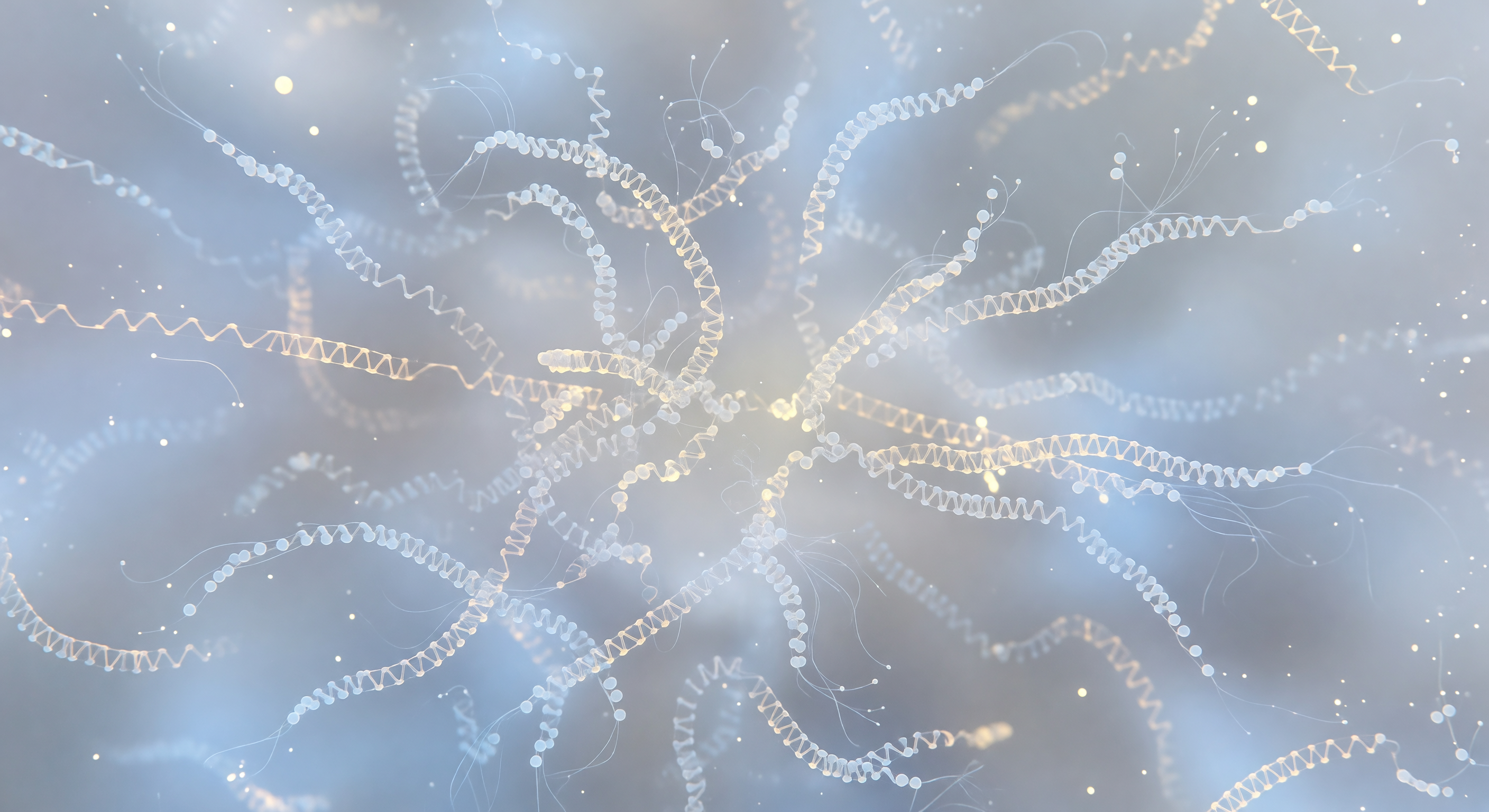
You are suspended at the geometric heart of a molecule that refuses to hold a single shape — the conformational ensemble spreading around you like a living fog, a blue-white probability cloud roughly eight nanometers across built from dozens of polypeptide conformers overlaid at near-total translucency, their collective presence suggesting structure without ever committing to it. This is an intrinsically disordered protein, a chain that has abandoned the stable folded architecture of classical structural biology in favor of a dynamic ensemble of configurations, each thermodynamically accessible, none dominant, the whole population sampling sequence space continuously on nanosecond timescales driven by thermal collisions with the surrounding solvent. To your left, a faint amber ribbon momentarily resolves — an alpha-helix flickering into hydrogen-bonded coherence for perhaps a nanosecond, its carbonyl oxygens catching warm internal light before the chain's entropic freedom dissolves it back into the blue-white blur — while nearby a hydrophobic cluster of aromatic residues pulses with brief yellow-gold luminescence, a transient energetic minimum forming and collapsing within microseconds as phenylalanine and tryptophan side chains press into fleeting van der Waals contact. The water is not background here but the dominant force of existence: spheroidal molecules barely 0.28 nanometers across hammer every exposed backbone segment in relentless thermal agitation, their collective jostling the engine that drives conformational sampling and the diffuse aqueous haze that swallows the ensemble's outermost tendrils beyond fifteen nanometers into statistical invisibility.
Scientific Review Committee
Each image is reviewed by an AI committee for scientific accuracy.
GPT
Image: Adjust
Caption: Adjust
The image is visually coherent and strongly matches the intended dreamy, translucent macromolecular aesthetic, but it leans more toward a stylized molecular illustration than a scientifically grounded microscopic view. The disordered protein ensemble is represented well in general: multiple semi-transparent chain-like conformers overlap in a cloud-like volume, and the blue-white palette works for a hydrated, low-contrast biomolecular environment. However, some structural elements read as overly regular and decorative, especially the repeating bead-and-spring motifs and the tidy helical segments, which make parts of the scene look more like abstract CGI than a true intrinsically disordered ensemble. At this scale, the dominant water environment is plausible, but the water molecules themselves are not realistically rendered as discrete .28 nm spheres; they function more as ambient sparkles and haze than molecular solvent. Lighting is attractive and consistent, though a bit too luminous and ethereal for strict microscopy realism. The caption matches the broad concept very well—disordered protein, transient helix, hydrophobic clustering, solvent-driven motion—but it over-specifies features like the exact nanosecond/microsecond dynamics and the visibility of water molecules, which the image cannot directly demonstrate. Overall: good conceptual fit, but it would benefit from slightly less stylization and more physically grounded molecular representation.
Claude
Image: Adjust
Caption: Adjust
I broadly agree with the previous reviewer's assessment but want to sharpen and partially contest several points. On scientific plausibility: the core conceptual rendering of an intrinsically disordered protein (IDP) as a diffuse, overlapping ensemble of conformers is genuinely well-executed. The radial explosion of semi-transparent chain-like strands from a luminous central hub effectively communicates conformational sampling — arguably better than most textbook illustrations. The blue-white palette is scientifically appropriate for a hydrated macromolecular environment under cryo-EM or NMR-ensemble visualization conventions. However, the structural motifs visible in the strands are far too regular and periodic — the repeating zigzag/helix patterns suggest crystallographic order that contradicts the IDP premise. A real disordered ensemble would show far more topological variety: random coils, irregular turns, sporadic secondary structure flickering in asymmetric positions. The current symmetry feels imposed rather than emergent. The amber/gold transient helix mentioned in the caption is marginally visible in the left-center region, which is a genuine success. The hydrophobic clustering with yellow-gold luminescence is also loosely present. However, individual water molecules (0.28 nm) are entirely absent — rendered instead as ambient sparkle, which is a meaningful scientific omission given the caption's explicit emphasis on solvent as 'the dominant force of existence.' The scale cues are weak: nothing anchors the viewer to the ~8 nm envelope stated in the description. On visual quality: the rendering is technically accomplished and aesthetically coherent, with good depth-of-field and translucency layering. The central glow is slightly overwrought and risks reading as a nucleus or active site rather than a mere center-of-mass reference point. No obvious compression artifacts or geometry errors. On caption accuracy: the description is richly specific — nanosecond helix flickering, microsecond hydrophobic clustering, 0.28 nm water molecules, 15 nm visibility falloff — and the image captures the gestalt but cannot substantiate most of these quantitative claims visually. The caption would be more honest if it framed these dynamics as implied rather than depicted. Overall recommendation: adjust the image toward less geometric regularity in the chain motifs and introduce more topological disorder; adjust the caption to temper claims about explicitly visible sub-nanometer water structure.
Grok
Image: Adjust
Caption: Adjust
I concur with both previous reviewers on the 'adjust' votes for image and caption, as the rendering captures the poetic essence of an intrinsically disordered protein (IDP) ensemble but falls short of full scientific rigor and descriptive fidelity. SCIENTIFIC PLAUSIBILITY (adjust): The central luminous hub with radiating, overlapping semi-transparent polypeptide-like strands excellently evokes the ~8 nm conformational cloud of an IDP, aligning with NMR or ensemble cryo-EM visualizations where multiple conformers are superimposed to show sampling of sequence space. The blue-white hydrated haze and faint amber/gold accents (visible in helical zigzags and clustered highlights) plausibly suggest transient alpha-helices and hydrophobic interactions (e.g., Phe/Trp van der Waals contacts), driven implicitly by solvent agitation. However, the chain motifs exhibit excessive regularity—repetitive zigzag, helical, and bead-on-string patterns radiate symmetrically, implying artificial order rather than the chaotic, asymmetric topological diversity (random coils, loops, beta-turns) expected in true IDPs like alpha-synuclein or tau. Discrete water molecules (.28 nm spheres) are absent; the small white dots and sparkles serve as atmospheric proxies but fail to depict the dense, jostling solvent shell (thousands of H2O molecules within 1-2 nm of the protein) that dominates thermal motion at this scale. No explicit scale cues (e.g., reference atoms or grid) anchor the ~15 nm visibility falloff. VISUAL QUALITY (adjust): Photorealistic stylization suits the quantum/microscopy context, with excellent translucency layering, depth-of-field fade, and ethereal glow enhancing immersion—no artifacts, aliasing, or inconsistencies noted. Yet the overwrought central radiance and uniform strand geometry tip it toward decorative CGI abstraction over structural realism. CAPTION ACCURACY (adjust): Strong gestalt match—the 'living fog' cloud, left-side amber helix, pulsing gold clusters, and solvent haze are visually present—but the text overpromises depictable details like 'nanosecond timescales,' 'microsecond clustering,' and 'spheroidal .28 nm water molecules hammering backbones,' which a static image implies via blur but cannot resolve or quantify. Constructive suggestions: For image, introduce irregular, non-periodic chain topologies (e.g., kinked coils, asymmetric protrusions) and a denser, subtler water molecular layer (tiny, numerous spheres in motion blur); tone down symmetry. For caption, rephrase dynamics/solvent as 'suggested by' the visuals to avoid unsubstantiated claims, e.g., 'implied nanosecond flickering.' This would elevate it to 'approve' territory.
Gemini
Image: Adjust
Caption: Adjust
The image successfully captures the 'ghostly' and translucent aesthetic required for a conformational ensemble, using a sophisticated depth-of-field and color palette that aligns with the blue-white/amber description. However, from a scientific standpoint, several adjustments are needed. First, the 'sunburst' radial symmetry is misleading; an intrinsically disordered protein (IDP) ensemble should appear as a tangled, overlapping 'hairball' of paths (a Gaussian chain or excluded volume cloud), not as distinct arms radiating from a central luminous hub. This geometry suggests a polymer star or a micelle rather than a single polypeptide chain sampling space. Second, the structural motifs within the strands are far too regular and periodic, resembling engineered ladders or stable helices rather than the stochastic, irregular 'random coil' nature of an IDP. Third, while the caption emphasizes water as the 'dominant force' and specifies '0.28 nm spheres,' the image represents solvent as sparse, decorative sparkles in a vacuum. At this scale, the protein should be embedded in a dense, crowded sea of water molecules. The caption is highly evocative but includes quantitative claims (nanosecond/microsecond dynamics, specific nanometer falloffs) that the static image can only metaphorically suggest. I recommend reducing the radial symmetry, increasing the topological 'messiness' of the chains, and depicting the solvent as a more pervasive, dense medium.
Matania — Synthesis
Image: Adjust
Caption: Adjust
The committee reached unanimous consensus on 'adjust' verdicts for both image and caption, with no dissenting votes across all four reviewers. The image is broadly praised for its atmospheric coherence, translucency layering, depth-of-field execution, and evocative blue-white palette consistent with hydrated macromolecular visualization conventions. The core conceptual gesture — overlapping semi-transparent conformers forming a diffuse cloud — is recognized as a genuine and effective communication of IDP ensemble behavior. However, three interlocking scientific deficiencies are identified with equal unanimity. First, the chain geometry is far too regular and periodic: repeating zigzag, helical, and bead-on-string motifs radiate with imposed symmetry, contradicting the stochastic, topologically diverse character of a true intrinsically disordered ensemble. The radial sunburst layout specifically evokes a polymer star or micelle architecture rather than a single polypeptide sampling conformational space. Second, solvent representation is atmospherically suggestive but scientifically absent: discrete water molecules at the 0.28 nm scale are entirely unrendered, replaced by ambient sparkle and haze, which is a meaningful omission given the caption's insistence on water as the dominant structural force. Third, no scale anchoring is present to ground the stated ~8–15 nm envelope. On the caption, reviewers appreciate its conceptual richness and evocative language but consistently flag that quantitative claims — nanosecond helix flickering, microsecond hydrophobic clustering, 0.28 nm water sphere impacts — are not visually substantiated by a static rendering and should be reframed as implied or suggested dynamics rather than depicted ones. The amber transient helix and gold hydrophobic clustering accents are noted as partial successes in visual-caption alignment.
Other languages
- Français: Fantôme de Protéine Désordonnée
- Español: Fantasma de Proteína Desordenada
- Português: Fantasma de Proteína Desordenada
- Deutsch: Geist des Ungeordneten Proteins
- العربية: شبح البروتين الفوضوي
- हिन्दी: अव्यवस्थित प्रोटीन का भूत
- 日本語: 天然変性タンパク質の幽霊
- 한국어: 무질서 단백질 유령
- Italiano: Fantasma di Proteina Disordinata
- Nederlands: Geest van Wanordelijk Eiwit