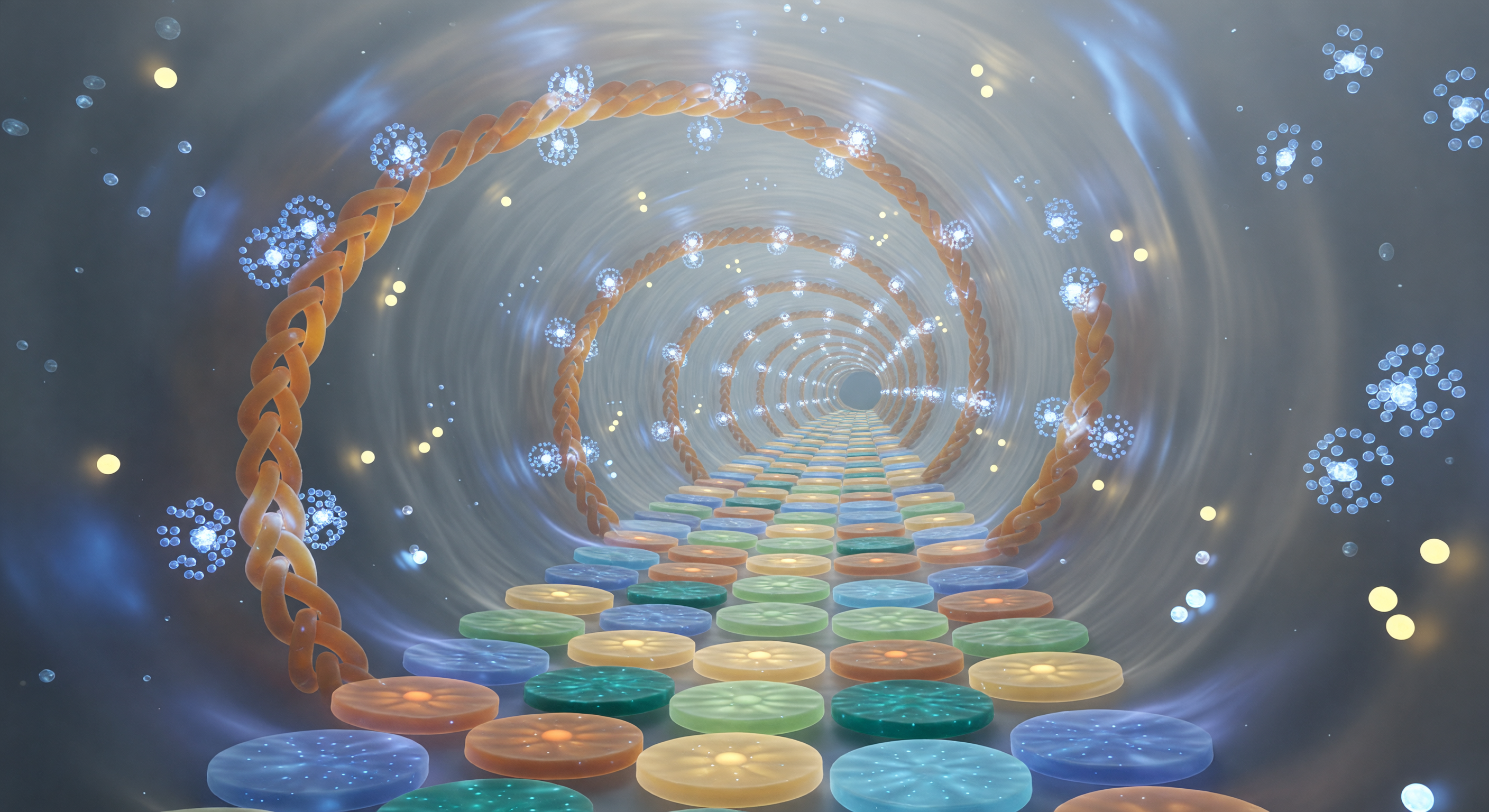
You are hurtling through a corridor so narrow it barely spans twenty atomic diameters, the walls alive with the restless blur of electron density rather than any solid surface — a vertiginous flight down the major groove of B-form DNA, where the 2.2-nanometer-wide channel spirals gently rightward in a clockwise helix, its geometry dictated entirely by the Watson-Crick base-pairing rules that enforce precise geometric complementarity between every amber adenine and sage-green thymine, every deep-teal guanine and sky-blue cytosine stacked 0.34 nanometers apart in aromatic platforms whose overlapping π-electron clouds shimmer with translucent violet-indigo interference. The phosphate-sugar backbone rises on both sides like a braided railing of orange-tan sea glass backlit from within, its negative charges drawing clusters of magnesium cations as hard white-blue sparks ringed by shells of oriented water, and sodium ions as soft gold halos drifting through the Debye screening layer — that milky, electrostatically charged fog where polarized water dipoles ripple in slow aurora-like wavefronts of blue-white light that wash rhythmically through the groove. Thermal bombardment is total and inescapable: 0.28-nanometer water molecules slam the base-pair floor in a continuous low tremor, each collision a flicker of white light instantly swallowed by the aqueous glow, reminding you that at this scale there is no stillness, only the ceaseless molecular violence of room-temperature solvent pressing in from every direction at once.
Other languages
- Français: Vol dans le Grand Sillon d'ADN
- Español: Vuelo por el Surco Mayor del ADN
- Português: Voando pelo Sulco Maior do DNA
- Deutsch: Flug durch die DNA-Hauptfurche
- العربية: التحليق في الأخدود الرئيسي للـDNA
- हिन्दी: DNA के प्रमुख ग्रूव में उड़ान
- 日本語: DNAの主溝を飛ぶ
- 한국어: DNA 주요 홈 비행
- Italiano: Volo nel Solco Maggiore del DNA
- Nederlands: Vliegen door de DNA-hoofdgroef