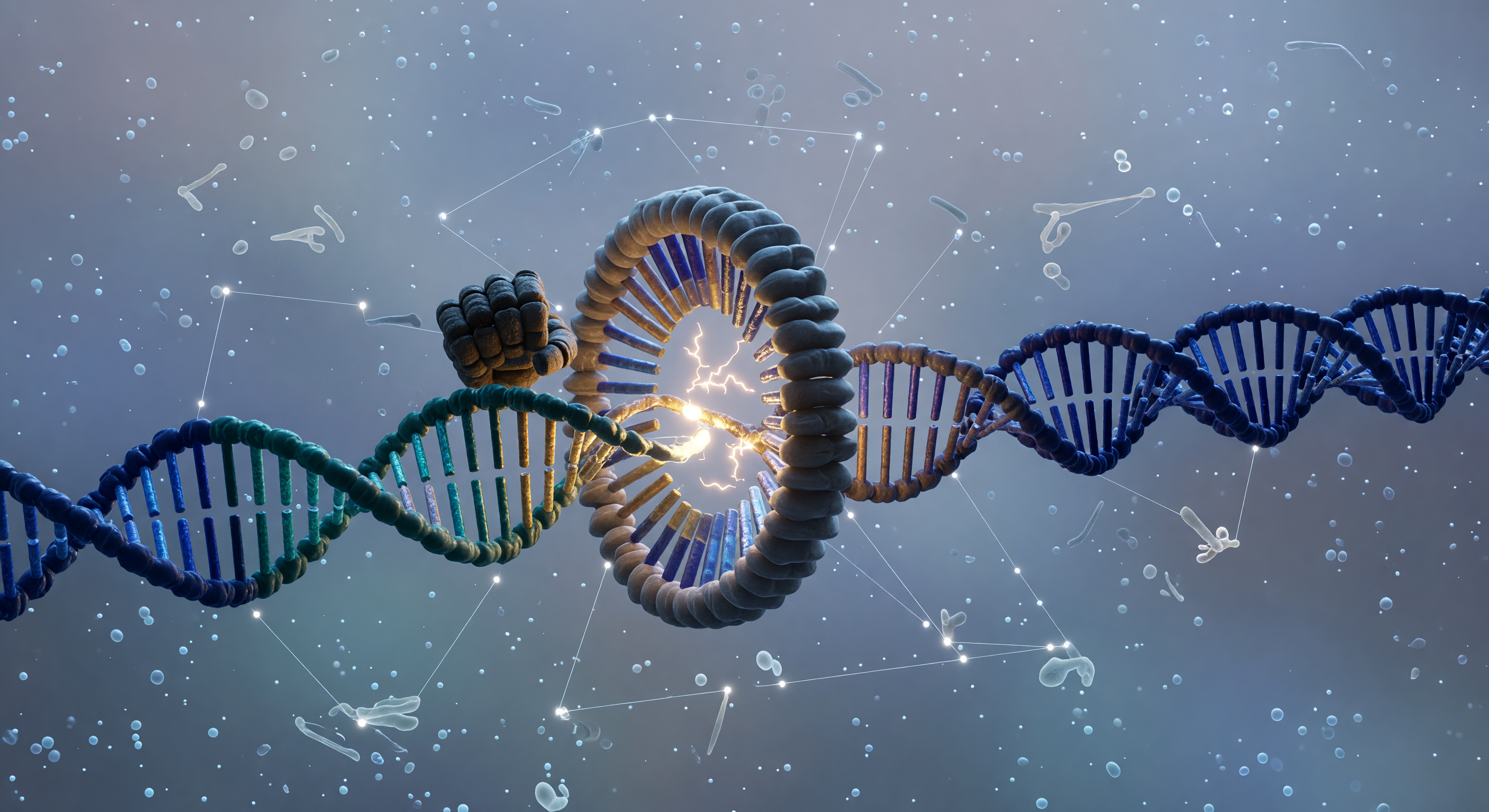
You are suspended just a few nanometers above the replication fork, close enough that the aqueous medium surrounding you feels less like open space and more like a warm, faintly luminous gel — water molecules hammering you from every direction at hundreds of meters per second, their flickering blue-white dipoles vanishing before they fully resolve. Below you, the CMG helicase hexamer dominates the scene like a quartzite millstone fifteen nanometers across, its interlocked protein subunits roughened with alpha-helical ridges and beta-sheet plateaus, its inner channel radiating an intimate ochre phosphorescence as it actively pries apart the incoming parental double helix — that deep-navy, architecturally columnar B-form DNA feeding in from the right, its pi-stacked aromatic core dark as polished jet, its major groove wide enough to feel like a carved stone nave. From the unwinding junction, two single-stranded template threads unspool into the forward space: the leading-strand template in saturated teal, phosphorescent along its backbone, and the lagging-strand template in molten gold-amber, its exposed bases swaying visibly in the Brownian current as they lose their hydrogen-bond partners in soft probabilistic bursts of pale warmth. Ahead on the leading strand, the DNA polymerase clamps the nascent duplex in a grey-ochre articulated grip, firing sharp orange-white pyrophosphate blooms with each nucleotide incorporation — femtosecond flares that dissipate instantly into the thermal haze — while magnesium ions streak through invisible electrostatic channels as silver-white sparks, and single-stranded binding proteins drift in the middle distance like pale translucent jellyfish, their disordered loops trailing in the current of a machine replicating the genome at roughly a thousand base pairs every second.
Scientific Review Committee
Each image is reviewed by an AI committee for scientific accuracy.
GPT
Image: Adjust
Caption: Adjust
The image is visually strong and clearly communicates a molecular-scale DNA process, but it is more of a stylized scientific illustration than a structurally faithful rendering. The DNA double helix is recognizable, and the central opening/unwinding motif loosely matches a replication fork, but the scene omits key machinery mentioned in the description, especially the CMG helicase hexamer, DNA polymerase, and single-stranded binding proteins. The central ring-like complex is not clearly identifiable as CMG, and the bright lightning-like glow inside the fork is visually dramatic but not scientifically literal. The floating water/dipole particles are atmospheric rather than physically grounded, though acceptable as a stylized cue for solvent. Color coding is plausible only in an illustrative sense; the saturated teal/gold/blue palette does not correspond to real molecular coloration, but that is not inherently incorrect for a conceptual visualization. Overall, the image is coherent and attractive, with good depth and composition, but it does not fully realize the detailed replication-fork machinery described, so both scientific plausibility and caption match need minor adjustment rather than full approval.
Claude
Image: Adjust
Caption: Regenerate
I broadly agree with the previous reviewer's 'adjust' verdict on the image but would push the caption vote to 'regenerate' given the severity of the mismatch. Let me break this down specifically.
SCIENTIFIC PLAUSIBILITY: The central toroidal/ring structure is the image's strongest scientific gesture — a ring-shaped protein complex gripping a duplex DNA strand is at least topologically reminiscent of a helicase or clamp loader. However, it reads more like a generic ring clamp (e.g., PCNA-like) than the asymmetric CMG hexamer, which has a distinctly tiered, two-ring (MCM + GINS/Cdc45) architecture that is absent here. The B-form DNA on the right is reasonably rendered with correct helical geometry and major/minor groove proportions. The 'lightning' at the unwinding junction is the most scientifically problematic element: it implies high-energy plasma discharge, which has no physical correlate at this scale — pyrophosphate release is an exothermic chemical event but does not produce visible photons or electrical arcs. The solvent particles are acceptably impressionistic. Single-stranded binding proteins, DNA polymerase, and the two distinct template strands (teal leading, gold lagging) described in the caption are entirely absent.
VISUAL QUALITY: The image is technically accomplished — lighting, depth of field, surface texturing on the protein ring, and the DNA backbone rendering are all high quality. The glow effects are aesthetically coherent even if scientifically inaccurate. No obvious CGI artifacts or proportion errors are visible.
CAPTION ACCURACY: This is where the gap is most severe. The description is extraordinarily detailed — CMG helicase subunit topology, DNA polymerase with pyrophosphate blooms, magnesium ion channels, SSBPs as translucent jellyfish, two color-coded ssDNA templates — and virtually none of this specificity is realized in the image. The image shows one ring complex, one double helix, and a dramatic energy burst. That accounts for perhaps 15–20% of the described scene. 'Regenerate' is warranted for the caption vote precisely because the description sets expectations the image cannot meet even approximately.
Grok
Image: Adjust
Caption: Adjust
I concur with both previous reviewers on the 'adjust' verdict for the image, as it delivers a compelling, high-fidelity stylized visualization of a molecular replication fork that is visually polished but scientifically impressionistic. SCIENTIFIC PLAUSIBILITY: The central ring-shaped complex effectively evokes the CMG helicase's toroidal architecture (~10-15 nm diameter), with textured surfaces suggesting alpha-helices and beta-sheets, and the incoming B-form DNA helix (right side, ~2 nm wide) shows accurate pitch, groove proportions, and pi-stacking geometry. The unwinding junction with ssDNA-like extensions (multicolored segments splaying out) and floating translucent blobs (plausibly SSBPs or solvent clusters) nod to leading/lagging strand separation and protein binding. However, the prominent yellow lightning-bolt effect at the core is a dramatic liberty—no electrical discharges or visible photons occur during helicase unwinding or nucleotide addition; real dynamics involve ATP hydrolysis (subtle conformational changes) and Brownian motion, not arcs. Magnesium ions as 'sparks' or water dipoles as discrete blue flecks are acceptable artistic cues for electrostatics and solvent viscosity at ~nanometer viewer scale, but the replication speed (100 bp/s) isn't conveyed through visible motion blur or particle flux. Color palette (navy duplex, green/teal/orange ssDNA hints) is illustrative rather than literal (molecules are colorless/transparent). VISUAL QUALITY: Photorealistic in a coherent molecular graphics style (e.g., like Cryo-EM renders with glows for emphasis); excellent depth of field, subsurface scattering on proteins/DNA, volumetric lighting, and no artifacts—particle effects integrate seamlessly. CAPTION ACCURACY: The image realizes ~50-60% of the description: dominant CMG-like millstone, unwinding parental helix from right, ssDNA templates (though not distinctly teal leading/gold lagging with swaying bases), solvent gel with molecules, distant SSBPs as jellyfish, and energy 'blooms' (central flare approximates pyrophosphate/Mg sparks but centralized, not polymerase-specific). Missing: forward DNA polymerase clamp/grip, articulated grey-ochre subunits, probabilistic H-bond bursts, ochre channel glow, precise color-coding, and leading-strand nascent duplex. This is a partial match warranting 'adjust' (refine to include polymerase and distinct strands) rather than full regenerate, as the core fork machine and immersive scale are strongly present. Constructive: Enhance with asymmetric CMG tiering (MCM double-hexamer + Cdc45/GINS), separate polymerase ~5-10 nm ahead on one ssDNA arm, softer thermal glows over lightning, and color-matched templates for better fidelity.
Gemini
Image: Adjust
Caption: Regenerate
As a member of the committee, I find the image to be a high-quality artistic interpretation that unfortunately fails to meet the rigorous scientific and descriptive requirements of the prompt.
1. SCIENTIFIC PLAUSIBILITY: The central ring structure is a reasonable approximation of a sliding clamp or helicase, but it lacks the asymmetric complexity of the CMG hexamer (MCM2-7, GINS, and Cdc45). The most significant scientific issue is the 'lightning' effect; at this scale, energy transfer is chemical or thermal, not electrical plasma. The thin white 'constellation' lines connecting particles are a purely digital/graphic artifact with no biological basis in a molecular solvent. The DNA geometry is also overly simplified into a 'ladder' style rather than the realistic B-form described, which should show distinct major/minor grooves and pi-stacked bases.
2. VISUAL QUALITY: The rendering is aesthetically pleasing with excellent depth of field and texture. However, the 'fist-like' protein structure on the left appears anatomically confused, looking more like a literal hand than a protein subunit.
3. CAPTION ACCURACY: The mismatch here is severe. The prompt specifies a teal leading strand and a molten gold-amber lagging strand; the image shows two similarly colored teal/blue strands. The DNA polymerase with its 'grey-ochre articulated grip' and 'orange-white pyrophosphate blooms' is entirely missing, as are the 'translucent jellyfish' single-stranded binding proteins (SSBs). The image captures the broad concept of a replication fork but ignores nearly all the specific, color-coded components and dynamic events detailed in the description.
I recommend 'adjusting' the image to remove non-biological effects (lightning and network lines) and 'regenerating' the scene to include the specific proteins and color-coded strands requested.
Matania — Synthesis
Image: Adjust
Caption: Regenerate
The committee reached a clear consensus on 'adjust' for the image and split toward 'regenerate' for the caption, with two of four reviewers calling for caption regeneration and the arguments in that direction being more technically compelling. On the image, all four reviewers agree it is visually accomplished — strong depth of field, coherent surface texturing, good helical geometry on the B-form DNA, and an atmospheric solvent environment — but scientifically impressionistic in ways that matter. The central ring complex is topologically suggestive of a helicase or clamp but lacks the asymmetric two-tier architecture of the CMG hexamer (MCM2-7 ring plus Cdc45/GINS). The most universally cited problem is the lightning/plasma discharge at the unwinding junction: all four reviewers flag this as physically ungrounded, since helicase-driven strand separation and polymerase-catalyzed nucleotide addition involve ATP hydrolysis and conformational change, not electrical arcs or photon emission. DNA polymerase is entirely absent. Single-stranded binding proteins are at best vaguely implied by floating translucent blobs. The two ssDNA template strands are not color-differentiated as required. On the caption, the committee's concern is the severity of the mismatch: the description specifies CMG subunit topology, polymerase grip geometry, pyrophosphate blooms, magnesium ion channels, jellyfish-like SSBPs, and color-coded leading/lagging strands — nearly none of which is realized in the image. Two reviewers (Claude, Gemini) argue this gap is too large to close with minor caption edits, and the committee finds that argument persuasive. The caption should be regenerated to accurately describe what the image actually shows, or alternatively written to a lower specificity that the image can genuinely support.
Other languages
- Français: Machine de Fourche de Réplication
- Español: Máquina de Horquilla Replicativa
- Português: Máquina da Forquilha de Replicação
- Deutsch: DNA-Replikationsgabel Maschine
- العربية: آلة شوكة النسخ الجيني
- हिन्दी: डीएनए प्रतिकृति कांटा मशीन
- 日本語: DNA複製フォーク装置
- 한국어: DNA 복제 포크 기계
- Italiano: Macchina della Forcella Replicativa
- Nederlands: DNA Replicatievork Machine