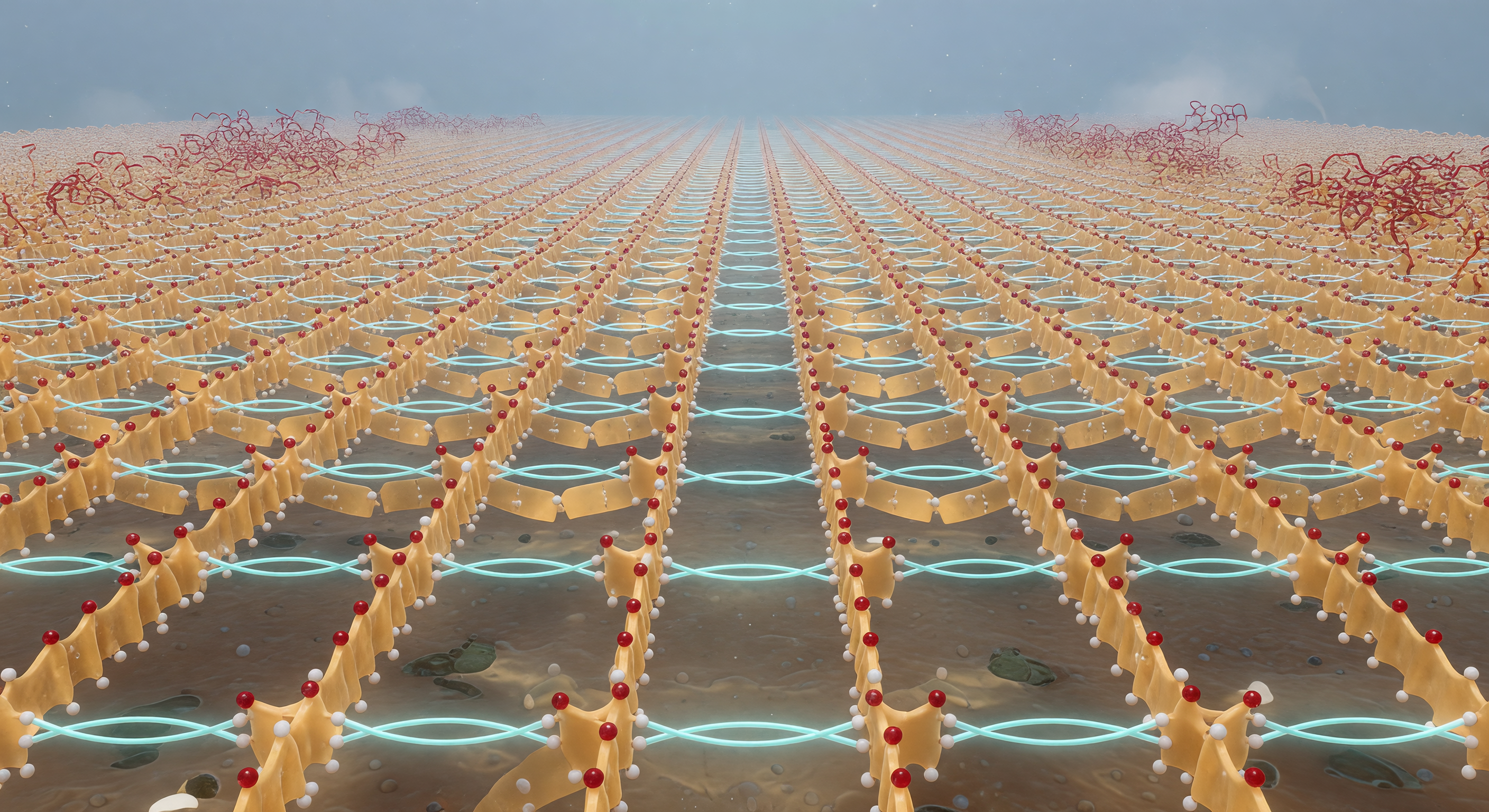
You drift just above a vast corrugated plain whose amber-parchment ridges sweep to every horizon in alternating directions — the backbone strands of an antiparallel beta-sheet, each one a dense ribbon of covalent bonds carrying the faint translucent sheen of electron-density clouds rather than any hard surface. Cherry-red carbonyl oxygens crown each ridge crest like garnets set into old bone, while pale amide nitrogen tips line the valley floors, and between every pair of adjacent strands a repeating series of cyan hydrogen bonds arches laterally — ghostly filaments of electrostatic probability glowing at 2.9-ångström intimacy, collectively lacing the plain into molecular chainmail of extraordinary regularity. The light here is directionless, a diffuse cold-white glow sourced from the surrounding aqueous medium rather than any sun, catching every backbone ridge top and leaving the valleys in warm amber shadow, while at floor level van der Waals contacts pack the molecular surface so tightly that no vacuum remains, the texture almost marbled. At the sheet's far edge, the disciplined corrugations dissolve abruptly into writhing red-orange connector loops — disordered turn regions frozen mid-fluctuation, their surfaces knobbed with side-chain protrusions — before the entire structure blurs into the blue-gray ionic haze of bulk solvent, a horizon that breathes with the constant reorientation of water dipoles too fast to resolve.
Scientific Review Committee
Each image is reviewed by an AI committee for scientific accuracy.
GPT
Image: Adjust
Caption: Adjust
The image is broadly consistent with an antiparallel beta-sheet rendered at molecular scale: the alternating strand directions, repeated hydrogen-bond network, and the red oxygens/white nitrogens are all visually legible and scientifically recognizable. The red disordered loops at the edges also fit the idea of turn regions. However, there are a few issues. The sheet is depicted as an extremely vast, perfectly regular landscape with a very strong macro-scale vanishing-point perspective that makes it feel more like an engineered grid than a protein assembly. The hydrogen bonds are stylized as glowing cyan loops; that is visually effective, but they read more like illuminated cables than weak electrostatic interactions. The surface texture is also a bit too smooth and uniform for a realistic molecular rendering, and the scale cues are slightly ambiguous because the scene resembles a terrain rather than a close structural visualization. The caption matches the general content well, but it overstates some details such as the exact “aqueous medium” lighting and the continual water-dipole haze, which are not clearly conveyed in the image. Overall: good conceptual match and strong visual design, but minor scientific-stylistic adjustments would improve plausibility.
Claude
Image: Adjust
Caption: Adjust
Overall this is a visually striking and scientifically informed rendering, but several specific issues prevent a full approval.
SCIENTIFIC PLAUSIBILITY: The core structural logic is sound — alternating strand directionality, repeated lateral hydrogen bonds, and the distinction between ordered sheet and disordered loop regions are all present and recognizable. The red spheres for carbonyl oxygens and white spheres for amide nitrogens follow conventional CPK-adjacent coloring. The cyan arching filaments for hydrogen bonds are a reasonable stylistic choice. However, the geometry is too perfectly periodic — real antiparallel beta-sheets exhibit measurable twist (roughly 15-20° per strand), causing the sheet to curl rather than extending as a perfectly flat infinite plain. The total absence of twist is a notable scientific inaccuracy. Additionally, the hydrogen bonds are depicted as closed oval loops rather than linear or slightly curved bridges between donor and acceptor atoms; this misrepresents their directionality and geometry. The van der Waals surface packing at floor level mentioned in the caption is not meaningfully conveyed — the inter-strand gaps look open rather than tightly packed. The disordered loop regions at the periphery are a genuine strength: their irregular, writhing morphology contrasts well with the ordered sheet.
VISUAL QUALITY: The rendering quality is high, with good depth-of-field progression and atmospheric haze simulating solvent blur at the horizon. The amber/gold ribbon coloration for backbone segments is coherent and aesthetically consistent. The main artifact is the overwhelming regularity and the extreme perspective recession, which gives the scene an engineered, crystalline grid feeling rather than a biological macromolecular assembly. The cyan hydrogen bond loops are visually dominant — perhaps overly so relative to the backbone — and their closed-loop geometry creates a minor visual confusion with ring structures. No major rendering artifacts or texture failures are present.
CAPTION ACCURACY: The description matches the image in broad strokes: corrugated plain, amber ridges, red oxygens, cyan hydrogen bonds, disordered red loops at edges, blue-gray solvent haze. However, the caption specifies 'pale amide nitrogen tips line the valley floors' — the white spheres visible are plausible but their placement in valley floors specifically is not clearly distinguishable from the image. The '2.9-ångström intimacy' of hydrogen bonds is a precise claim that the image cannot convey without scale bars. The 'directionless cold-white' lighting claim is partially contradicted by the warm amber shadowing in valleys, which does appear, but the overall lighting reads more as a standard directional scene light than a diffuse aqueous-medium glow. The water-dipole reorientation at the horizon is evocative prose but not rendered in any distinguishable way beyond generic fog.
RECOMMENDATIONS: Introduce visible beta-sheet twist to improve structural realism. Revise hydrogen bond geometry from closed ovals to open arched bridges with clear donor-acceptor polarity. Add a subtle scale indicator or reference molecule. Soften the lighting to better match the described diffuse aqueous environment. Caption should temper claims about features not clearly visible, such as exact bond distances and water dynamics.
Grok
Image: Adjust
Caption: Adjust
SCIENTIFIC PLAUSIBILITY: The image effectively captures the essence of an antiparallel beta-sheet with alternating amber backbone ribbons, cherry-red carbonyl oxygens crowning the ridges, subtle white amide features in valleys, cyan hydrogen bond arches lacing strands, and chaotic red-orange loops at the edges transitioning to solvent haze—all aligning with standard molecular visualizations (e.g., CPK coloring variants). The vast, immersive scale evokes a microscopy-like drift over a macromolecular landscape, consistent with structural biology renders. However, key inaccuracies persist: real beta-sheets exhibit right-handed twist (~1° per residue, cumulative), yet this remains perfectly flat and grid-like, as noted by Claude—disagreeing with GPT's milder 'engineered grid' concern, this is a moderate scientific flaw for plausibility. Hydrogen bonds appear as closed cyan loops/ovals rather than straight 2.9Å bridges from N-H to C=O, overstating their curvature and implying ring-like stability over electrostatics. No visible side chains on the sheet (only on loops), van der Waals packing is hinted at via marbled floor texture but not tightly resolved, and dynamics like water dipole reorientation are absent. Lighting has directionality with amber shadows, not fully diffuse aqueous glow. Overall solid but needs twist and refined H-bond geometry. VISUAL QUALITY: Photorealistic stylized rendering with excellent depth-of-field, atmospheric perspective (blue-gray haze), and coherent glows/textures—no artifacts like aliasing or clipping. Strong immersive perspective and material sheen (electron-density translucency implied). Minor issues: H-bond dominance distracts from backbone; extreme regularity feels artificial; ribbon thickness slightly bulky for atomic scale. High quality, coherently quantum-stylized. CAPTION ACCURACY: Strong match to core visuals (corrugated ridges, red garnets, cyan arches, disordered loops, solvent blur), but discrepancies: 'pale amide nitrogen tips' in valleys are vague white elements not distinctly tipped; 'no vacuum remains' vdw marbling is present but not 'tightly packed'; 'directionless cold-white glow' contradicted by shadowed valleys; 'breathing horizon' not dynamic. Precise '2.9-Ångström' unmeasurable without cues. Agree with both priors on adjustments; add: introduce subtle twist, linear H-bonds with polarity arrows, faint side-chain knobs on sheet, scale bar (e.g., 10nm), softer omnidirectional lighting. Temper caption specifics.
Gemini
Image: Adjust
Caption: Adjust
The image successfully captures the 'landscape' aesthetic of the prompt, but several structural inaccuracies hinder its scientific plausibility. First, as noted by previous reviewers, the lack of a right-handed twist is a significant oversight; a beta-sheet of this extent would naturally curl rather than remain a perfectly flat Euclidean plane. Second, the hydrogen bonds are rendered as closed cyan loops. This is chemically misleading, as hydrogen bonds are directional dipole-dipole interactions between specific donor (N-H) and acceptor (C=O) groups, not circular filaments. Third, the 'marbled' floor suggests a literal ground plane, which creates a scale confusion; at this resolution, the space between strands should be occupied by side chains (R-groups) or solvent molecules, yet the sheet appears to be a backbone-only model resting on a macro-scale surface. The absence of side chains on the ridges—which should alternate protruding above and below the sheet—makes the structure look more like a synthetic polymer than a protein. Lastly, the lighting clearly originates from an upper-left source, creating distinct shadows that contradict the 'directionless, diffuse' lighting described in the caption. To improve, the model should introduce a 15-20° twist per strand, replace the loops with linear bridges, and add side-chain 'knobs' to the backbone ridges.
Matania — Synthesis
Image: Adjust
Caption: Adjust
The committee is unanimous in voting for adjustment on both image and caption, with no approvals or regeneration requests from any reviewer. The image is broadly praised for its visual ambition, depth-of-field execution, atmospheric haze, CPK-adjacent coloring conventions, and the effective contrast between the ordered sheet interior and the disordered loop periphery. However, four converging scientific objections emerge across all reviewers. First, and most critically, the beta-sheet is rendered as a perfectly flat, infinite plane, entirely omitting the well-established right-handed twist of approximately 15–20° per strand that causes real antiparallel sheets to curl. This is flagged as a moderate-to-significant scientific inaccuracy by Claude, Grok, and Gemini, with GPT noting the engineered-grid feeling that results. Second, the hydrogen bonds are depicted as closed cyan oval loops rather than open, directional bridges between donor N-H and acceptor C=O atoms; all four reviewers identify this as chemically misleading, as it implies ring-like or covalent character rather than weak electrostatic directionality. Third, side chains are entirely absent from the sheet backbone ridges, which should show alternating above-and-below R-group protrusions; their absence makes the structure resemble a synthetic polymer rather than a protein. Fourth, the lighting is observably directional with amber shadowing in the valleys, contradicting the caption's claim of a diffuse, directionless aqueous-medium glow. The caption is generally well-matched to the image's broad visual content but is faulted for asserting specific details not clearly rendered, including the precise 2.9-ångström hydrogen bond intimacy (no scale reference is present), the tight van der Waals packing (the inter-strand floor appears open), the placement of amide nitrogen tips specifically in valley floors (not distinctly legible), and the water-dipole reorientation at the horizon (indistinguishable from generic atmospheric fog). The committee finds the conceptual framework and visual design quality strong, but the structural inaccuracies are sufficient to require targeted scientific revision before approval.
Other languages
- Français: Steppe des feuillets bêta antiparallèles
- Español: Estepa de lámina beta antiparalela
- Português: Estepe da folha beta antiparalela
- Deutsch: Antiparallele Beta-Faltblatt-Steppe
- العربية: سهب الصفيحة بيتا المتعاكسة
- हिन्दी: प्रतिसमांतर बीटा-शीट मैदान
- 日本語: 逆平行ベータシートの草原
- 한국어: 역평행 베타 시트 스텝
- Italiano: Steppa del foglio beta antiparallelo
- Nederlands: Antiparallel bèta-blad steppe