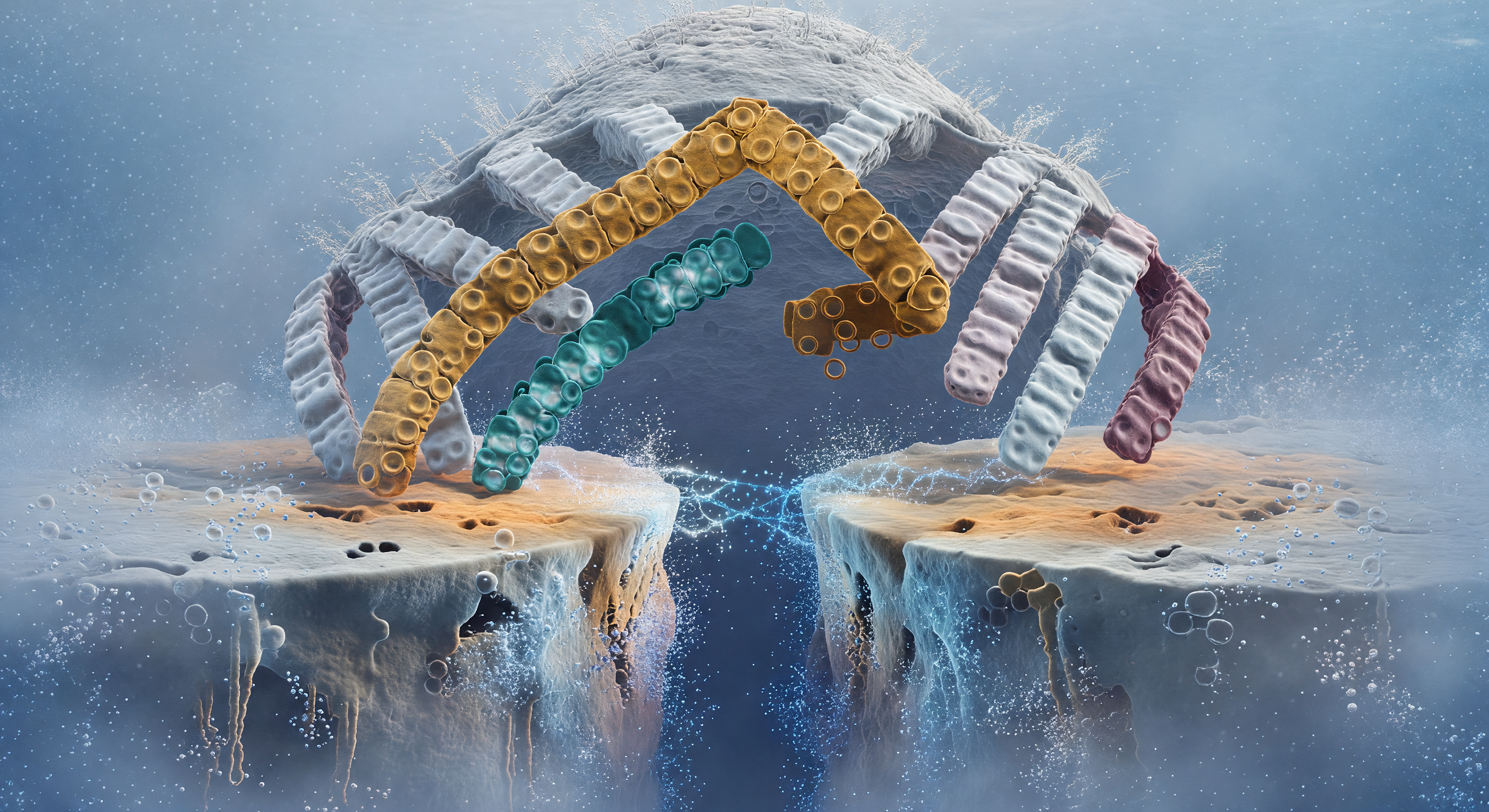
The view opens onto two vast opposing surfaces separated by a narrowing void barely wide enough for a few water molecules — the closing interface between an antibody's Fab fragment and its target antigen, resolved here into overwhelming sculptural detail. From behind and above, the beta-sandwich body of the Fab looms like a pewter massif, its laminar ridges of tightly hydrogen-bonded beta-strands giving way at the crown to six CDR loops surging forward like enormous architectural fingers: the amber H3 loop arcing in a long confident curve, the teal L3 reaching in from below, the four flanking loops framing them in graduated silvers and dusty mauves to form a cupped amphitheatre of complementary molecular geometry. Across the narrowing gap, the antigen epitope curves away like a convex planetary horizon, its ochre and terracotta surface contoured with uncanny precision to receive the approaching loops — the product of evolutionary or affinity-matured shape complementarity operating across a contact zone of roughly five by six nanometres. Water molecules are being expelled from this drying interface in real time, radiating outward as brief opalescent sparks of dipole-reorienting thermal energy, while cyan hydrogen-bond bridges flicker and consolidate across the remaining Ångström gap — luminous blue-white threads of shared electron density stabilizing one by one as electrostatic, van der Waals, and hydrophobic contributions sum toward the final binding free energy. The surrounding medium presses in from every direction as warm sapphire solvent haze, a thermally turbulent ocean of molecular bombardment that makes the slow, deliberate geometry of this molecular recognition feel all the more improbable and precise.
Macromolecules