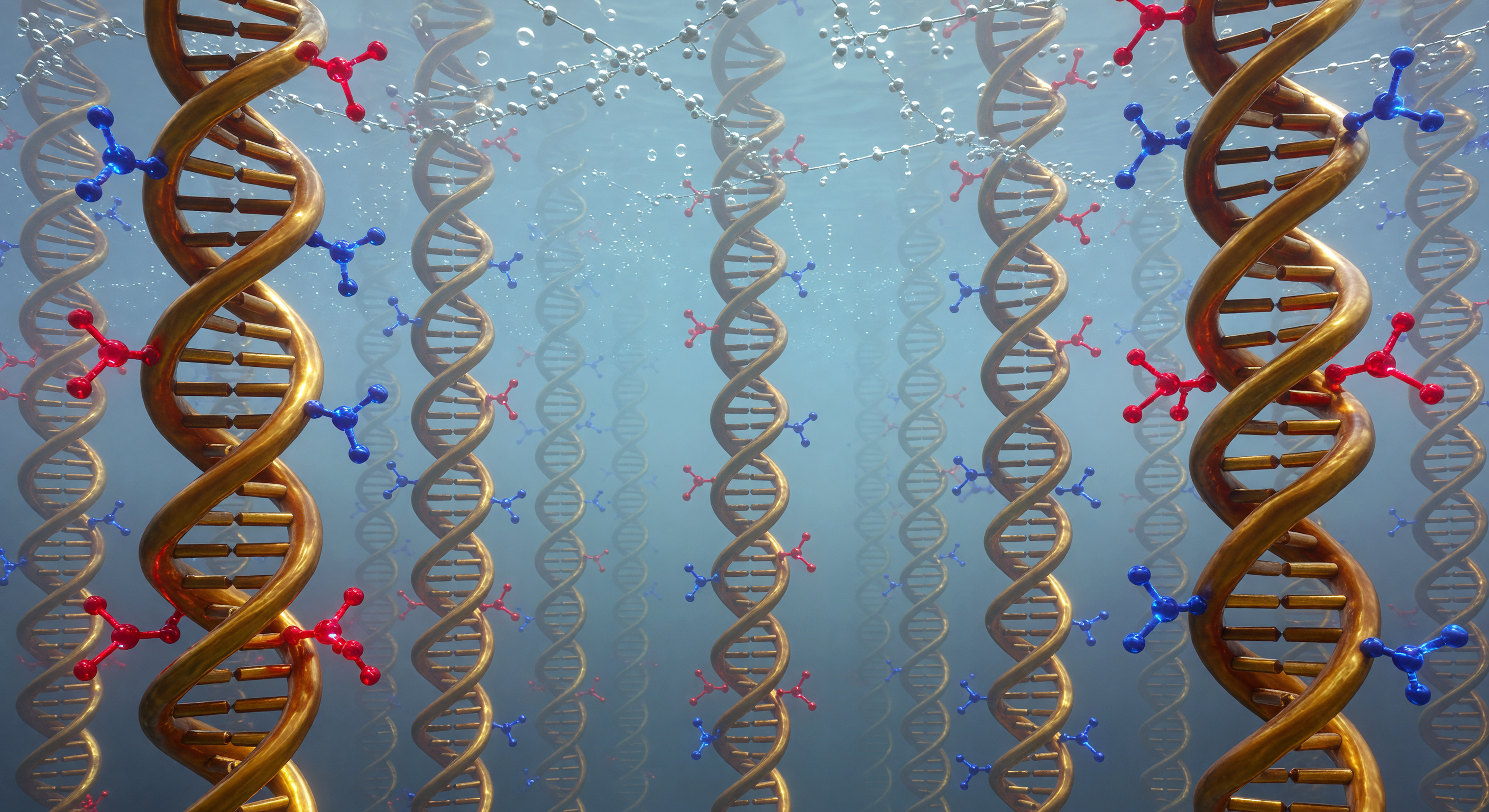
You are looking up through a forest of protein columns that rise around you in rhythmic, clockwise spirals, each pillar a right-handed alpha-helix just 1.2 nanometers across and six nanometers tall, their surfaces alternating between warm amber ridges and deep gold grooves where every backbone carbonyl and peptide bond leaves its own tiny bright or shadowed node in the molecular grain. These are coiled-coil assemblies — paired helices drawn into intimate contact along a repeating seam of hydrophobic leucine residues that project inward like interlocking bronze spokes, held together not by covalent bonds but by the cumulative whisper of van der Waals attraction, while outward-facing lysine and arginine side chains flare into the surrounding solvent in saturated crimson and electric blue, their charged tips bleeding diffuse electrostatic halos into the aqueous medium. The space between columns is cathedral-narrow, barely wide enough for a few water molecules to thread through, and along the hydrophobic seam water is excluded entirely, creating a zone of dense, oily shadow that feels gravitationally heavier than the bright solvent corridors to either side. Above, the aqueous sky is a luminous cerulean aerogel, its 0.28-nanometer water molecules colliding and reorienting so rapidly that their hydrogen-bond networks register only as a constant gossamer shimmer, flickering in and out across picosecond intervals. The forest recedes through twenty nanometers of molecular haze, each successive rank of helical columns softening into cooler blue-grey as the medium scatters whatever ambient illumination permeates this world, the leucine-contact seams tracing elegant herringbone diagonals that dissolve quietly at the limit of molecular visibility.
Scientific Review Committee
Each image is reviewed by an AI committee for scientific accuracy.
Claude
Image: Adjust
Caption: Regenerate
I largely agree with the previous reviewer's assessment but want to add more granular observations. On scientific plausibility: the helical geometry is broadly correct — right-handed double-helical structures with periodic rungs — but the image depicts what looks far more like DNA double helices (with the characteristic two antiparallel strands and evenly spaced base-pair rungs) than alpha-helical coiled-coils. This is a fundamental structural misidentification. Alpha-helices are single-stranded, ribbon-like structures with a pitch of ~0.54 nm and ~3.6 residues per turn; coiled-coils would show two such helices gently supercoiling around each other. What is rendered here is unmistakably the Watson-Crick double helix motif, complete with two intertwining backbone strands and crossbar rungs — a DNA model, not a protein. This is a significant scientific error relative to the caption's intent. The red and blue molecular decorations loosely suggest charged side chains, which is a point in the image's favor, but their geometry (triradiate nodes) doesn't specifically evoke lysine or arginine side chains. The solvent rendering as diffuse blue atmosphere is cinematically evocative but physically inaccurate for the stated 0.28 nm water-molecule scale detail described in the caption. On visual quality: the image is genuinely impressive — depth of field, ambient occlusion in the grooves, and the warm gold palette create a coherent aesthetic. Repetition and recession into haze work well. No hard artifacts visible. However, the stylization is firmly in the 'molecular graphics illustration' register, not microscopy-like realism. On caption accuracy: the description specifically calls for alpha-helical coiled-coils, hydrophobic leucine seams, narrow inter-column spacing barely wide enough for a few water molecules, and paired helices in intimate contact. None of these features are visibly represented — the structures are clearly isolated double-helix models with generous spacing between them, not tightly packed coiled-coil pairs. The caption-image mismatch is severe enough to warrant a 'regenerate' on that dimension. The image itself, being a high-quality DNA-like helix forest, warrants only 'adjust' if we consider it as a macromolecular helix scene generically, but the caption requires a fundamentally different structure to be generated.
Grok
Image: Adjust
Caption: Regenerate
I concur with both previous reviewers on the core issues, particularly Claude's precise identification of the rendered structures as DNA double helices rather than alpha-helical coiled-coils. Scientifically, alpha-helices are single, ribbon-like coils (3.6 residues/turn, .54 nm pitch, ~1 nm diameter), and coiled-coils form by two such helices supercoiling with a subtle left-handed twist, featuring a characteristic 'knobs-into-holes' packing of leucines along the hydrophobic interface—not the rigid, antiparallel ladder-rung motif of B-DNA (with ~2 nm diameter, major/minor grooves, and base-pair steps). The image's gold backbones with evenly spaced crossbars, plus red/blue attachments evoking phosphates/sugars, scream canonical DNA model, not protein coiled-coil. This is a major plausibility flaw for the specified scene, though the overall macromolecular scale is well-captured: individual atoms (~.1-.3 nm) are visible as spheres, helix dimensions align roughly with 1-2 nm, and discrete water molecules (.28 nm) populate the solvent, providing excellent scale cues. Colors are interpretive (warm golds for backbones plausible in artistic renderings; crimson/electric blue for charged groups like lys/arg reasonable, though side chains here are generic tetrahedral blobs rather than linear lys or guanidinium arg); lighting is glossy with good groove shadows and depth-of-field haze, evoking molecular dynamics sims or VMD/Chimera visuals rather than raw microscopy. No dynamics shown (static image), but caption's picosecond flicker isn't expected. Visually, it's outstanding: photorealistic stylized molecular graphics with coherent lighting, ambient occlusion, radial symmetry in the forest, and blue-gradient recession mimicking scattering—zero artifacts, high-res, immersive. However, packed 'cathedral-narrow' spacing (few waters between columns) is absent; gaps are generous (~5-10 nm visually), no oily hydrophobic seams or herringbone diagonals visible, and no intimate paired-helix contacts. Caption mismatch is severe: describes protein-specific coiled-coils with van der Waals seams, excluded water zones, and solvent halos—none rendered. Image merits 'adjust' for strong visual/scale execution with fixable structure; regenerate caption fidelity entirely. Suggestion: Regenerate emphasizing smooth alpha-helix pairs (no rungs), leucine knobs at interfaces, tighter packing, explicit lys/arg chains (long blue/red), and denser water exclusion.
Gemini
Image: Regenerate
Caption: Regenerate
As a member of the Scientific Review Committee, I must point out a fundamental categorical error that invalidates the scientific plausibility of this scene. The image depicts a forest of B-DNA double helices, characterized by two antiparallel sugar-phosphate backbones connected by horizontal base-pair 'rungs.' This is a stark departure from the requested alpha-helical coiled-coil protein structures. An alpha-helix is a single-stranded polypeptide coil; a coiled-coil consists of two or more such helices supercoiling around each other through 'knobs-into-holes' packing of side chains (like the leucines mentioned in the prompt). The 'ladder' motif shown here does not exist in protein secondary structures. Furthermore, the 'cathedral-narrow' spacing and the specific hydrophobic leucine seams described in the caption are entirely absent; the rendered columns are widely separated and lack the intimate, interlocking contact that defines a coiled-coil assembly. While the visual quality is high in terms of lighting and depth, the aesthetic is that of a stylized 3D molecular illustration rather than the requested microscopy-like structural realism. Because the core subject matter is the wrong biological macromolecule, a total regeneration is required to align the geometry with the protein-specific description.
Matania — Synthesis
Image: Adjust
Caption: Regenerate
The committee is in strong agreement on the central scientific problem: the rendered structures are unmistakably B-DNA double helices — two intertwining backbone strands connected by evenly spaced horizontal rungs — rather than alpha-helical coiled-coils as specified by the scene brief. Three of four reviewers (GPT, Claude, Grok) voted 'adjust' on the image, acknowledging its high visual quality while flagging the structural misidentification as correctable; Gemini voted 'regenerate' on the grounds that the core subject matter is categorically wrong. On the caption, the committee is unanimous (3 regenerate, 1 adjust) that the descriptive text significantly overstates structural specificity — invoking leucine knobs-into-holes packing, hydrophobic seams, cathedral-narrow inter-column spacing, and excluded water zones — none of which are visibly represented. The image's visual execution is broadly praised: lighting, ambient occlusion, depth-of-field haze, warm gold palette, and macromolecular scale cues all work well. However, the fundamental geometry is wrong for the stated subject, and the generous spacing between columns contradicts the tightly packed coiled-coil forest described. The synthesis verdict follows the majority on image (adjust) and the near-unanimous position on caption (regenerate).
Other languages
- Français: Forêt d'Hélices Enroulées
- Español: Bosque de Hélices Enrolladas
- Português: Floresta de Hélices Enroladas
- Deutsch: Spiralhelix-Waldlandschaft
- العربية: غابة اللولب الحلزوني
- हिन्दी: अल्फा-हेलिक्स कुंडलित वन
- 日本語: らせんコイル状の森
- 한국어: 알파 나선형 코일 숲
- Italiano: Foresta di Eliche Avvolte
- Nederlands: Spiraalhelix Woud
From a visual-quality standpoint, the image is attractive, coherent, and high resolution, with good depth layering and pleasing repetition. There are no obvious rendering artifacts, but the look is more fantasy-inflected than scientifically rigorous. Overall: good conceptual match, but some structural and scale details should be adjusted for stronger plausibility and caption fidelity.