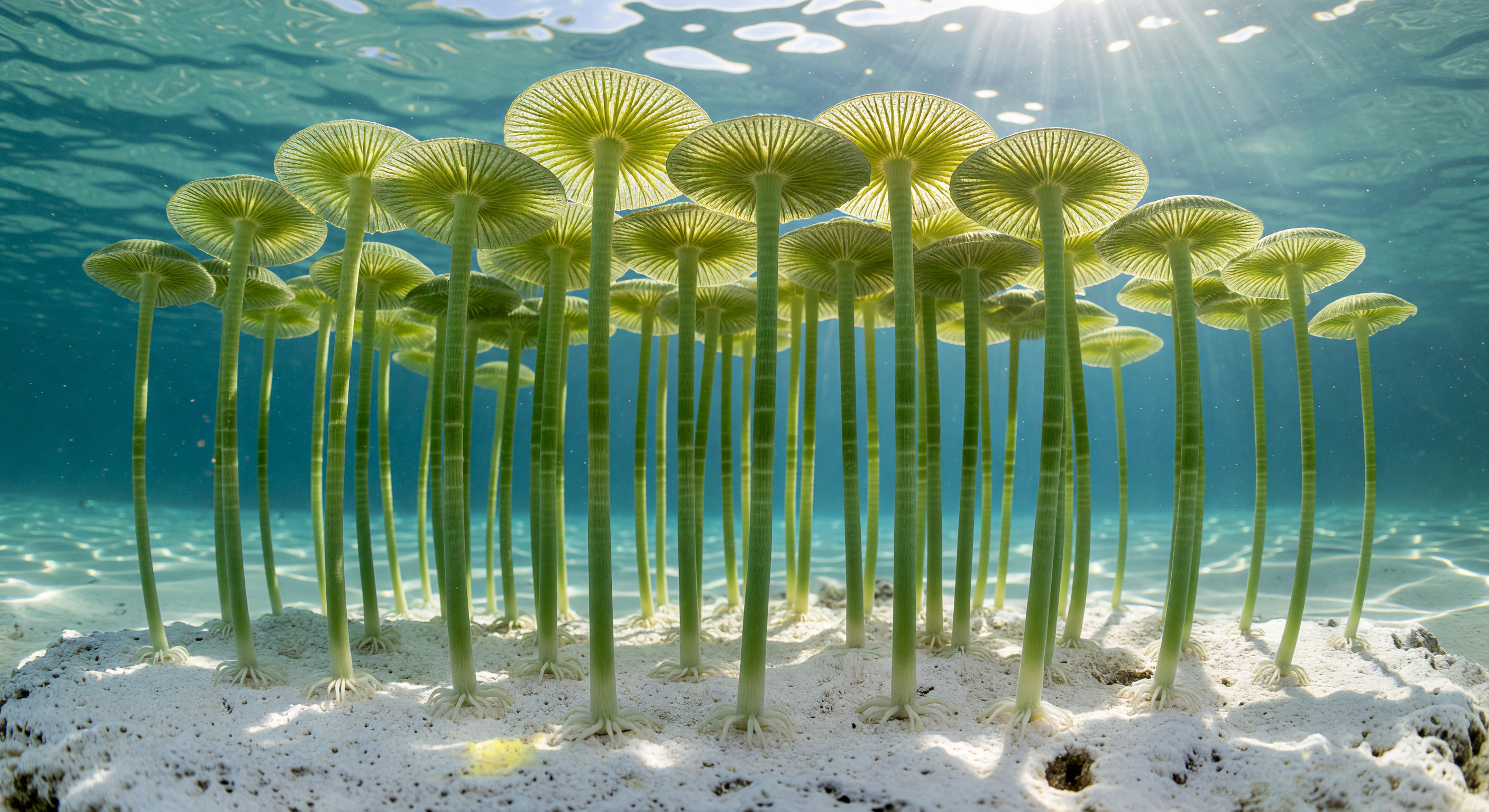
Looking straight up from the seafloor, you see a forest of slender jade columns rising from bleached white limestone, each one a single living cell no taller than your finger, crowned by a luminous disc that glows chartreuse and straw-yellow as Mediterranean morning light passes clean through its radial segments like sunlight through a rose window. These are *Acetabularia acetabulum*, among the largest single cells on Earth — each entire stalk, holdfast, and umbrella cap a solitary nucleus commanding centimetres of organised living architecture, the chloroplasts massed along the sun-facing flank in a slow migration invisible except as a barely perceptible deepening of green. The caps are gametangial structures, their precise wedge-shaped rays packed with nuclei awaiting the signal to release gametes, the whole disc a reproductive organ built and governed by one enormous nucleus tucked far below in the rhizoid, anchored in pale crystalline rock by finger-thin holdfasts a few millimetres wide. Above the colony, shafts of caustic light ripple through a turquoise water column alive with suspended particles, the ocean surface glittering overhead like hammered silver, while between the stalks cool shadow is cut by transmitted slivers of warm green wherever overlapping caps pool their glow into something almost golden. The scene reads as cathedral and tide pool simultaneously — an architecture of breathtaking geometric precision assembled, without division of labour, by a single cell.
Other languages
- English: Acetabularia Caps Backlit Sunrise
- Français: Capsules Acetabularia Contre-Jour Aurore
- Español: Sombrillas Acetabularia Contraluz Amanecer
- Português: Acetabularia Retroiluminada pelo Amanhecer
- Deutsch: Acetabularia Kappen Gegenlicht Sonnenaufgang
- العربية: أكواب أسيتابولاريا مضاءة بالفجر
- हिन्दी: एसिटेबुलेरिया छत्र सूर्योदय प्रकाश
- 日本語: アセタブラリア傘逆光の夜明け
- 한국어: 아세타불라리아 갓 역광 일출
- Nederlands: Acetabularia Hoeden Tegenlicht Zonsopgang