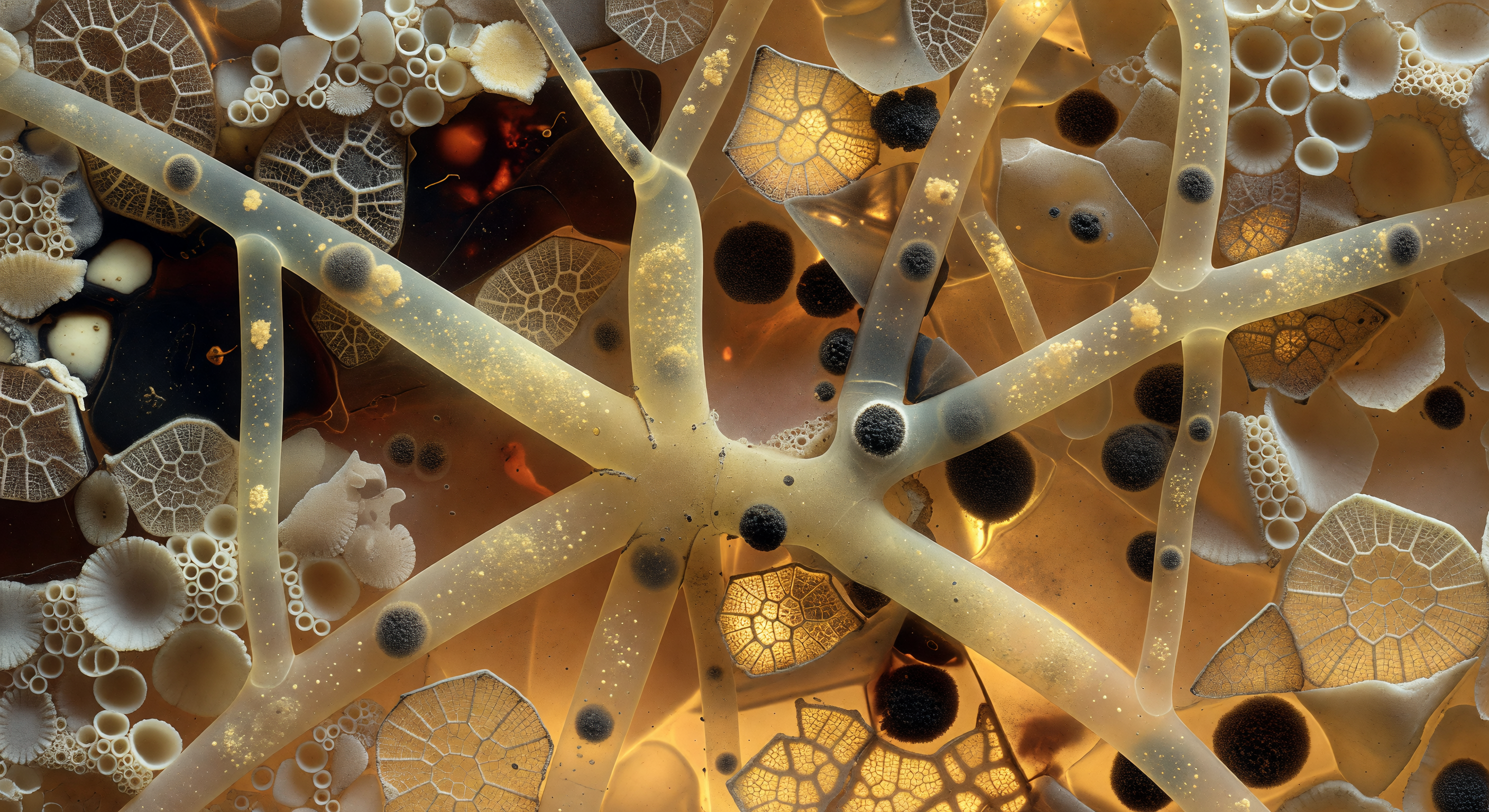
You stand suspended inside the living architecture of a Xenophyophore — one of the ocean's most improbable giants, a single cell that may span tens of centimetres, yet contains within it this intricate mineral fortress of its own construction. Around you, the test wall is a densely packed mosaic of scavenged debris: foraminifera shells pressed together like pale ivory flagstones, radiolarian lattice fragments glowing where warm amber light filters through their preserved silica geometry, and near-black organic cement binding everything into a structure that reads simultaneously as geology and as living tissue. Threading through this lapidary matrix, the linellae channels — branching tubes forty to eighty microns across at true scale — carry pale golden cytoplasm studded with dense charcoal-grey nuclear bodies, their translucent walls barely distinguishable from the surrounding amber field except where a slightly cooler refractive tone betrays living fluid against mineral mass. This is the paradox at the heart of the Xenophyophora: an organism so vast it incorporates the skeletal remains of countless other protists into its own body wall, yet remains throughout a single uninterrupted cytoplasm, its nuclei drifting through warm mineral corridors in unhurried procession, deep on the abyssal seafloor where no light has ever reached except the backlit amber glow of its own biology.
Other languages
- Français: Section Linellae Xénophyophore
- Español: Sección Linellae Xenofiófera
- Português: Seção Linellae Xenofiófera
- Deutsch: Xenophyophora Linellae Schnitt
- العربية: مقطع لينيلاي زينوفيوفورا
- हिन्दी: ज़ेनोफियोफोरा लिनेला खंड
- 日本語: キセノフィオフォラ線管断面
- 한국어: 크세노피오포라 리넬라 단면
- Italiano: Sezione Linellae Xenofioforа
- Nederlands: Xenophyophora Linellae Doorsnede