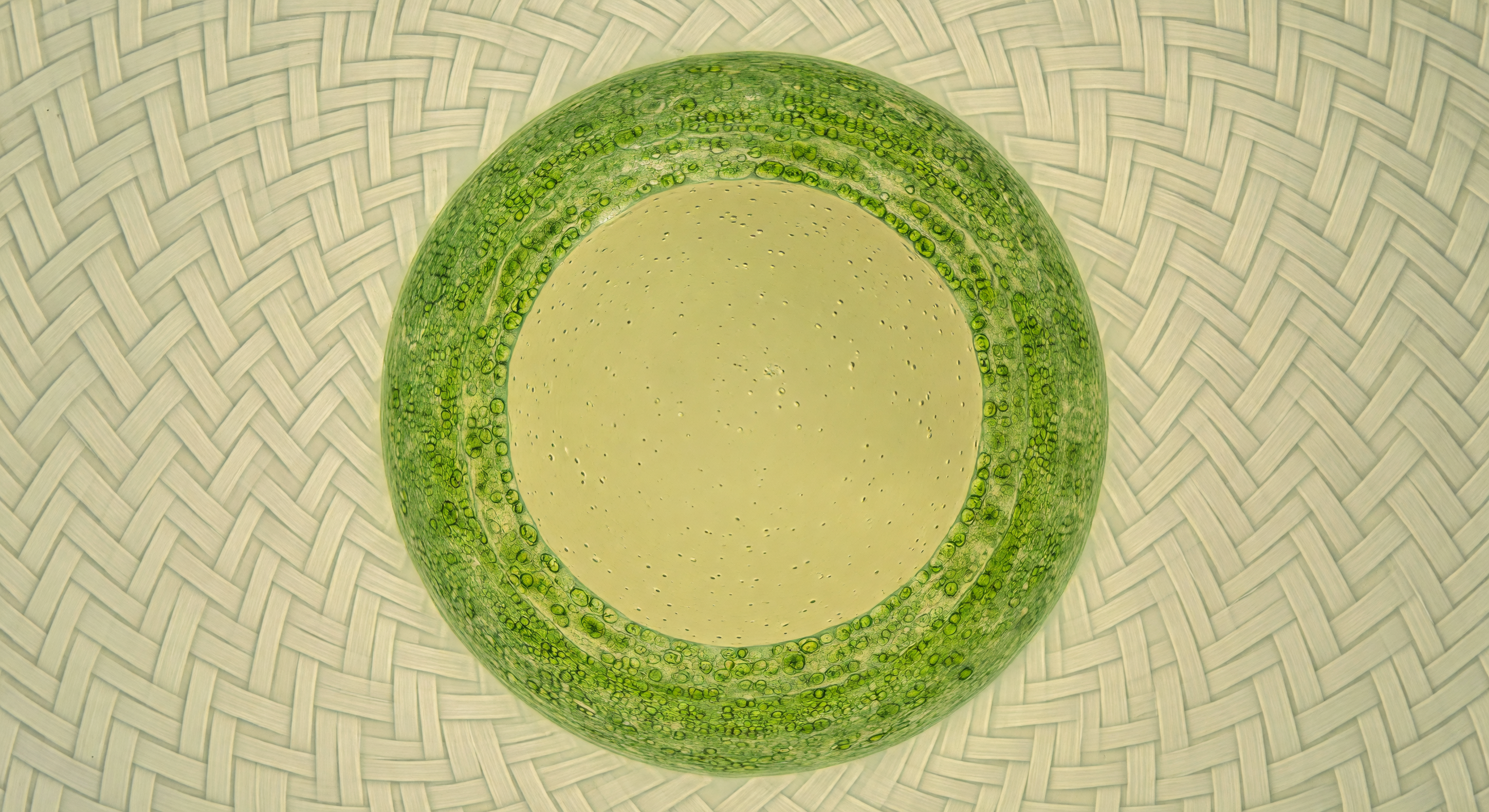
You stand at the exact center of a living sphere, and every direction you look curves away from you in an unbroken arc — a sealed cathedral three centimeters across whose walls are the cell itself, a single *Valonia ventricosa* algal cell maintaining its architectural integrity through turgor pressure as precise and rigid as blown glass. The entire enclosing surface blazes with a continuous mosaic of chloroplasts pressed flat into the cortical ectoplasm, their collective photosynthetic pigment painting the spherical horizon in saturated emerald, shifting to forest shadow at the poles where light from the surrounding sea diminishes, the whole inner dome functioning as a self-illuminating lamp whose green radiance reaches you from every direction simultaneously with almost no attenuation through the extraordinarily still, straw-yellow vacuolar sap — a fluid chemically alien to seawater, its elevated potassium concentration invisible but somehow felt in the density of the medium. Through the living green mantle, barely resolved, the cellulose microfibril layers of the wall itself form a cream-white herringbone lattice — opposing diagonal bands laid down in successive laminations, a woven structural textile holding the sphere rigid against the osmotic pressure differential that would otherwise collapse or rupture this improbable mononuclear architecture. Occasionally, a vesicle or suspended crystal drifts through the sap at speeds so glacial it appears stationary, catching the ambient green light as a momentary fleck of gold — the only visible evidence of the cytoplasmic dynamics and ionic chemistry quietly sustaining, within a single membrane-bound cell, the entire biology of this organism.
Other languages
- Français: Cathédrale Vacuolaire de Valonie
- Español: Interior Catedralicio de Valonia
- Português: Interior Catedralício da Valônia
- Deutsch: Valonia Vakuolen Kathedrale Innen
- العربية: داخل كاتدرائية فجوة فالونيا
- हिन्दी: वेलोनिया रिक्तिका गिरजाघर भीतर
- 日本語: バロニア液胞大聖堂内部
- 한국어: 발로니아 액포 대성당 내부
- Italiano: Interno Cattedrale Vacuolo Valonia
- Nederlands: Valonia Vacuole Kathedraal Interieur