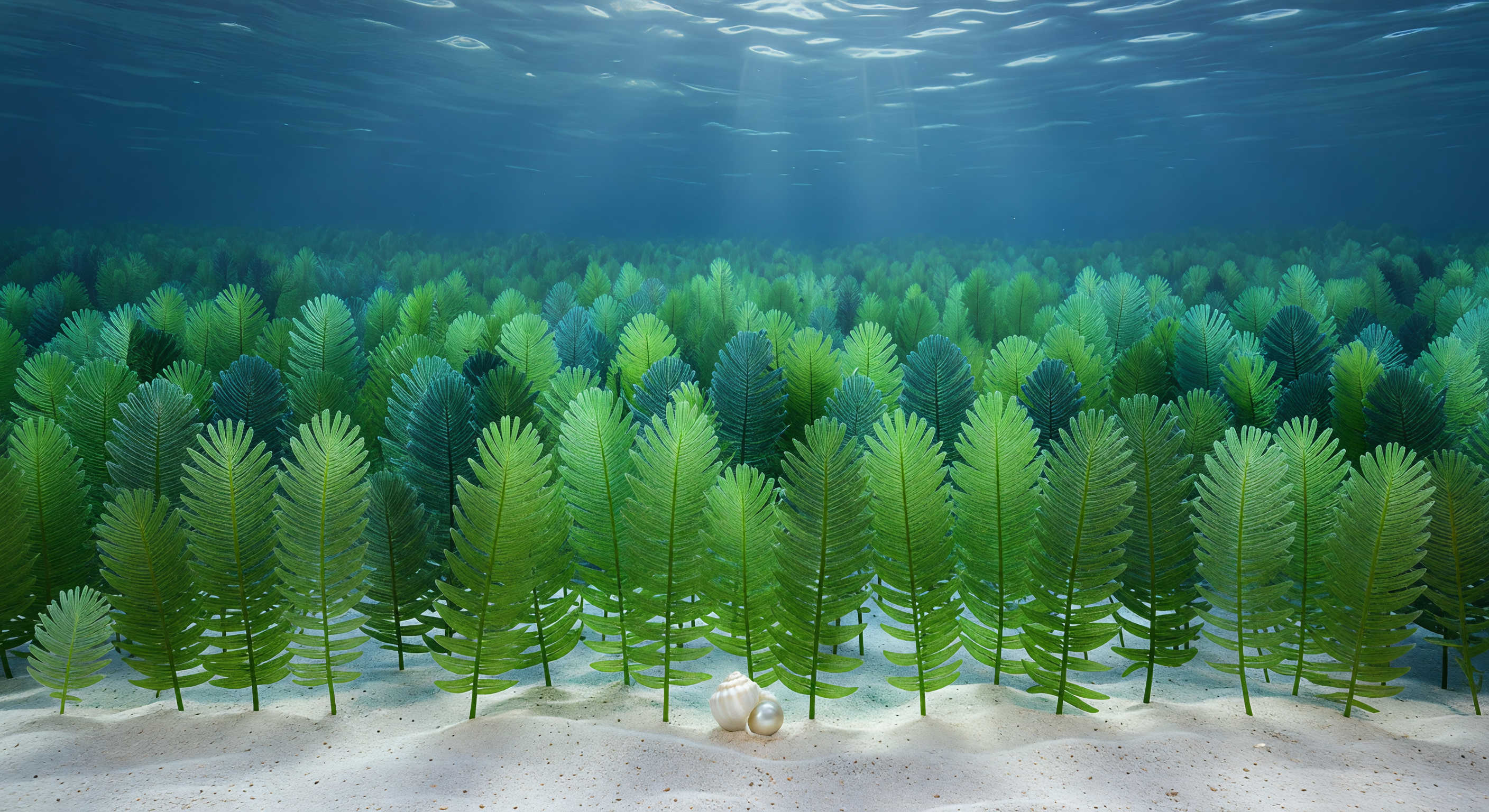
Hovering centimeters above the Mediterranean seafloor at twelve meters depth, you find yourself eye-level with one of biology's most radical architectures: an unbroken emerald carpet of *Caulerpa taxifolia*, each feathered frond a single coenocytic organism — no internal walls, no compartments, just one continuous cytoplasm enclosed within a membrane that stretches across the entire thallus, from stolon to pinnule tip. Each rachis, no thicker than a knitting needle, branches into dozens of paddle-flat pinnules arrayed with the geometric precision of a living tessellation, their chlorophyll-dense cortex so concentrated that the thinnest edges glow translucent lime-yellow where diffuse, caustic-scattered sunlight rakes diagonally down through the water column above. Within these glassy walls, cytoplasmic streaming moves silently — rivers of granular green cytoplasm circulating at a few micrometers per second, the cell's internal logistics operating at a scale you could almost perceive if you held still long enough. The sole interruption to this alien monoculture is a single bleached gastropod shell resting at the boundary between sand and stolon mat, its ivory calcite surface an incongruous relic of animal architecture against the relentless, vegetative intelligence of a world built from a single cell, repeated to the horizon.
Other languages
- Français: Tapis marin de Caulerpa
- Español: Alfombra marina de Caulerpa
- Português: Tapete submarino de Caulerpa
- Deutsch: Caulerpa-Teppich am Meeresgrund
- العربية: سجادة كولربا تحت البحر
- हिन्दी: कॉलेर्पा की समुद्री चादर
- 日本語: コーレルパの海底カーペット
- 한국어: 코울레르파 해저 카펫
- Italiano: Tappeto marino di Caulerpa
- Nederlands: Caulerpa zeebodemtapijt