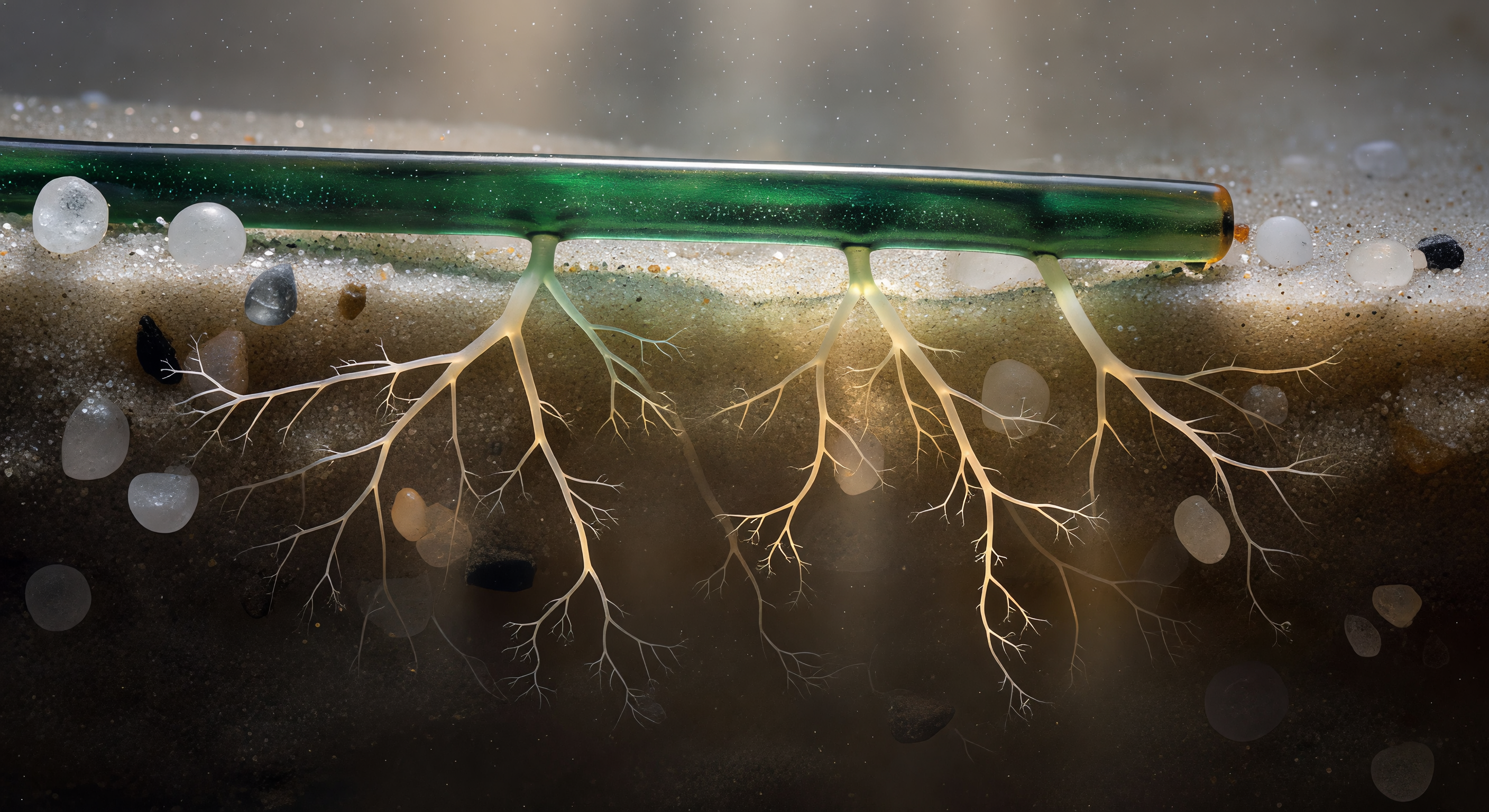
Peering laterally into this cleanly sheared wall of coastal sediment, you find yourself suspended in warm, particulate darkness beside individual sand grains the size of boulders — frosted quartz spheroids and feldspar plates that dwarf the translucent amber rootlets threading between them with extraordinary precision. Above you, the stolon of a *Caulerpa* plant arches like a pressurized cylinder of green glass, its lacquered emerald surface catching a thin meniscus of coastal light along its upper edge — and yet this entire structure, from the glistening stolon overhead to the finest filament disappearing into brown-black sediment two centimeters below, is a single cell, one continuous cytoplasm bounded by a single membrane, containing no internal walls despite encompassing a volume that stretches meters across the seafloor. The rhizoid network descending from the stolon's underside branches with fractal regularity, primary cylinders a hundred microns wide splitting into secondary and tertiary rootlets that conform precisely to the curved topography of individual mineral grains, anchoring the organism physically while also absorbing dissolved nutrients from interstitial porewater — a task accomplished without the division of labor that multicellular plants require. The light gradient tells the full story of this buried world: bright, blue-green diffuse radiance at the sediment surface deepening through amber-tan to near-total darkness below, the finest rhizoid tips visible only as faint warm outlines before vanishing into granular obscurity.
Other languages
- Français: Rhizoïdes de Caulerpe Sous les Sables
- Español: Rizoides de Caulerpa Bajo Sedimento
- Português: Rizoides de Caulerpa Sob a Areia
- Deutsch: Caulerpa Rhizoid Querschnitt Untergrund
- العربية: جذور الكولبيا تحت الرمال
- हिन्दी: कॉलेर्पा राइज़ॉइड भूमिगत परत
- 日本語: 海藻仮根の地下断面
- 한국어: 코울레르파 가근 지하 단면
- Italiano: Rizoidi di Caulerpa Sotto Sedimento
- Nederlands: Caulerpa Rhizoïden Ondergronds Doorsnede