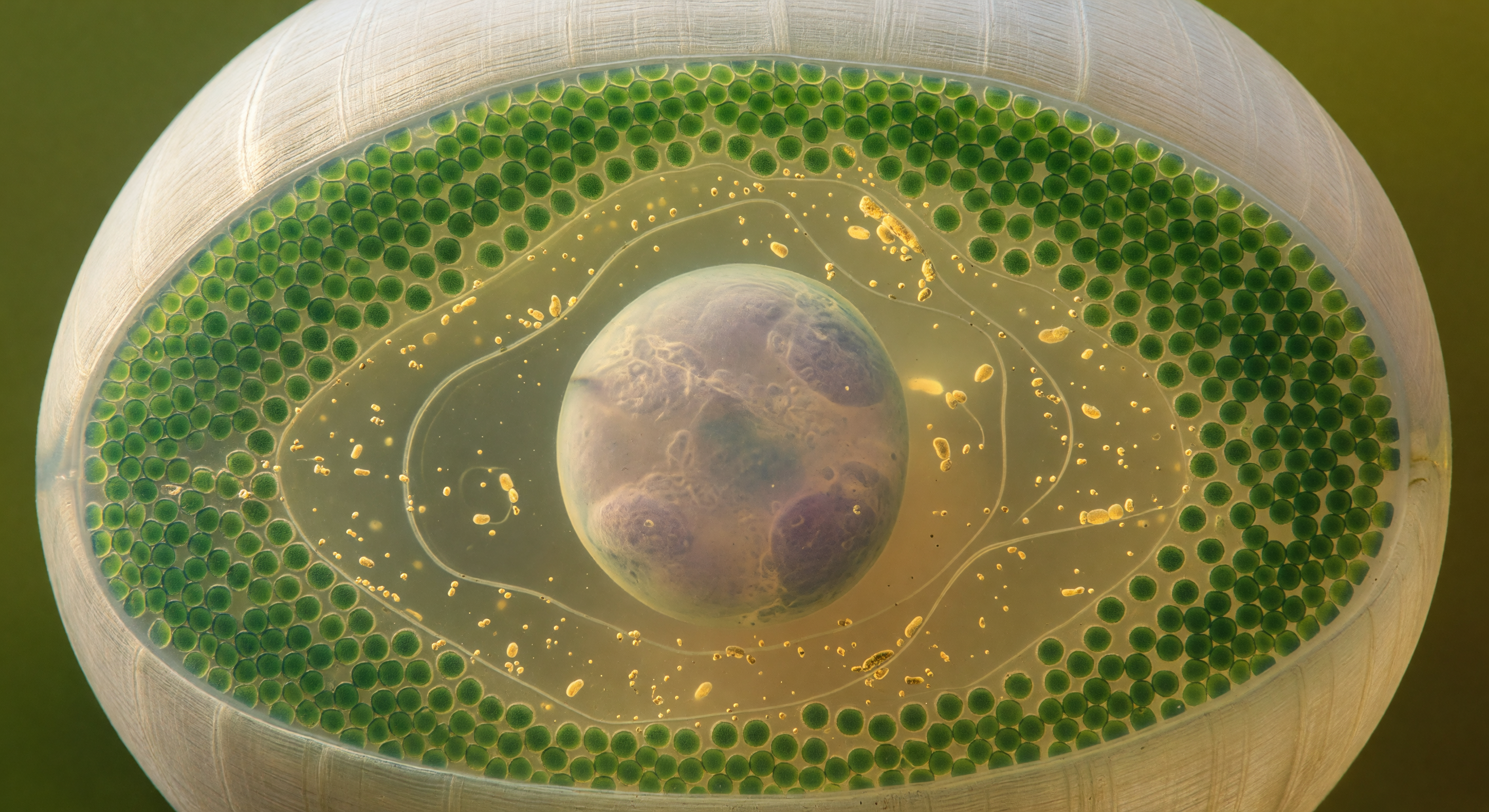
You are suspended inside the rhizoid chamber of a living *Acetabularia*, a green alga capable of reaching ten centimeters in height while remaining a single cell — and the vast pale sphere dominating your field of view is its one and only nucleus, an 80-micron structure that must coordinate the entire organism's growth, regeneration, and reproduction alone. Pressed against the surrounding cell wall in an unbroken mosaic, hundreds of chloroplasts form a stained-glass pavement of deep jade, each disc glowing with its own emerald saturation as sunlit seawater transmits through the cellulose-microfibril wall from outside, filling the enclosed space with warm amber-green light that seems to emanate from every direction at once. The nucleus itself is not a hard object but a softly luminous membrane-bounded world, its pearl-grey surface shading into lavender where internal chromatin condenses, and at its heart the nucleolus sits as a denser indistinct mass — a factory of ribosomal RNA production felt more than resolved through the translucent nuclear envelope. Between wall and nucleus, the cytoplasm moves in the slow looping arcs of cyclosis, golden granules and slivers of endoplasmic reticulum drifting at geological pace around the nucleus and back, the whole interior a warm, slightly viscous medium whose unhurried motion belies the fact that this streaming is the cell's only means of distributing materials across a body that, by any conventional measure, should be far too large to function without a circulatory system.
Other languages
- Français: Intérieur du Noyau Acétabulaire
- Español: Interior del Núcleo de Acetabularia
- Português: Interior do Núcleo de Acetabulária
- Deutsch: Acetabularia Zellkern Innenwelt
- العربية: داخل نواة الأسيتابولاريا
- हिन्दी: एसिटाबुलारिया केंद्रक भीतरी दृश्य
- 日本語: アセタブラリア単核内部
- 한국어: 아세타불라리아 핵 내부
- Italiano: Interno del Nucleo Acetabularia
- Nederlands: Acetabularia Celkern Interieur