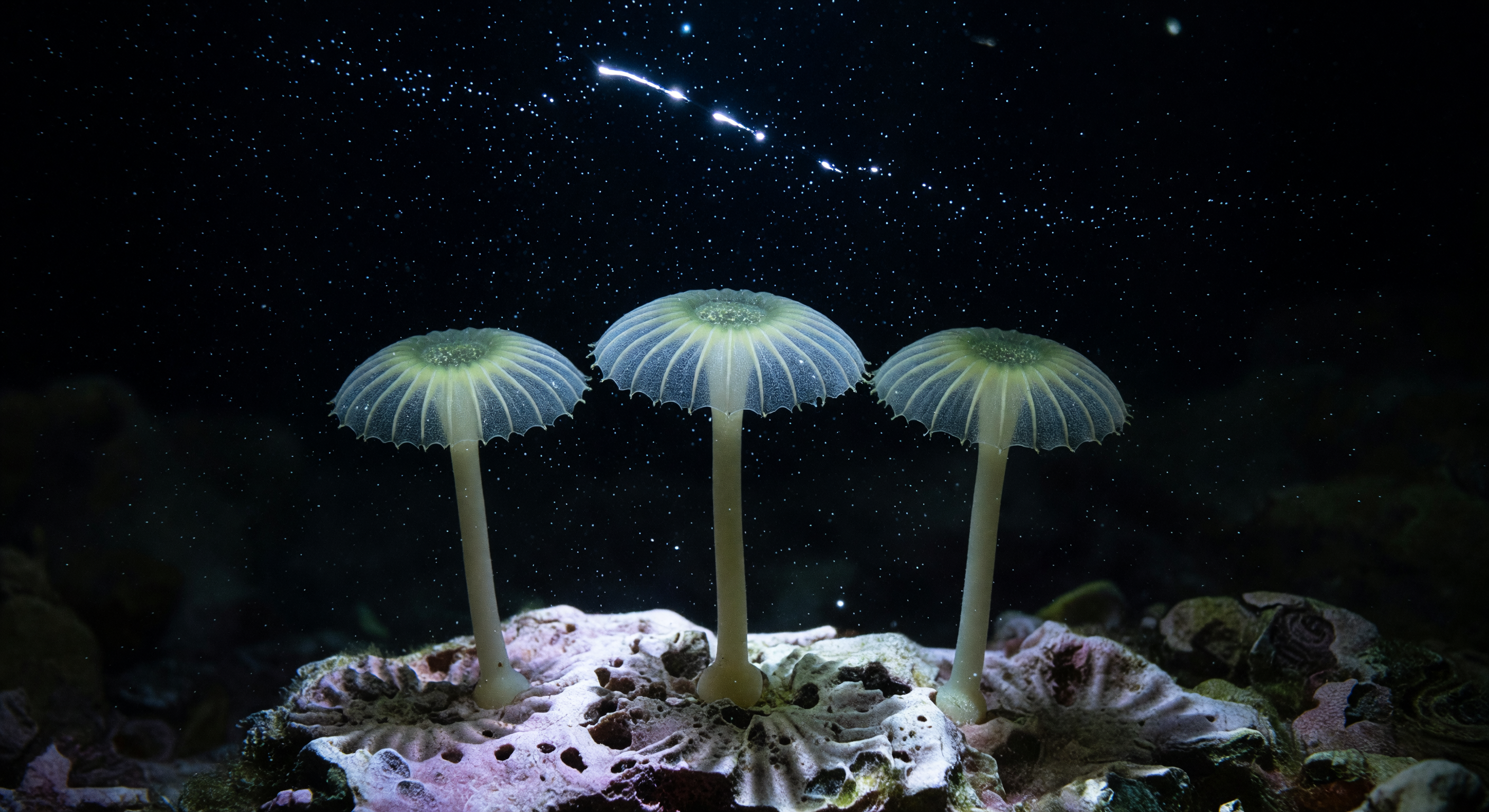
Three pale stalks rise from the limestone crust before you, each one a single living cell standing as tall as you are wide, their umbrella caps fanning open in precise radial segments like lace cut from frosted sea-glass. Between the irregular cascades of bioluminescent streaks fired by panicked dinoflagellates sweeping through the water column above, the only light in the world is the faint grey-green phosphorescence bleeding outward from within each stalk — chloroplasts suspended in cytoplasmic gel, glowing like foxfire seen through ivory, the thinnest cap margins luminous where the membrane barely holds. When a streak arrives — a sharp, chemical-blue crack through the particulate Mediterranean darkness — raking illumination transforms the caps into architectural sculptures, their radial ribs casting hard-edged shadow-stripes down the stalks and briefly revealing the granular interior fog of a single cell's living organization before absolute darkness swallows the scene again. Each of these organisms is not a colony or a tissue but one continuous cell, its single enormous nucleus resting in the rhizoid holdfast below as a barely perceptible pale node against the encrusted rock, the entire cytoplasm streaming in slow invisible currents through a body visible to the naked eye. The water itself participates — dense with suspended microaggregates that catch each bioluminescent burst as a slow-motion galaxy of sparks — and time here is measured not by any internal clock but by the random panic of invisible organisms above, their flight becoming, briefly, your only sun.
Other languages
- Français: Bioluminescence Nocturne Acetabularia
- Español: Bioluminiscencia Nocturna Acetabularia
- Português: Bioluminescência Noturna Acetabularia
- Deutsch: Nächtliche Acetabularia Biolumineszenz
- العربية: توهج الأسيتابولاريا الليلي
- हिन्दी: एसीटाबुलेरिया रात्रि जैवदीप्ति
- 日本語: アセタブラリア夜の生物発光
- 한국어: 아세타불라리아 야간 생물발광
- Italiano: Bioluminescenza Notturna Acetabularia
- Nederlands: Acetabularia Nachtelijke Bioluminescentie