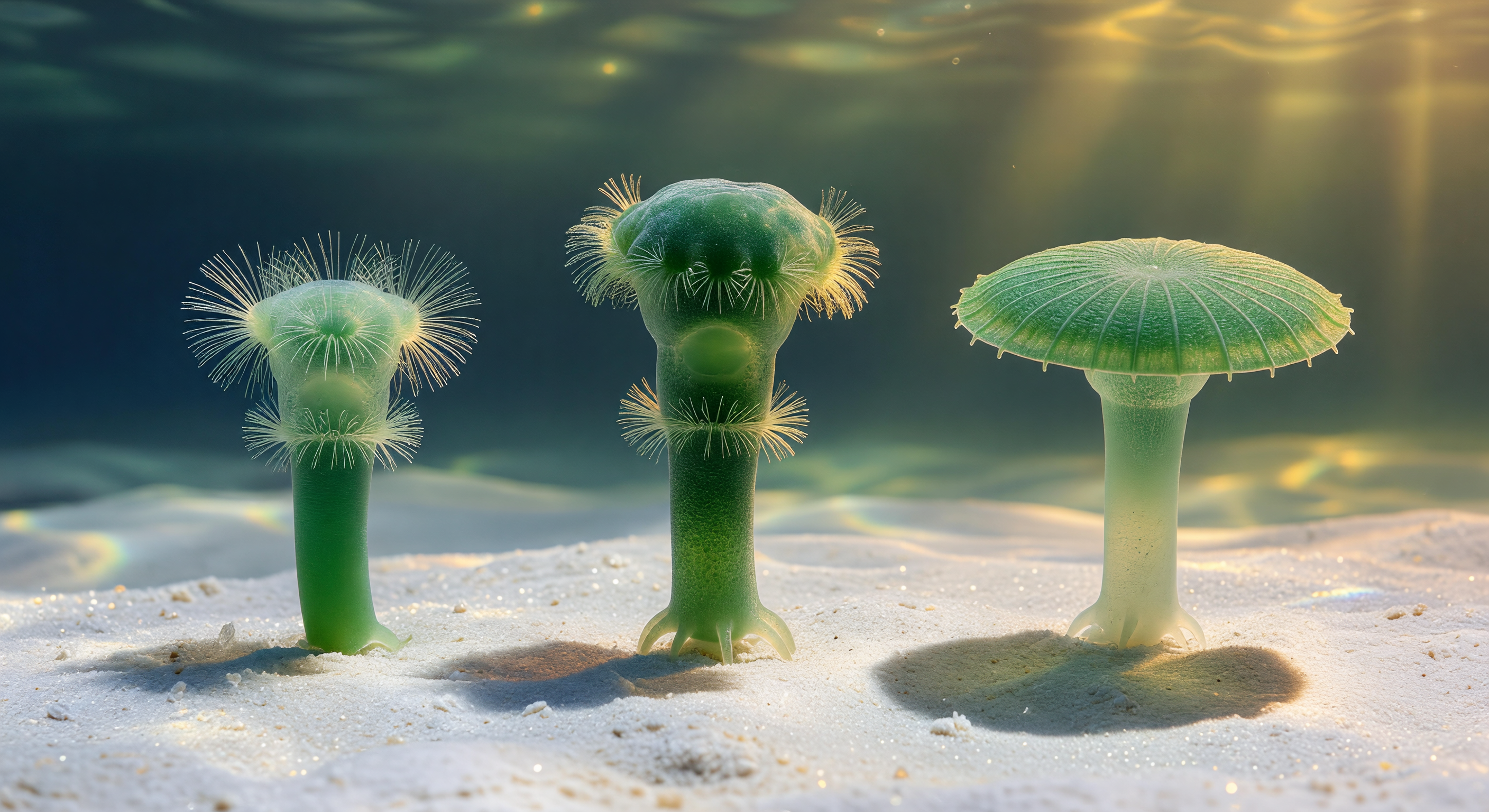
Three individuals of *Acetabularia* rise from the bleached aragonite floor like architectural monuments — a juvenile trailing feathery hair whorls of radiating cytoplasm, an adolescent swelling into an unresolved proto-cap of fusing ray primordia, and a mature organism spreading its perfectly tessellated reproductive disc like a green parasol — each one a single cell, each one centimeters tall, each stage of development separated in space as clearly as illustrations in a textbook. Warm raking light drives in from the right, turning the cap margins to stained-glass emerald while the open water beyond holds everything in deep oceanic blue, and on the chalk-pale substrate beneath the mature cap a crisp circular shadow marks where living tissue refracts the sun into a thin caustic ring. *Acetabularia* is among the most extraordinary organisms in biology: despite reaching up to ten centimeters, each individual is a single uninucleate cell — its one enormous nucleus sequestered far below in the rhizoid, while morphogenetic signals encoded in long-lived messenger RNAs travel the length of the stalk to orchestrate cap formation entirely without cell division. The calcium carbonate impregnating the stalk walls, the chloroplast-carpeted cortex glowing faintly green, the slow rivers of cytoplasmic streaming invisible at this scale but coursing within — every structure visible here is the architecture of one cell deciding, slowly and over weeks, what shape it will become.
Other languages
- Français: Trio d'Acétabulaires Éclairé de Côté
- Español: Trío de Acetabularia Iluminado Lateral
- Português: Trio de Acetabulária com Luz Lateral
- Deutsch: Acetabularia Entwicklungstrio Seitlich Beleuchtet
- العربية: ثلاثي أسيتابولاريا بإضاءة جانبية
- हिन्दी: एसीटाबुलेरिया विकास त्रय पार्श्व-प्रकाशित
- 日本語: アセタブラリア成長三態の側光
- 한국어: 아세타불라리아 성장 삼단계 측면 조명
- Italiano: Trio di Acetabularia Illuminato di Lato
- Nederlands: Acetabularia Ontwikkelingstrio Zijdelings Belicht