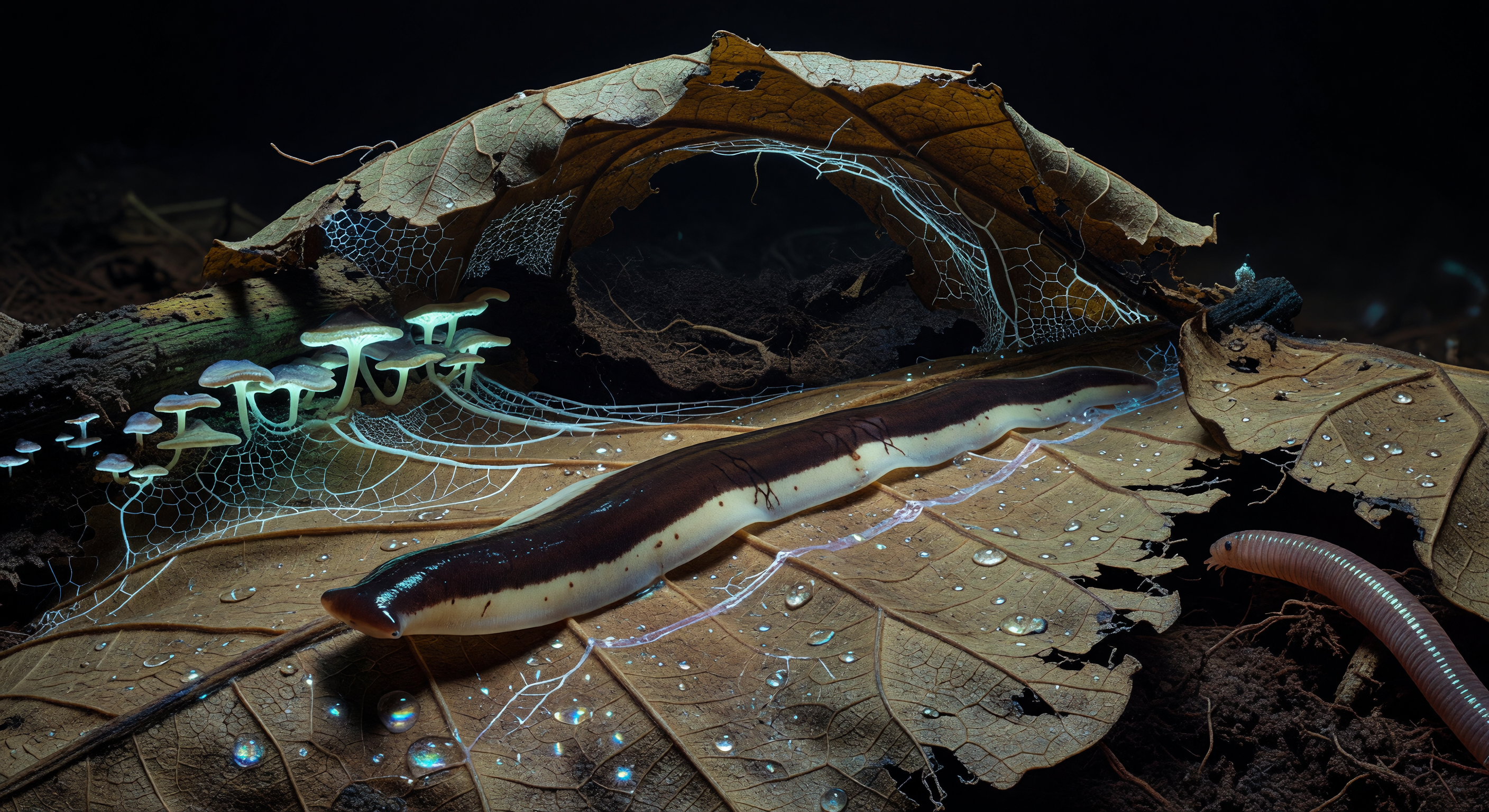
You are pressed flat against the underside of a decomposing tropical leaf, your entire ribbon body — twelve centimeters of chocolate-brown and cream-banded tissue — conforming without resistance to the microtopography of collapsed veins and white fungal hyphae, reading the substrate through a thin film of your own mucus while the only light in this absolute forest-floor darkness comes from bracket fungi thirty millimeters to your left, pulsing cold blue-green bioluminescence that catches every moisture droplet as a prismatic lens and throws the hyphal lattice into sharp low-relief shadow. *Bipalium kewense* is a land planarian — a free-living platyhelminth that abandoned aquatic life for the saturated chemistry of tropical leaf litter, moving by muscular undulation across surfaces it grips with adhesive glands, its hammer-shaped head sweeping in slow lateral arcs as chemosensory margins parse molecular gradients that its diffuse nervous system processes not as thought but as turning. The earthworm emerging at the frame's far edge — its annular segments each the width of your entire body, its skin surging in visible peristaltic rings — represents a prey item you will subdue by everting your pharynx directly through your ventral surface, secreting digestive enzymes externally before ingesting liquefied tissue, a feeding strategy unchanged in its fundamentals since the earliest bilaterians moved across Ediacaran seafloors. Behind you, a thin iridescent line of mucus catches the bioluminescent light — the only record that anything has moved here at all, already being colonized by the same microbial decomposers that are slowly returning this entire leaf to soil.
Other languages
- Français: Chasseur Nocturne des Feuilles Mortes
- Español: Cazador Nocturno en la Hojarasca
- Português: Caçador Noturno na Serapilheira
- Deutsch: Nächtlicher Jäger im Falllaub
- العربية: صياد ليلي في الأوراق المتعفنة
- हिन्दी: रात का उष्णकटिबंधीय शिकारी
- 日本語: 夜の熱帯落葉ハンター
- 한국어: 밤의 열대 낙엽 사냥꾼
- Italiano: Cacciatore Notturno tra le Foglie
- Nederlands: Nachtelijke Jager in Bladstrooisel